
This paper investigates the "slow-down" phenomenon of bubble walls during first-order cosmological phase transitions (PT), focusing on deflagration and hybrid expansion modes. By analyzing steady-state single-bubble solutions and droplet hydrodynamics, the authors account for the suppressed Gravitational Wave (GW) emission observed in strong PT simulations, such as those performed for the LISA mission context.
TL;DR
Recent simulations of the early Universe's first-order phase transitions have a "missing energy" problem: the Gravitational Waves (GWs) are much weaker than predicted. This paper reveals why. As bubbles of new vacuum collide, their shock waves heat the surrounding plasma and create "droplets" of old vacuum that shrink much slower than the original bubbles expanded. By modeling this hydrodynamical "slow-down," the authors provide a missing link between particle physics parameters and the actual GW signals detectable by experiments like LISA.
The "Speeding Ticket" of the Early Universe
In the standard picture of cosmic phase transitions, we calculate the wall velocity ($\xi_w$) of a single bubble in isolation and assume it stays that way until the transition ends. However, the Universe is crowded. In strong transitions, bubbles are preceded by shock waves—walls of hot, moving plasma.
When a bubble tries to expand into the shock wave of its neighbor, it faces two problems:
- Thermal Pushback: The plasma is hotter than the nucleation temperature, reducing the "pressure" driving the expansion.
- Kinematic Headwind: The plasma is already moving away, forcing the bubble to "chase" it.
Methodology: Two Paths to Slow-Down
The authors dissect the problem using two sophisticated hydrodynamical frameworks.
1. Impeding Shocks and Local Friction
The authors solve the Klein-Gordon equation coupled to a relativistic fluid. They test how a bubble’s velocity ($\xi_w$) changes when the "ambient" temperature is raised to the temperature of a shock wave ($T_+$).
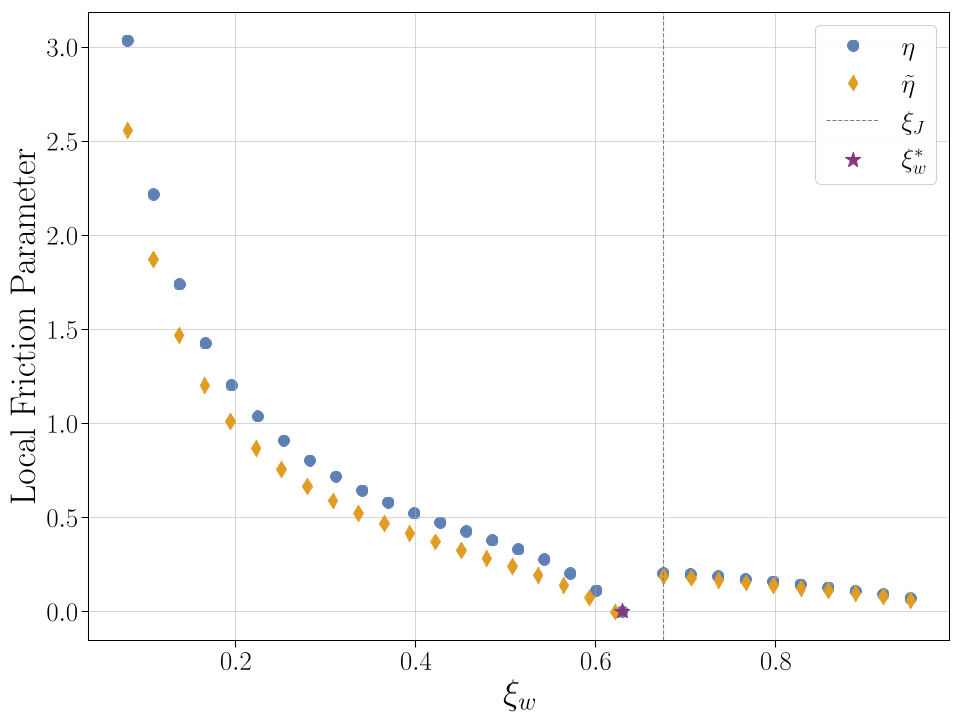 Figure 1: Evolution of friction coefficients as a function of wall velocity. The discontinuity at the Jouguet velocity (dashed line) marks the transition from hybrids to detonations.
2. The Droplet Mechanism
As the transition nears completion, the "sea" of new vacuum surrounds small "pockets" or droplets of the old (false) vacuum. These droplets don't expand; they shrink.
The authors solve the self-similar fluid equations for these shrinking droplets. By using a clever boundary condition based on global energy conservation, they can predict the shrinking velocity ($\xi_d$) without knowing the complex temperature history inside the droplet.
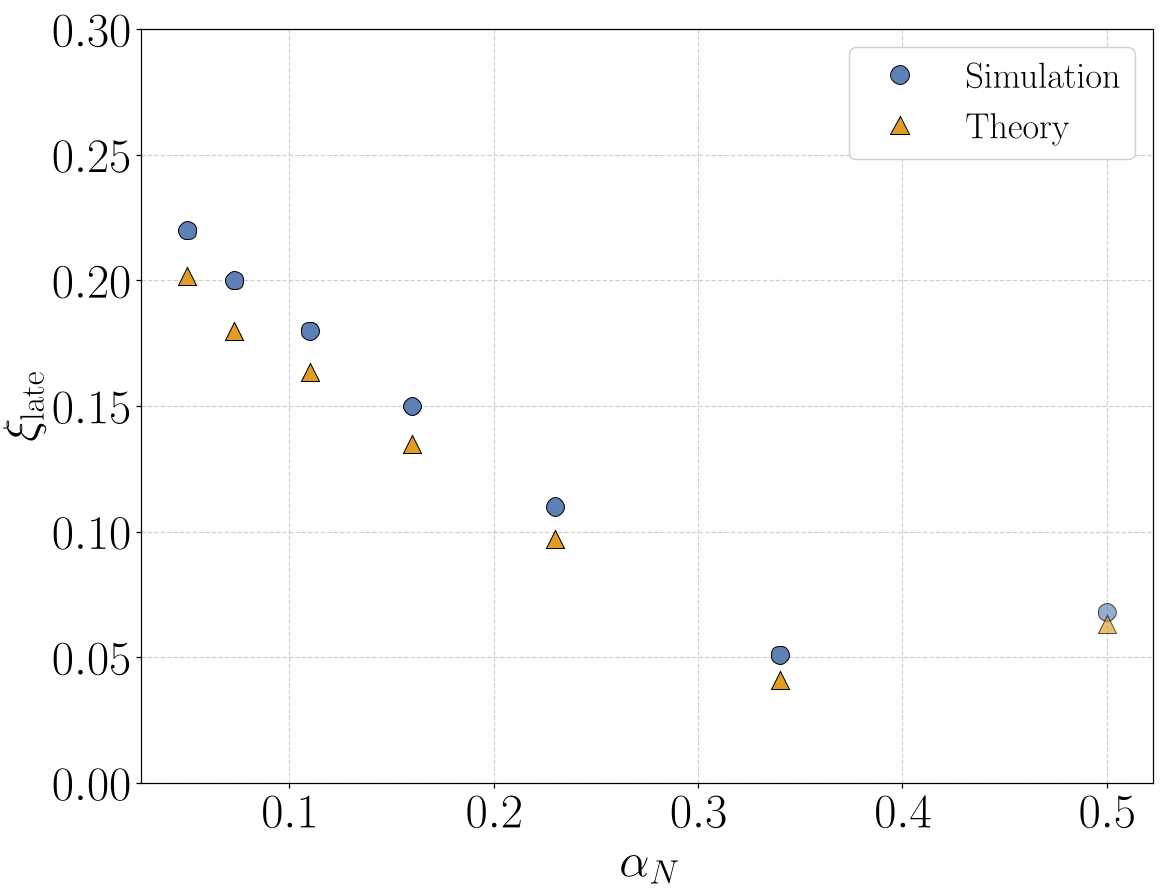 Figure 2: The predicted late-time wall velocities (orange) match 3D simulation data (blue) with high precision, proving that droplets are the dominant factor in late-stage wall slow-down.
Why Does This Matter for GW Detection?
The intensity of GWs depends on the kinetic energy of the fluid. If the bubbles slow down significantly during the final 30% of the transition (the droplet stage), the total "sound wave" energy is drastically reduced.
The paper identifies a crucial new parameter: $\delta a/a$ (the change in relativistic degrees of freedom).
- In the "Bag Model" (often used in simulations), $\delta a$ is tiny.
- In the Standard Model or its realistic extensions, $\delta a$ is large.
The authors show that the heating effect is much stronger when $\delta a/a$ is large. This means that Standard Model-like transitions might suppress GWs even more than our current simulations suggest.
Critical Insight & Future Outlook
The most profound takeaway is the correlation between shock width and GW suppression. Wider shocks mean more of the Universe's volume gets "pre-heated," leading to slower droplets and quieter GWs.
However, the study also highlights a "Perturbativity Crisis." To explain the slow expansion (deflagrations) seen in strong transitions, one needs massive friction, which requires Yukawa couplings ($y \gtrsim 10$) so large they break our mathematical tools. This suggests we either need better non-perturbative physics or that these transitions must naturally involve a large change in degrees of freedom to provide the necessary "thermal pressure."
Conclusion
As we prepare for LISA and other GW observatories, this work warns us: single-bubble physics is not enough. The "droplet" stage of the early Universe is not just a footnote—it is a primary director of the cosmic symphony's volume.