
SLPA: Mimicking Human Communication to Uncover Overlapping Communities
SLPA: Uncovering Overlapping Communities in Social Networks via A Speaker-listener Interaction Dynamic Process
This paper introduces the Speaker-listener Label Propagation Algorithm (SLPA), a general framework for detecting overlapping community structures in social networks. By simulating a dynamic interaction process where nodes exchange and accumulate multiple labels in memory, SLPA achieves superior performance in identifying overlapping nodes and complex community memberships.
TL;DR
In social networks, we are rarely defined by a single circle; we are simultaneously members of families, professional groups, and hobbyist communities. This paper presents SLPA (Speaker-listener Label Propagation Algorithm), a highly efficient, near-linear time algorithm that simulates a dynamic communication process to discover these overlapping layers. By allowing nodes to "remember" past interactions rather than just adopting the majority view, SLPA sets a new standard for accuracy and scalability in community detection.
Problem & Motivation
Most early community detection algorithms assumed a partitioning approach—every node belongs to exactly one cluster. However, real-world social structures are inherently a cover, where nodes reside in the intersections of multiple groups.
The challenge lies in balancing efficiency with resolution. The popular Label Propagation Algorithm (LPA) is incredibly fast but typically converges to disjoint sets. Previous extensions, such as Copra, often suffer from instability or produce fragmented, "noisy" small communities because they update labels by forgetting the past. The authors of SLPA recognized that a node's "identity" in a network should be a product of its collective history of interactions, not just its most recent state.
Methodology: The "Speaker-Listener" Dynamic
SLPA departs from simple label swapping by introducing a memory-based interaction model consisting of three distinct phases:
- Initialization: Each node begins with its own unique label (ID) in its memory.
- Evolution (The Core): For iterations, nodes take turns being "Listeners." Neighbors act as "Speakers," selecting a label from their memory to send—weighted by how frequently that label appears. The Listener then records the most popular label received into its own memory.
- Post-processing: After iterations, the memory represents a frequency distribution. A threshold is applied: if a label accounts for less than of the memory, it’s discarded. Remaining labels indicate the communities the node belongs to.
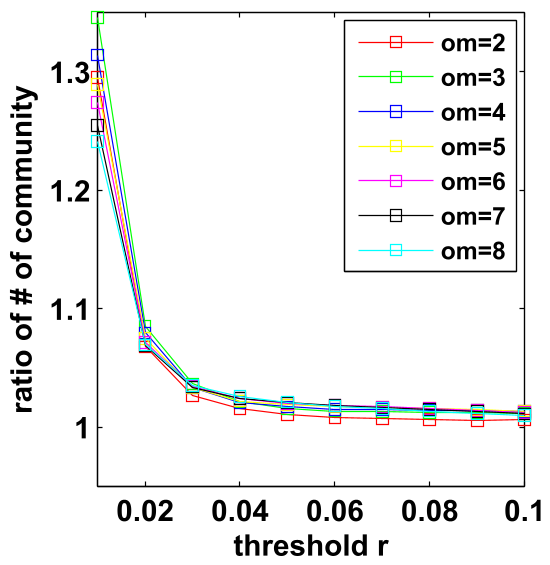 Figure: The asynchronous update loop where nodes accumulate labels over time.
Why does this work? Because labels that are centrally located within a dense community will be "spoken" more often and thus circulate more effectively in the memories of community members. The accumulation mechanism provides a "smoothing" effect similar to synchronous updates but retains the convergence speed of asynchronous systems.
Experiments & Results
The authors tested SLPA against heavyweights like CFinder (Clique Percolation) and Copra using the LFR benchmark—a synthetic network generator that mimics real-world power-law distributions.
Scalability
The execution time of SLPA scales almost linearly with the number of nodes , as shown below. This makes it applicable to massive social networks where or algorithms fail.
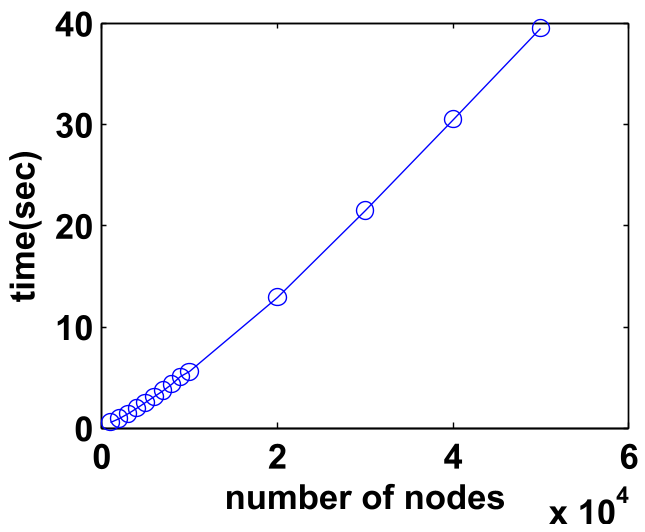 Figure: SLPA shows near-linear time complexity, scaling effectively up to 50,000 nodes in this benchmark.
Detection Accuracy
In terms of Normalized Mutual Information (NMI) and F-score, SLPA consistently outperformed its peers. Most impressively, while other algorithms' performance degraded as nodes belonged to more communities (increasing ), SLPA's accuracy remained stable or even improved.
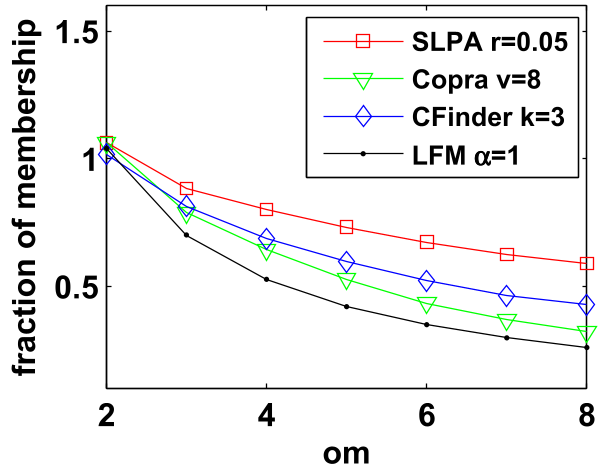 Figure: NMI comparison showing SLPA (red line) maintaining superior performance even as network complexity increases.
Critical Analysis & Conclusion
Takeaway: SLPA proves that overlapping community detection doesn't require complex global optimization. By refining the local rules of label propagation—specifically by adding memory and a frequency-based speaker rule—we can recover complex global structures.
Limitations:
- Parameter Sensitivity: While more stable than Copra, the choice of threshold and the number of iterations still requires some tuning depending on the network density.
- Resolution Limit: Like many local methods, it might struggle with very deep hierarchical overlaps unless the thresholding is carefully calibrated.
Future Work: The "Speaker-Listener" framework is highly modular. Future iterations could integrate Edge Weights or be applied to Temporal Networks where we track how community memberships evolve as the "conversation" changes over time.
Senior Editor's Note: SLPA remains a foundational algorithm in the network science toolkit due to its balance of "human-like" logic and computational efficiency.