
SMAC: Redefining Centrality through Semantic Subgraph Matching
SMAC: Subgraph Matching and Centrality in Huge Social Networks
The paper introduces SMAC (Subgraph Matching and Centrality), a flexible framework for defining node importance in massive social networks by combining semantic constraints with structural subgraph patterns. Utilizing a specialized pruning algorithm, it computes top-k central vertices across graphs with millions of nodes, significantly outperforming standard RDF engines like Apache Jena.
TL;DR
Classic centrality measures like PageRank or Betweenness ignore the rich semantic data (attributes and edge types) found in modern social networks. This paper introduces SMAC, a framework that allows users to define their own importance metrics using subgraph patterns and attribute constraints. By implementing a high-performance pruning algorithm called SMAC-Answer, the authors achieve massive speedups over traditional RDF triple stores on graphs with over 15 million edges.
The "Semantic Blindness" Problem
In a typical social network analysis, we might rank a user as "central" simply because they have many connections. However, in a real-world LinkedIn marketing scenario, a "central" person might specifically be a VP of Production at an Auto Manufacturer with more than 5 years of experience who is connected to at least three employees in a target firm.
Exisiting centrality measures are:
- Application Independent: They don't care about your specific business mission.
- Structure-Only: They ignore vertex properties (age, title, salary) and edge labels (colleague vs. friend).
- Computationally Expensive: Naive subgraph matching on huge graphs is NP-complete, making custom semantic queries difficult to scale.
Methodology: The SMAC Framework
SMAC (Subgraph Matching and Centrality) bridges the gap between graph querying and network science.
1. Defining Importance via Patterns
A Pattern Query (PQ) in SMAC consists of:
- Subgraph Query (): The structural "skeleton" (e.g., a triangle or a star).
- Constraints (): Predicates on variables (e.g.,
?u.title = 'CEO'). - Scoring Function (): How to turn variable values into numbers.
- Aggregations (): How to combine scores when a node appears in multiple matches.
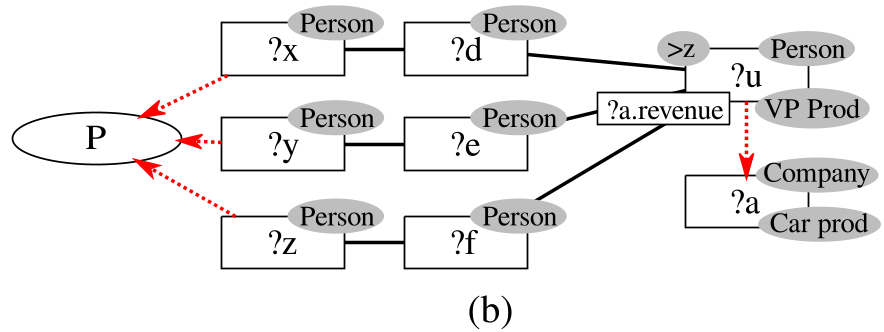 Fig 1: Graphical representation of user-defined patterns where gray ovals denote constraints and rectangles denote scoring terms.
2. The SMAC-Answer Algorithm
The core innovation is how SMAC avoids searching the entire graph. The algorithm uses a three-phase approach:
- Partial Substitution: It only binds "Essential Variables" (those involved in scoring).
- Upper Bounding: It uses a distance-based index () to estimate the maximum possible score a vertex could achieve if the rest of the pattern were completed.
- Top-k Pruning: It processes candidates in decreasing order of their upper bounds. If a candidate's maximum possible score is lower than the -th best score found so far, the entire branch is pruned.
Experimental Results
The authors compared SMAC-Answer against Base (naive matching) and Apache Jena (a SOTA SPARQL engine at the time).
Efficiency and Scalability
On the YouTube and Flickr datasets, SMAC-Answer maintained a steady lead regardless of query complexity. While Apache Jena struggled with the self-joins required for complex patterns, SMAC’s pruning kept the runtime low.
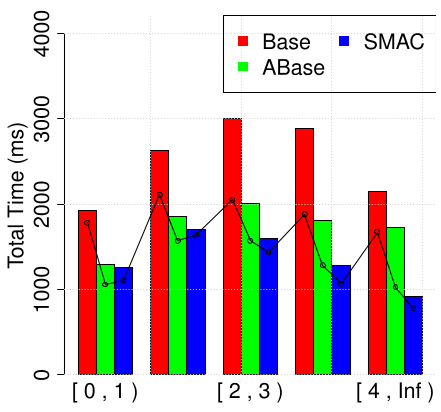 Fig 2: Results sorted by query size across different datasets (CiteSeerX, YouTube, Flickr).
Key Insights from Experiments:
- Selectivity Matters: As the number of matching subgraphs increases, SMAC's performance gap over Jena widens (up to 16x).
- Non-Essential Variables: The more "extra" variables a query has that don't affect the score, the more SMAC can prune, leading to significant runtime savings.
Critical Analysis & Conclusion
Takeaway
SMAC transforms centrality from a static mathematical property into a dynamic, queryable feature. This is highly relevant for modern systems where "importance" is contextual.
Limitations
- Probabilistic Graphs: The current framework assumes edges are deterministic (either exist or don't). In many modern contexts (like link prediction), edges have probabilities.
- Index Maintenance: The distance-based index used for pruning requires pre-computation, which might be expensive for frequently changing graphs.
Future Outlook
The move toward Attributed Graph Mining continues to grow. Integrating SMAC with Graph Neural Networks (GNNs) could allow for even more sophisticated "importance" definitions where the scoring function itself is learned from data rather than manually specified by the user.