
Is it a Small World After All? Mapping the Digital Paradox of Intercultural Competence
Is it a small world after all?: mapping intercultural competence in computer mediated communication users
This study investigates the developmental stages of intercultural awareness and sensitivity among Spanish college students using Computer-Mediated Communication (CMC). By integrating Bennett’s Developmental Model of Intercultural Sensitivity (DMIS) and a survey of 398 netizens, the researchers map the relationship between digital socializing habits and perceptions of "otherness."
TL;DR
Frequent use of social media and online networks might actually be making us less open to cultural differences. This study of 398 Spanish college students reveals that while the internet promises a "global village," high-frequency users often retreat into ethnocentric worldviews, whereas moderate users exhibit higher levels of empathy and openness.
The Digital Mirage: Why Connection Doesn't Equal Competence
We often assume that because young people are "digital natives" constantly interacting in global virtual spaces, they are naturally more interculturally competent. However, the authors argue that this global interconnectedness is often a surface-level phenomenon.
The core problem lies in the "myth of the technological revolution": information ubiquity frequently leads to fragmented gossip rather than critical thinking. In the EU context, the distinction between "foreigner" (often romanticized) and "immigrant" (often stereotyped) creates a friction point that digital communication doesn't necessarily resolve.
Methodology: Mapping the Mind of a Netizen
The researchers utilized a factor analysis of 26 criteria to define nine dimensions of Intercultural Communication Competence (ICC), including:
- Predisposition: Willingness to interact.
- Openness to Alternatives: Curiosity about novelty.
- Non-verbal Awareness: Sensitivity to body language.
- Universalistic Worldview: The ethnocentric trap of seeing the world through only one's own values.
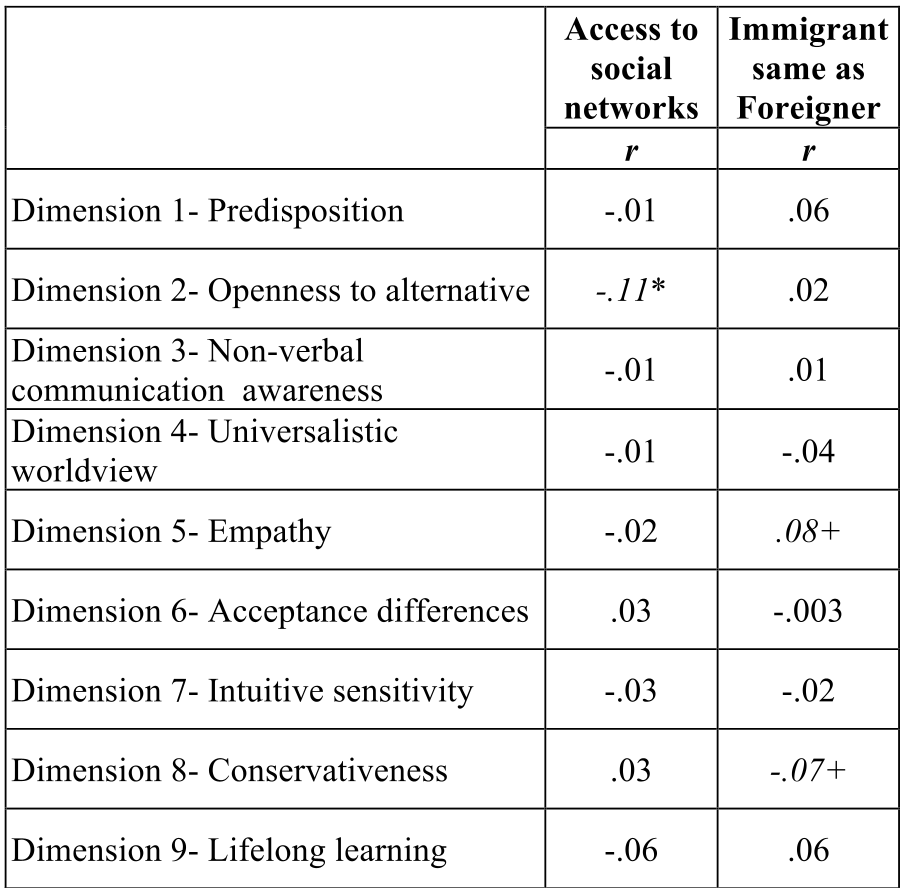
They then mapped these against the frequency of Social Network access and attitudes toward immigrants.

Key Finding: The "Moderate" Sweet Spot
The most striking result from the study is the negative correlation between frequent CMC access and Openness to Alternatives.
- The High-Frequency Trap: Students who are "always online" (High Frequency) scored lower (M=3.0) on openness compared to average users (M=3.19). These users tend to create "virtual communities of equals," which effectively acts as an echo chamber, reinforcing a Universalistic Worldview—an ethnocentric stance where they assume their values are the global norm.
- The Moderate Advantage: Average users spend less time in these echo chambers and are more likely to engage with diverse knowledge sources, leading to higher levels of Empathy and Predisposition.
The Mapping of Sensitivity
Using Bennett’s Developmental Model of Intercultural Sensitivity (DMIS), the authors visualized where students fall on the spectrum from Ethnocentric (Denial, Defense, Minimization) to Ethno-relative (Acceptance, Adaptation, Integration).
The study found a "Fifth Stage" area in the center of their mapping. This area is defined by Acceptance of Cultural Difference and Intuitive Sensitivity. Users in this zone are neither digital hermits nor addicts; they possess the ability to perceive cultural misunderstandings as they happen.
Critical Insights & Future Outlook
Takeaway
The "Small World" of the internet is only as large as the user's willingness to step outside their own cultural bubble. Simply being "connected" does not foster competence.
Limitations
The study acknowledges that the sample is limited to a specific academic context in Spain. It does not yet account for the type of content (e.g., educational vs. entertainment) or specific language skills which may act as moderators.
Future Work
The researchers aim to explore how gender, job expectations, and real-world interactions with ethnic minorities further influence the developmental stages of these digital natives. In an era of AI-algorithm-driven feeds, understanding the "conservativeness" trap of high-frequency internet use is more critical than ever.