
Smart Campus Evolution: Bridging the Gap Between Sensing and Socializing
Towards a Smart Campus with Mobile Social Networking
This paper introduces a flexible, service-oriented architecture for a Smart Campus based on Mobile Social Networking (MSN). By combining an OSGi-based server with lightweight mobile middleware, it integrates social contexts—such as proximity and communication history—to facilitate real-world social interactions among students and faculty.
TL;DR
While many "Smart Campus" projects focus on smart buildings, this research shifts the focus to the human element. By deploying a lightweight Mobile Social Networking (MSN) architecture, the authors transform smartphones into social sensors. This allows students to find quiet study spots based on real-time occupancy and share media via "opportunistic" Bluetooth networks even when the Internet is down.
Probing the Motivation: Why "Smart" Wasn't Enough
Previous iterations of Smart Campuses were often "ego-centric"—focused on the interaction between a single user and a service (like a digital map). However, a campus is a social ecosystem. The authors identified that existing Mobile Social Networking systems faced three critical hurdles:
- High Power Consumption: Real-time sensing kills smartphone batteries.
- Network Reliance: Most systems fail if the Wi-Fi or Cellular network is congested or unavailable.
- Lack of Semantic Context: Raw GPS coordinates don't explain social dynamics, like "who is studying with whom."
Methodology: A Two-Pronged Architecture
The researchers proposed a split-logic system to solve the "heavy lifting" problem of mobile sensing.
1. The Server: The OSGi Brain
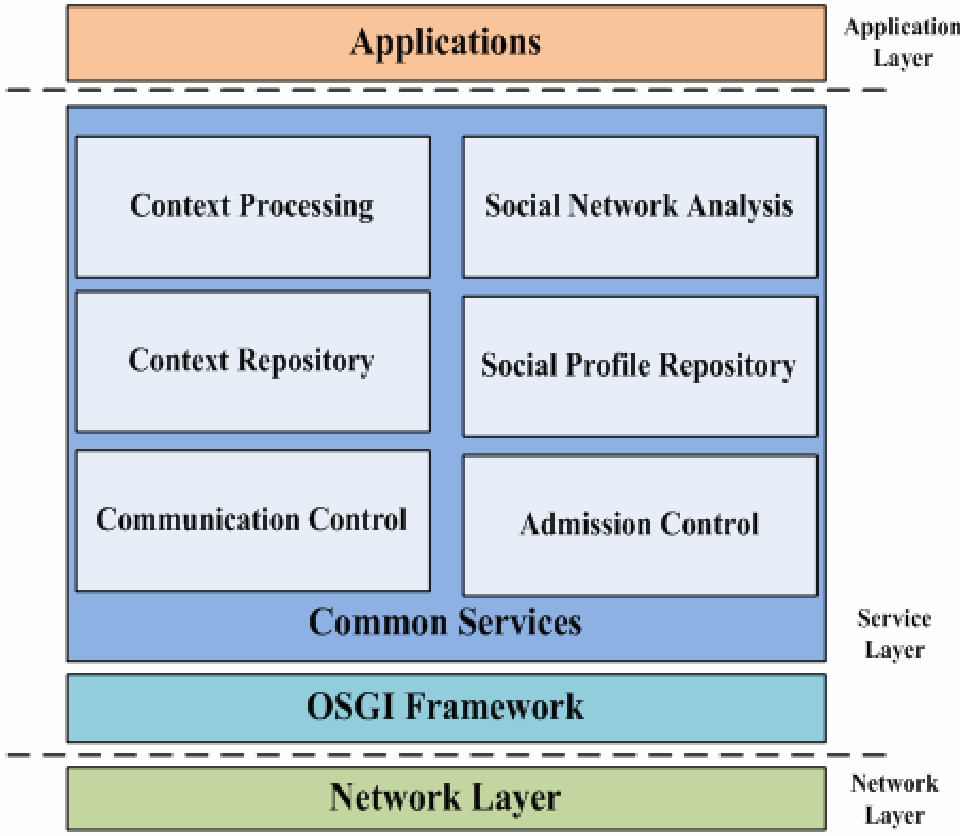
By using the OSGi (Open Services Gateway Initiative) framework, the server becomes a modular hub. It handles context storage, social network analysis, and pattern mining. This offloads the heavy semantic reasoning from the mobile device to the cloud.
2. The Client: Lightweight Middleware
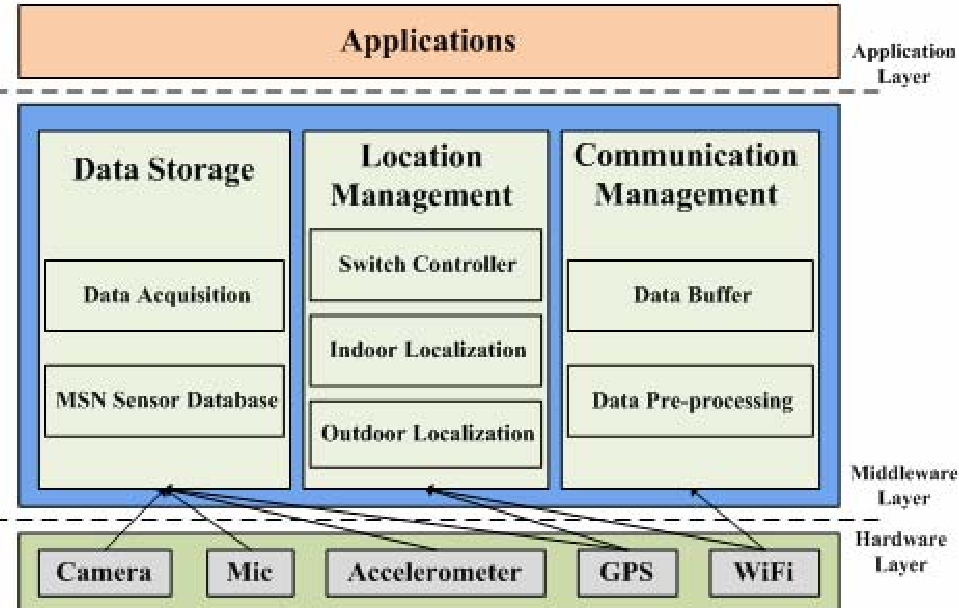
Recognizing that mobile devices have limited resources, the middleware uses a "Delta Storage" strategy: it only records a new sensor reading if it differs from the previous one. To save energy, it opts for batch-uploading data rather than constant streaming.
Real-World Deployment: Three Killer Apps
The authors didn't just build a framework; they deployed three distinct applications to prove its versatility:
- Where2Study: Uses Wi-Fi RSSI (Signal Strength) and a triangle centroid algorithm to estimate classroom crowdedness. It essentially creates a "Live Heatmap" of academic activity on campus.
- I-Sensing: A participatory sensing tool where a user can ask a "task" (e.g., "Is the cafe line long?") and nearby users can respond with photos or text to earn points.
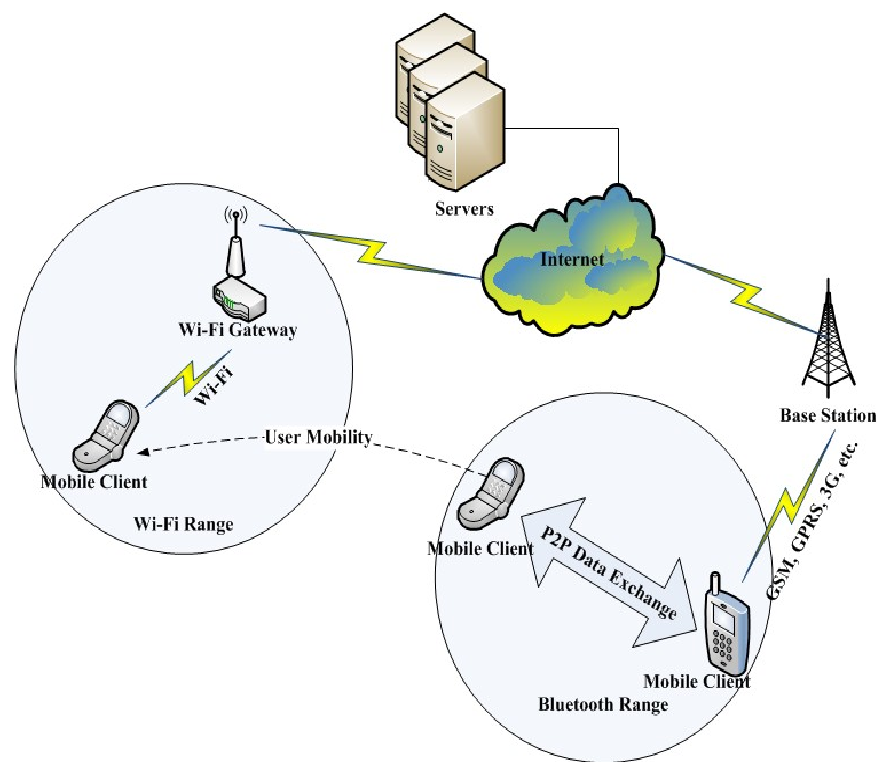
- BlueShare: An "Opportunistic Network" tool. It uses Bluetooth to pass files from person to person (Store-and-Forward). This is crucial for environments where infrastructure fails or is too slow (e.g., 200 students trying to download the same slides simultaneously during a break).
Experimental Insights
The study highlights that by separating sensing (Client) from processing (Server), the system maintains high scalability. The integration of indoor positioning (Wi-Fi) and outdoor positioning (GPS) ensures that the social link is never broken, regardless of the user's location.
Critical Analysis & Future Outlook
Takeaway: This work successfully demonstrates that MSN can enhance the "Connectedness" of a physical space. By treating humanity as a sensor network, the campus becomes more than just a set of buildings—it becomes a responsive community.
Limitations: While the energy-saving strategies are helpful, constant Wi-Fi scanning for positioning remains a battery drain. Future work could likely integrate lower-energy BLE (Bluetooth Low Energy) or inertial odometry to further reduce the power footprint.
Future Prospect: As we move toward 6G and ubiquitous AI, the "Semantic Extraction" mentioned in this paper will likely shift toward on-device Edge AI, allowing for even deeper social insights without compromising privacy or battery life.