
SCCRS: Crowdsourcing the Truth in the Age of Fake News
Smart Crowdsourcing Based Content Review System (SCCRS): An Approach to Improve Trustworthiness of Online Contents
SCCRS (Smart Crowdsourcing Based Content Review System) is a novel decentralized framework designed to validate online news and social media content through a self-learned crowdsourcing strategy. By utilizing a Multi-Objective Genetic Algorithm (MOGA), the system dynamically selects optimal reviewer sets that balance topic familiarity, availability, and demographic diversity to ensure unbiased content reporting.
TL;DR
The Smart Crowdsourcing Based Content Review System (SCCRS) is a decentralized approach to cleaning up social media. Instead of relying on fallible AI or a single "truth arbiter," it uses an intelligent algorithm to select a balanced, diverse team of human reviewers based on three pillars: Availability, Quality, and Familiarity (AQF).
Context: Why AI and Individuals Fail
Modern information ecosystems are plagued by "deceptive news"—content designed to trigger engagement rather than inform. While platforms attempt to use NLP (Natural Language Processing) to flag bad content, computers still struggle with sarcasm and context. Meanwhile, human moderation is often bottlenecked by biased individuals or a lack of specialized knowledge (e.g., a sports expert reviewing a medical news piece).
The authors argue that the solution isn't just "more humans," but a smarter selection of humans.
Methodology: The AQF & MOGA Framework
The core of SCCRS is the selection of a "Reviewer Set." The system tracks reviewers across three main dimensions:
- Availability (A): Metrics like login rates, response times, and session lengths.
- Quality (Q): Historical accuracy measured against pre-classified content (Detection Rate vs. False Alarm Rate).
- Familiarity (F): A weight-based score reflecting the reviewer's expertise in specific topics.
To prevent "echo chambers" or systematic bias, SCCRS employs a Multi-Objective Genetic Algorithm (MOGA). This algorithm treats a set of reviewers like a "chromosome," evolving the population over generations to maximize both the AQF score and the Diversity Index (Gini-Simpson index for age, gender, and race).
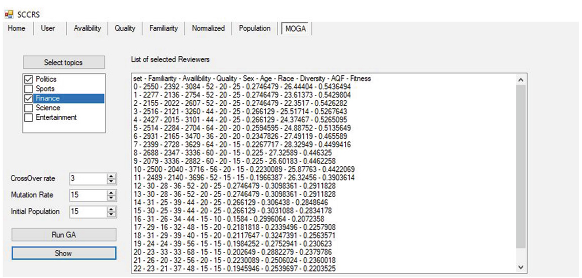 Fig 1: The application interface displaying how reviewer attributes and AQF values are tracked.
The Consensus Model
Before a reviewer's feedback on a new article is accepted, they are tested with hidden, already-classified content. If they fail to identify the "ground truth" of these control samples, their review for the target news is rejected or down-weighted. This ensures that only high-quality, non-biased feedback reaches the final consensus.
Experimental Performance
The researchers simulated the system with 9,999 reviewers. The results proved that the Genetic Algorithm (GA) effectively "evolved" better reviewer sets over time.
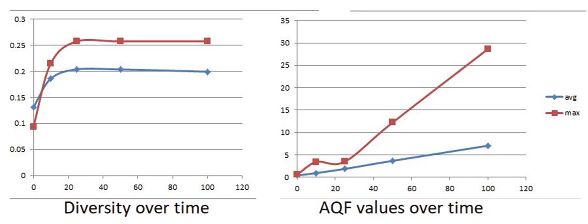 Fig 2: The upward trend of Diversity and AQF values across generations of the Genetic Algorithm.
Key findings include:
- Diversity gains: Age and race diversity scores saw significant jumps within the first 25 iterations.
- Fitness Convergence: The system's overall "fitness" (the balance of quality and diversity) stabilized after 100 iterations, proving the selection model is sustainable.
- Latency: Using the NS3 simulator, the researchers confirmed that the decentralized communication between nodes (requesters and approvers) is efficient enough for real-world social media speeds.
Critical Insight & Future Outlook
SCCRS represents a shift from "AI-as-Judge" to "AI-as-Orchestrator." By treating reviewer selection as a multi-objective optimization problem, the system mitigates the "Cold Start" problem (by using default weights) and handles "Trolls" (by auditing them against known content).
Limitations: The system's current implementation relies on a central "Control Node" to process rankings, which could be a bottleneck.
Future Work: The authors propose integrating Blockchain and Cryptocurrencies. By using a "Proof of Stake" concept, reviewers could be rewarded with digital assets for accurate reviews, further incentivizing high-quality participation in the content review ecosystem.
Takeaway
Trust in digital content cannot be automated by a single algorithm. It requires a diverse, verified, and expertly curated human crowd, orchestrated by a system that values diversity as much as accuracy.