
Smart Evolution: Countering Malicious Information Diffusion via Reputation Games
Smart Evolution for Information Diffusion Over Social Networks
The paper proposes a "Smart Evolution Model" for information diffusion in social networks, utilizing Evolutionary Game Theory (EGT) and a reputation mechanism to combat malicious users. It introduces two schemes—one with and one without the indirect reciprocity principle—to analyze how rational users can identify and isolate spreaders of detrimental information.
TL;DR
Social networks are battlegrounds for influence, but malicious actors often weaponize them with rumors and misinformation. This paper introduces a Smart Evolution Model based on Evolutionary Game Theory (EGT). By incorporating a dynamic reputation mechanism and the principle of Indirect Reciprocity, it provides a mathematical framework for how rational users can autonomously suppress the spread of negative information without requiring centralized control.
Problem: The Blind Spot in Network Defense
Most existing defense mechanisms against malicious information focus on "Influence Blocking Maximization" (IBM). These are macroscopic approaches—think of them as "cutting wires" or "deleting nodes" based on the network's structure. However, they ignore the microscopic behavior of individual users:
- Users lack global visibility of the network.
- User decisions are driven by personal payoffs and local interactions.
- Malicious actors are "pre-programmed" to spread harm, while rational users must learn whom to trust.
Methodology: The "Smart" in Smart Evolution
The authors shift the focus from network structure to Evolutionary Selection. They utilize the Death-birth (DB) updating rule, where a user abandons a failing strategy and adopts a neighbor's strategy based on its fitness.
1. Reputation as a Currency of Trust
The core innovation is a reputation system dictated by a Social Norm. Reputation is not static; it is updated based on:
- Information Trueness (): Is the shared content factual?
- Strategy Duration (): How long has a user been spamming the same strategy? (If it's too long, reputation drops).
- Strategy Consistency: Does the information align with the receiver’s interests?
2. The Power of Gossip (Indirect Reciprocity)
The paper compares two interaction schemes:
- Without Reciprocity: Users maintain private blacklists of neighbors.
- With Indirect Reciprocity: "I help you because you helped others." Users share reputation values through a gossip channel. This creates a global "social credit" that isolates malicious nodes much faster.
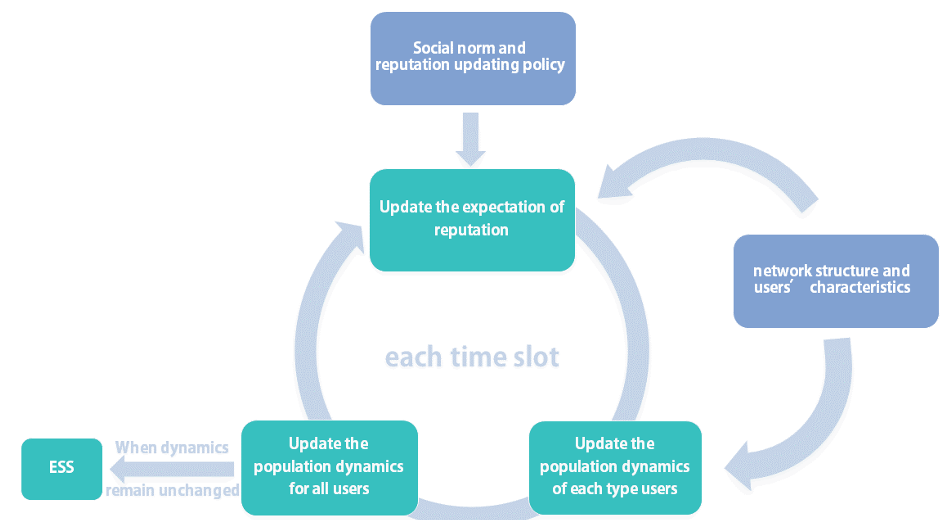 Figure 1: The workflow of predicting information diffusion using the smart evolution model.
Mathematical Intuition
The authors derive the Population Dynamics (), which represents the rate of change of users who forward information. While the math involves complex binomial moments, the physical intuition is simple: the "fitness" of the forwarding strategy is discounted by the neighbor's reputation. If a neighbor has low reputation (malicious), their "successful" forwarding doesn't tempt others to copy it.
Experimental Proof: Curbing the Spread
The authors validated the model using synthetic data and real-world graphs (Facebook socfb-Haverford76 and Sina Weibo logs).
Key Insights from Results:
- Reputation Drop: There is a "cliff-like" drop in forwarding behavior once the Patience Threshold () is reached. This is the point where rational users collectively realize a neighbor is a malicious bot or spammer.
- Reciprocity Efficiency: Models using Indirect Reciprocity reached stability significantly faster (22,000 steps vs. 35,000 steps).
- Real-world Impact: In Sina Weibo episodes (e.g., rumor about "the end of the world"), the model successfully matched actual diffusion patterns while showing that a reputation mechanism could have reduced the final spread magnitude significantly.
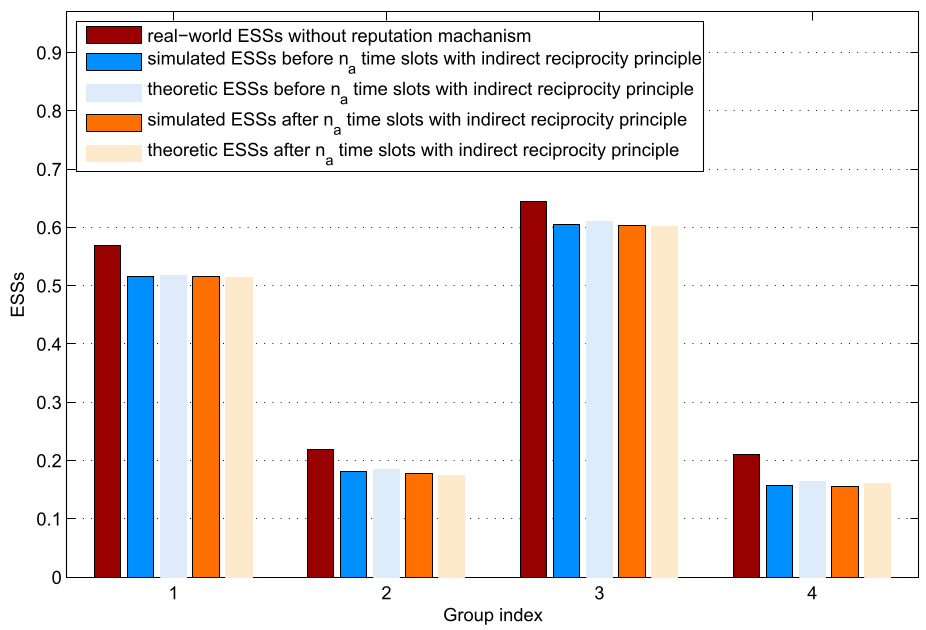 Figure 2: ESS (Evolutionarily Stable States) comparison between actual Weibo results and the proposed reputation-based scheme.
Conclusion and Future Outlook
The "Smart Evolution" model proves that social networks can be "self-healing." By empowering individual users with reputation-sharing tools, the system naturally evolves away from malicious influence.
Limitations: The model assumes "Weak Selection" (users aren't overly aggressive in changing minds) and requires a way to verify information trueness (). Future Direction: Integrating AI-driven fact-checking as the source for the parameter could turn this theoretical framework into a real-time defense plugin for modern social media platforms.