
Smart Food: Can the 'Wisdom of the Crowd' Solve the Calorie Counting Crisis?
Smart food: Crowdsourcing of experts in nutrition and non-experts in identifying calories of meals using smartphone as a potential tool contributing to obesity prevention and management
The study, "Smart Food," investigates the feasibility of using smartphone imagery and crowdsourcing to estimate meal calories for obesity management. It demonstrates that professional nutritionists can estimate calories with high accuracy (+8% error), and that aggregating opinions through crowdsourcing—specifically taking the "mode" of a crowd—significantly outperforms individual estimations.
TL;DR
Researchers at the University of Ulster have demonstrated that while individual calorie estimation is difficult, "crowdsourcing" expertise via smartphone photos can achieve near-perfect accuracy. While individual experts have an 8% error rate, the statistical mode of an expert crowd reduces error to negligible levels, outperforming 79% of individual professionals. This paves the way for a more reliable "Social-Medical" approach to obesity management.
The Human Bottleneck in Weight Management
The global obesity crisis demands personalized interventions, yet the foundation of these interventions—accurate calorie tracking—is notoriously broken. Most people struggle to estimate portion sizes, and "non-experts" (the general public) are often off by more than 50%. Even for professionals, "intra-rater variability" means the same expert might give different answers on different days.
The authors' insight was to stop looking for a single "perfect" estimator and instead look at the Crowd. If a group of experts looks at the same smartphone photo, does their collective opinion cancel out individual biases?
Methodology: Experts vs. Trained Novices
The study compared two distinct groups:
- Experts: 12 registered dietitians/nutritionists with an average of 12 years of experience.
- Non-experts: 12 healthy adults who received a 20-minute "crash course" in nutrition.
Participants viewed 15 meal photos (breakfast, lunch, and dinner) on a smartphone and estimated the calorie count. The study was longitudinal, repeating the survey one month later to account for consistency (intra-rater variability).
Why the "Mode" Matters
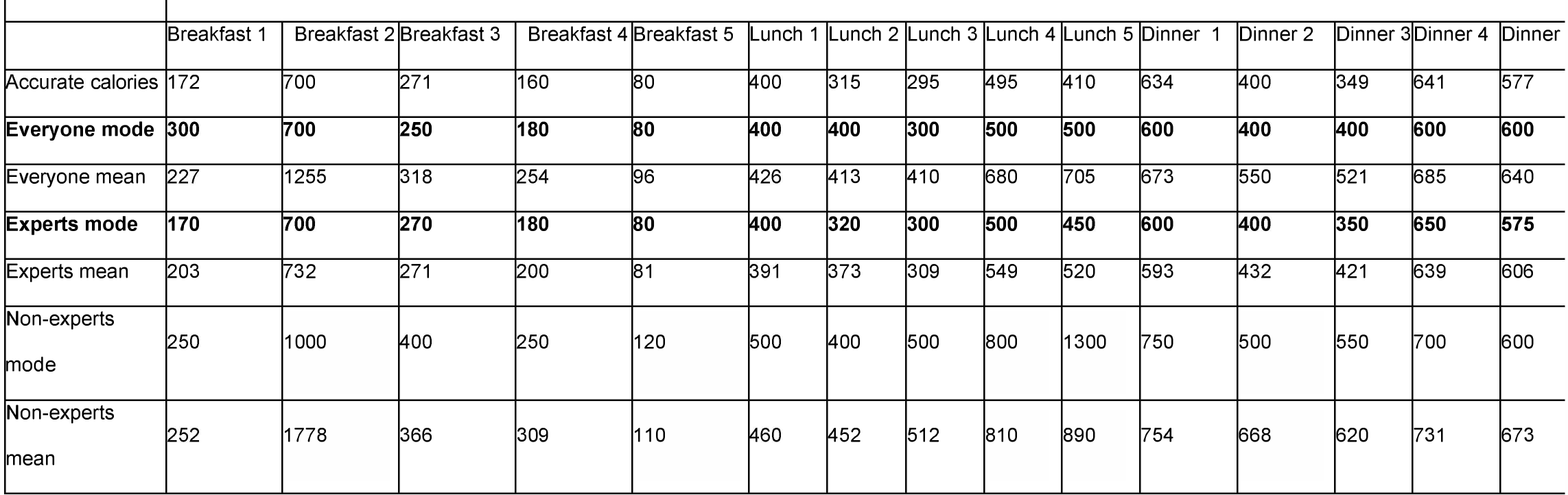
The most technical and fascinating result of this paper lies in the statistical aggregation. The researchers didn't just look at the average; they looked at the Mode (the most frequent value provided by the crowd).
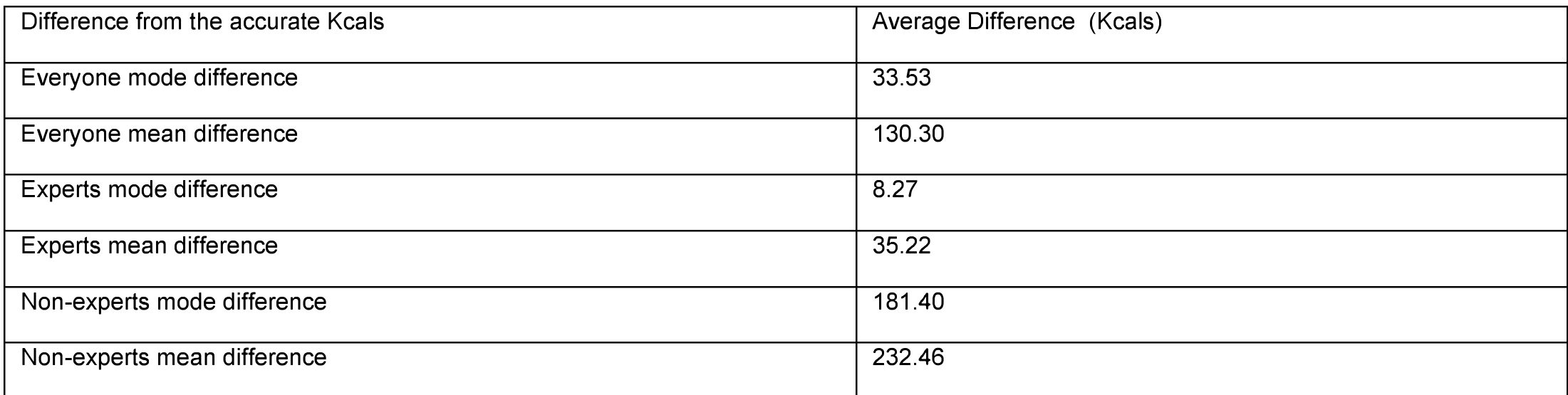
As shown in the data, the Experts Mode was the gold standard:
- Average Error Rate: The expert mode had an absolute error of only 8 calories.
- Superiority: This method was more accurate than 79% of individual experts.
- The Non-Expert Boost: Even for non-experts, the crowd's median performance outperformed 63% of individuals, suggesting that even "novice crowds" are smarter than "novice individuals."
Critical Analysis & Future Outlook
Takeaway: This study validates that smartphones are not just communication devices but sophisticated diagnostic tools. By piping a photo to a "crowd" of experts, a mobile app can provide feedback that is more accurate than an in-person visit to a single nutritionist.
Limitations:
- The sample size (24 participants) is small for a definitive crowdsourcing study.
- It relies on "Short Training" for non-experts, which might not be scalable for every user of a commercial app.
The Future of Nutrition Tech: This paper serves as a bridge between manual logging and fully automated AI. While we wait for Computer Vision to become 100% accurate at identifying hidden ingredients (like oils or sugars in a sauce), crowdsourced expert verification remains the most reliable high-fidelity solution for clinical obesity management.