
Smart Heart Monitoring: Bridging Sensor Data and EMRs with Ensemble Deep Learning
A smart healthcare monitoring system for heart disease prediction based on ensemble deep learning and feature fusion
The paper proposes a Smart Healthcare Monitoring System (SHMS) for heart disease prediction by utilizing ensemble deep learning and feature fusion. The system integrates wearable sensor data with Electronic Medical Records (EMRs) and achieves a state-of-the-art accuracy of 98.5% on benchmark datasets.
TL;DR
Predicting a heart attack before it occurs requires more than just high-frequency sensor data; it needs clinical context. This paper introduces a Smart Healthcare Monitoring System (SHMS) that fuses wearable sensor signals with Electronic Medical Records (EMRs). By applying a novel conditional probability-based feature weighting and an ensemble deep learning architecture, the researchers achieved a remarkable 98.5% accuracy, setting a new benchmark for heart disease prediction.
Problem & Motivation: The Context Gap
Traditional heart disease prediction systems face two major hurdles:
- Data Silos: Systems usually rely on either real-time sensors (like ECG) or static medical records (EMRs), but rarely both in a unified, structured format.
- Generic Weighting: Most machine learning models treat feature importance as "global." For instance, they might assign the same weight to "Cholesterol" regardless of whether the model is trying to predict "Healthy" or "At-Risk," which dilutes the diagnostic power of critical variables.
The authors' insight was to create a framework that not only fuses these data sources but also calculates the specific significance of a feature relative to each possible diagnostic class.
Methodology: The Core Architecture
The SHMS operates across four strategic layers:
1. Feature Extraction and Fusion
The system extracts Framingham Risk Factors (FRFs)—such as smoking history, BMI, and age—from unstructured EMRs using text mining (tokenization and N-grams). These are then fused with real-time sensor data (heart rate, blood pressure, oxygen saturation) to create a "rich" feature vector.
2. Information Gain (IG) Selection
To avoid the "curse of dimensionality," the system uses Information Gain to prune irrelevant features, reducing the computational burden on the deep learning model.
3. Conditional Probability Weighting
This is the "secret sauce." Instead of a general weight, the system computes: This ensures that if a feature value (e.g., specific blood pressure range) is highly indicative of a specific class (heart disease), it receives a higher weight during the training of the neural network.
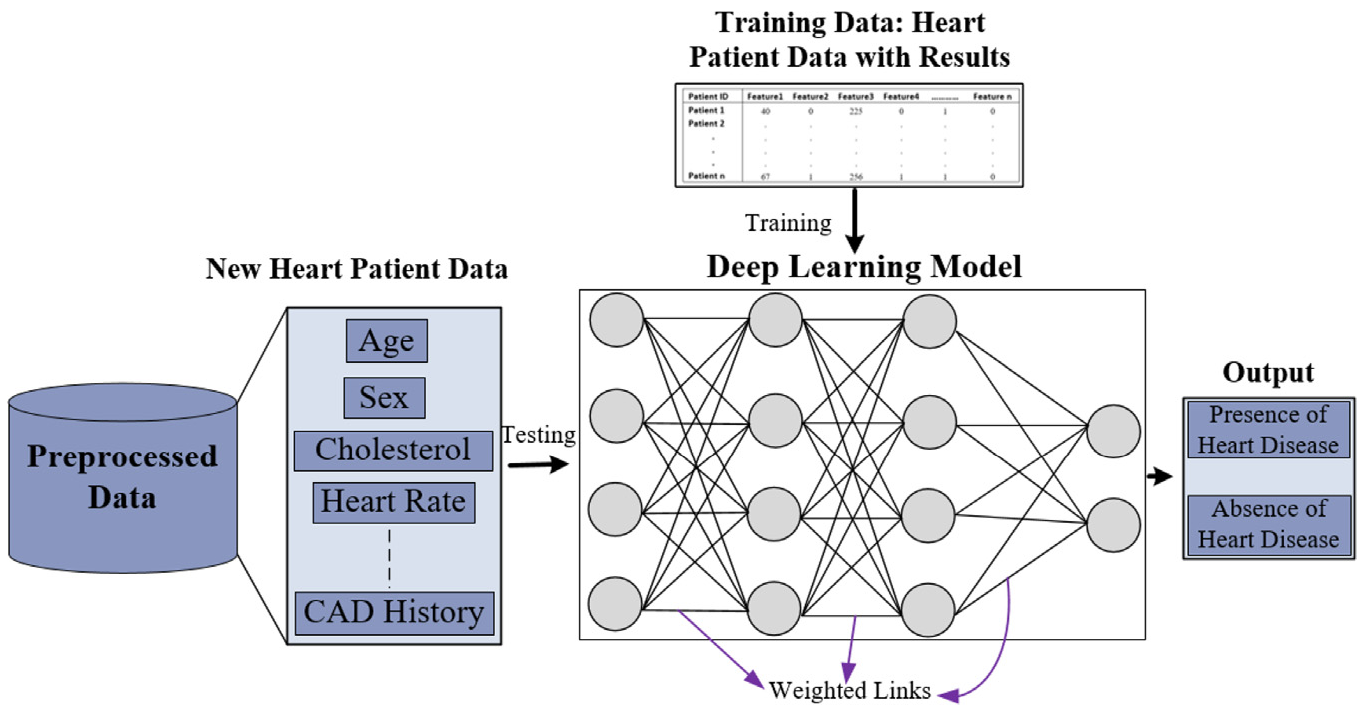 Figure 1: The ensemble deep learning model featuring input, hidden, and LogitBoost layers.
4. Ensemble Deep Learning & Ontology
The classifier uses a 5-layer feed-forward network optimized by LogitBoost. Post-prediction, an OWL-based ontology uses Semantic Web Rule Language (SWRL) to provide personalized dietary and activity recommendations (e.g., recommending increased physical activity if BMI and heart rate are high).
Experiments & Results: A New SOTA
The model was validated using the Cleveland and Hungarian datasets from the UCI repository.
- Baseline Comparison: The proposed model (98.5%) significantly outperformed SVM, Random Forest, and MLP.
- The Weighting Effect: When using "General" weighting, the deep learning model achieved ~84.9% accuracy. Switching to the proposed "Specific" weighting catapulted performance to 98.5%.
- Ablation Study on Fusion: Sensor data alone gave 71% accuracy, and EMR data alone gave 69%. The fused dataset immediately jumped to 84% even before optimization, proving that multi-source data is essential.
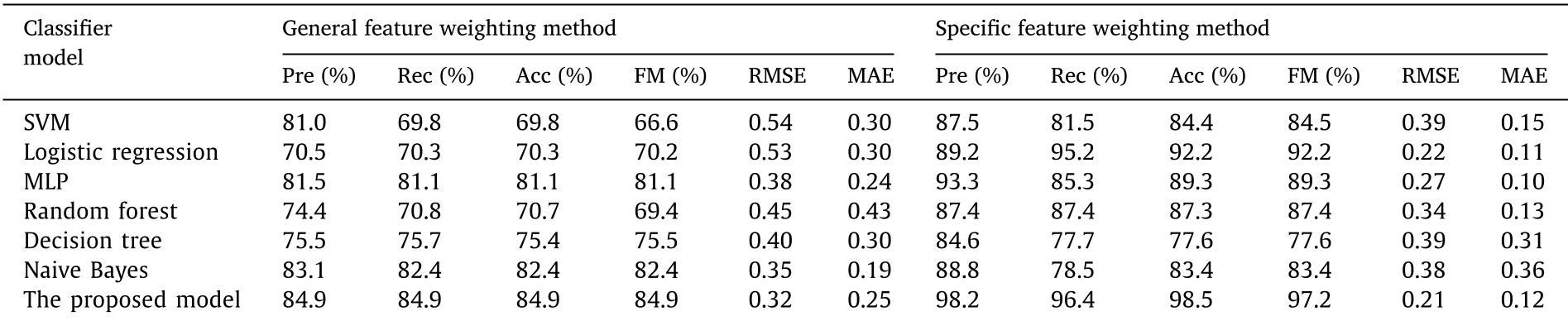 Table 1: Drastic performance gains using Specific Feature Weighting over General Weighting.
Critical Analysis & Conclusion
Takeaway
The success of this system lies in its hybrid nature. It doesn't just treat heart disease prediction as a black-box classification problem; it incorporates medical domain knowledge (FRFs and Ontology) with advanced ensemble deep learning.
Limitations
- Dataset Size: While 597 cases provide a solid pilot, the efficacy of the ensemble model on "Healthcare Big Data" (millions of records) remains to be seen.
- Real-time Latency: The text-mining step for EMRs could introduce latency in a live clinical environment if not optimized.
Future Outlook
The next step for this technology is its integration into Edge-Fog computing environments (like HealthFog), where the heavy lifting of ensemble deep learning can be handled by fog nodes while providing real-time alerts to patients via wearable devices.