
Smart Information Spreading: Overcoming Topology with Intelligent Social Gossip
Smart Information Spreading for Opinion Maximization in Social Networks
This paper introduces a novel "smart information spreading" framework for opinion maximization in social networks, shifting the focus from static seed node selection to dynamic sequential decision-making. By leveraging a Dynamic Bayesian Network (DBN) and reinforcement learning-based algorithms (CAMO, DAMO, ADMO), the smart source can outperform competitors even when starting from structurally disadvantaged network positions.
TL;DR
Most research into social influence asks "Who should we target?" This paper asks "How should we spread?" By modeling social networks as Dynamic Bayesian Networks (DBN) and treating information spreading as a Sequential Decision Problem, the authors demonstrate that a "smart" source can dominate the public opinion landscape even if it starts from a weak, non-central position in the network.
Background: The Shift from Seeding to Spreading
Traditionally, Opinion Maximization was seen as a variant of Influence Maximization—finding that "golden" set of seed nodes to trigger a cascade. However, in modern social media, information isn't a one-shot deal; it's a continuous injection.
The authors identify a critical gap: existing models don't account for the heterogeneous social learning abilities (stubbornness vs. receptivity) and the clutter of competing information sources. They propose a shift toward "Smart Information Spreading," where nodes don't just pass info randomly but choose the best neighbor to "influence" based on predicted opinion shifts.
Methodology: The Bayesian Social Brain
The paper's core innovation lies in its mathematical modeling of individual belief.
1. The DBN Representation
The network is modeled as a Dynamic Bayesian Network. Every node maintains a belief state , which represents its affinity for different message classes (ideologies or products). When a node receives a message, it updates its internal "Dirichlet distribution" parameters.
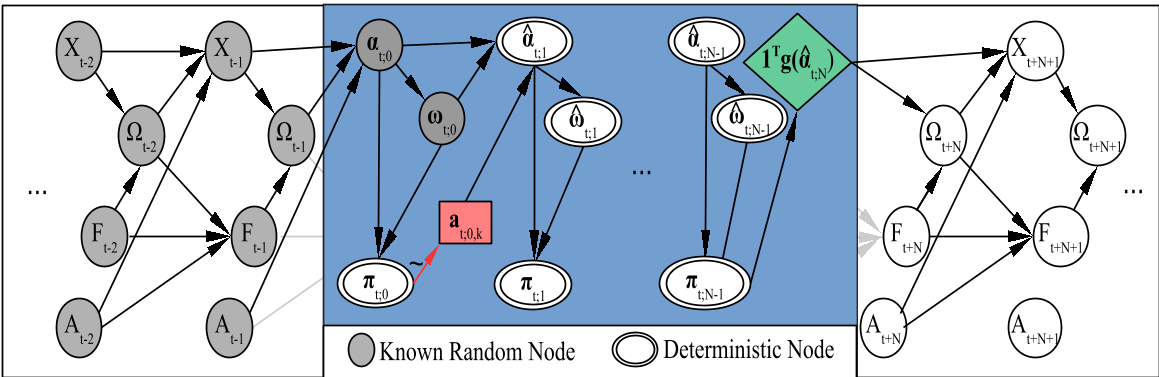
2. Decision Framework (CAMO & ADMO)
- CAMO (Centralized): Uses a central controller to perform "probabilistic diffusion," effectively simulating steps into the future to pick the best current action.
- ADMO (Decentralized): This is the practical winner. Each node uses stateless Q-learning to maximize the Sum of Discounted Future Rewards (S.O.D.F.R.). It looks beyond immediate neighbors, considering how a neighbor's neighbors might respond steps down the line.
Why It Works: The "Toy Model" Insight
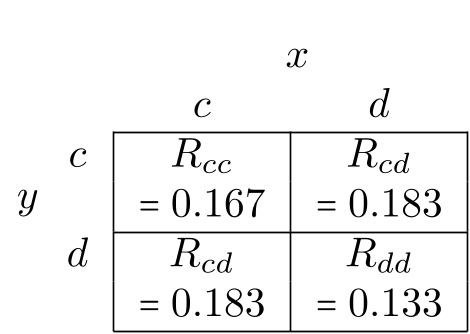
The authors use a 4-node toy model to show a "greedy" approach (sending to the person most easily convinced) is often sub-optimal. Instead, a mixed strategy (Boltzmann distribution) that balances between different targets often results in higher total network affinity.
Experiments: Beating the Hubs
The researchers tested their algorithms on Barabasi-Albert (PA) graphs and Facebook ego-networks.
Topology doesn't define Destiny
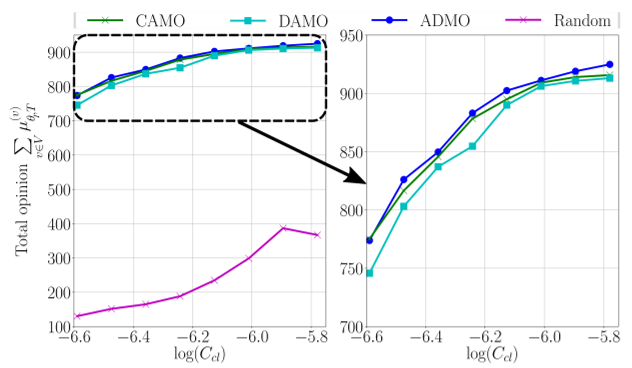
A striking result is shown in the Centrality vs. Final Opinion plot. Even when the smart source has a very low current-flow closeness centrality (meaning it's in the "periphery"), it manages to gain more "market share" of minds than random sources sitting at the network "hubs."
Evolution of Belief
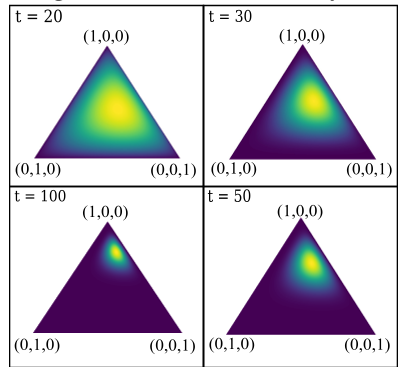
By visualizing the Dirichlet distribution on a simplex (the triangle plots), we can see the network's belief "polarizing" toward the desired class over time, becoming sharper and more confident as the smart spreading algorithm penetrates the community.
Critical Insight & Conclusion
The ADMO (Decentralized) approach proves that localization is an advantage, not a bug. By exchanging "action-values" (-values) with immediate neighbors, nodes can make "globally efficient" decisions with only "local" information.
Takeaway: In the war for opinions, the mechanism of spreading (the algorithm) can effectively overcome poor initial placement (the topology). This has massive implications for digital marketing and political campaigning, where the strategy of engagement might matter more than the initial star power of the influencers.
Limitations: The model assumes a "push-only" gossip protocol and requires knowledge of neighbor belief parameters, which in real-world settings might require sophisticated sentiment analysis or proxy data to estimate.