
SORec: Bridging the Gap Between IoT Failure and Social Collaboration
Smart object recommendation (SORec) architecture using representation learning in Smart objects-Based Social Network (SBSN)
The paper introduces SORec, a novel recommendation architecture specifically designed for Smart object-Based Social Networks (SBSN). It addresses the unique task of recommending replacement objects when a smart object fails, utilizing representation learning through a heterogeneous SBSN graph and the Node2Vec embedding technique.
TL;DR
In the hyper-connected world of the Social Internet of Things (SIoT), what happens when your critical device fails? SORec (Smart Object Recommendation) is a first-of-its-kind architecture that treats object failure as a trigger for social collaboration. By modeling a "global virtual world" of objects and users through heterogeneous graph embeddings, SORec recommends the most suitable neighbors to borrow hardware from—achieving a 41% precision boost over traditional methods.
The "Broken Link" in Current IoT Research
Most IoT recommendation research operates under the assumption that devices are always functional, focusing on which service to use. However, smart objects are prone to hardware breakdowns, battery depletion, and human error.
The authors identify a critical gap: when an object fails, a user often needs a temporary replacement rather than a new purchase. Recommending a "borrowable" object requires more than just service similarity; it requires balancing:
- Geographic Proximity: How far do I have to travel to get it?
- Manufacturer Influence: Is the replacement compatible with my existing ecosystem?
- Economic Influence: Is the lending fee within my historical spending pattern?
- Social Trust: Do our objects already "know" each other through co-location or ownership?
Methodology: Mapping the SBSN Heterogeneous Graph
SORec utilizes a three-tier architecture (User, Edge, Cloud) to process data. The heart of the system is the Smart Object-Based Social Network (SBSN), represented as a complex graph .
1. The Architecture
The system offloads data cleaning to the Edge Layer to ensure low-latency processing, while the Cloud Layer manages the recommendation generator.
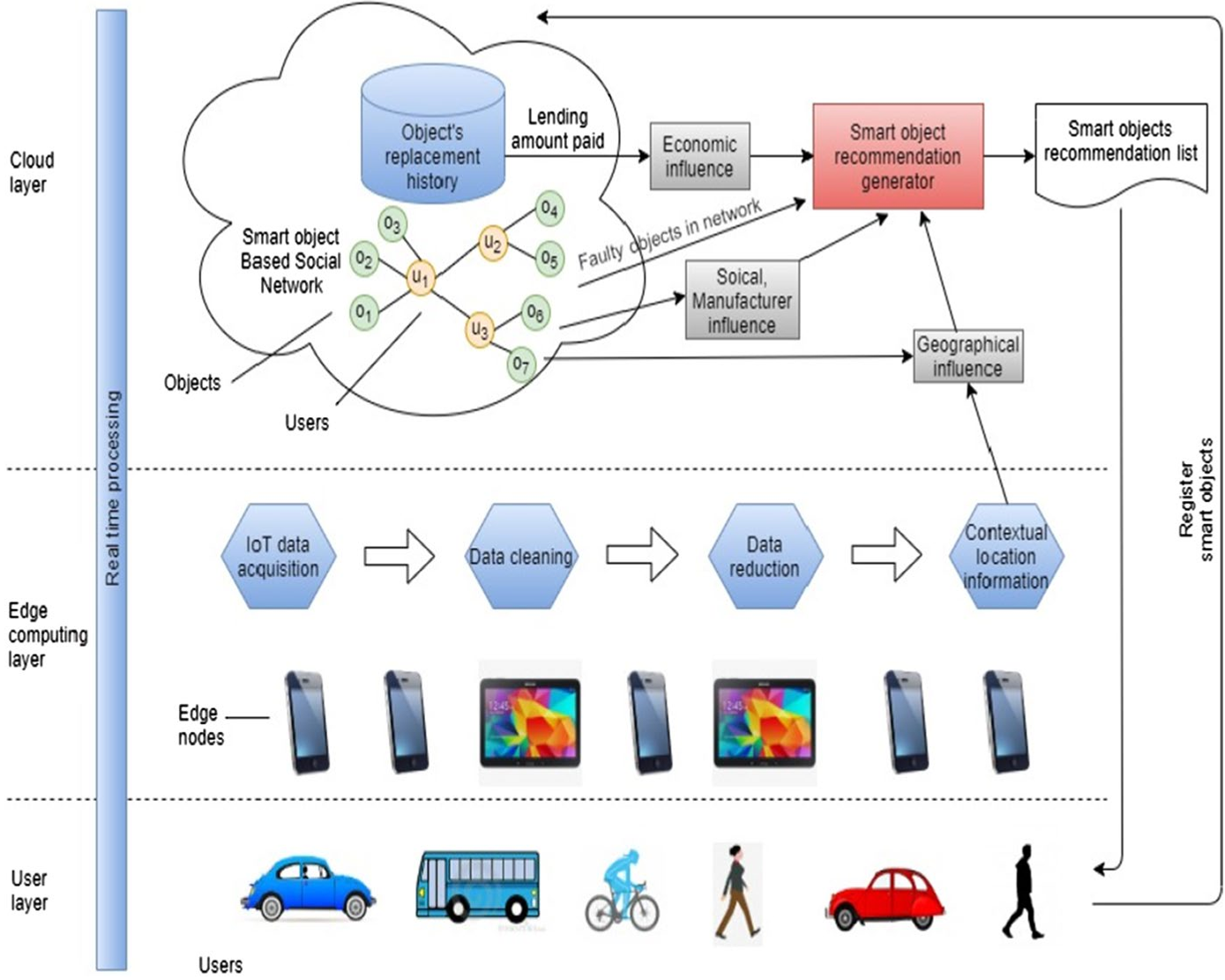
2. Transition Probabilities & Embedding
Rather than simple edges, SORec calculates Transition Probabilities between nodes. For instance, the transition from a User to an Object is a weighted sum of Economic (EI), Manufacturer (MI), and Geographic (GI) influences.
The authors then apply Node2Vec, a graph embedding technique that uses biased random walks (controlled by parameters and ) to explore the graph's structure. This allows the model to learn latent representations that capture both local "communities" of devices and broader network roles.

Experiments: Superior Precision through Context
The model was tested on an augmented SIoT dataset containing over 14,000 objects.
Key Findings:
- Precision Supremacy: SORec reached a precision of 0.763, dwarfing Probabilistic Matrix Factorization (PMF) which sat at 0.541.
- Context Matters: The ablation study ("SORec variants") showed that removing Geographic Influence (WG) caused the steepest drop in performance, proving that in physical device lending, location is king.
- Flexibility: Unlike DeepWalk or LINE, the Node2Vec approach (with ) successfully captured the heterogeneous "neighborhoods" of users and their diverse electronics.

Critical Insight: The Future of Collaborative IoT
SORec represents a shift toward resilient IoT. By leveraging the "Social" in SIoT, it creates a mechanism for hardware redundancy that doesn't rely on owning multiple backup devices.
Limitations & Outlook: While SORec is robust, the authors acknowledge the challenge of data sparsity—as the number of objects grows to trillions, finding overlaps in borrowing history becomes harder. Future iterations may explore Attention Mechanisms to dynamically weigh contextual factors based on the specific type of object (e.g., a "lending fee" might matter more for a high-end camera than a power tool).
Takeaway for Architects
If you are building SIoT platforms, don't just model services. Model the lifecycle and failure states of the hardware. The path to a truly "Smart" city lies in how its components support one another when things go wrong.