
Smart Operation for Wind and Diesel Systems: Bridging Economics and Grid Stability
Smart Operation of Wind Turbines and Diesel Generators According to Economic Criteria
This paper introduces a centralized Energy Management System (EMS) for Smart Grids that optimizes the operation of wind turbines (WTs) and diesel generators using an Optimal Power Flow (OPF) algorithm. The core contribution is a Sequential Quadratic Programming (SQP) approach that minimizes total operational costs, including production, power imports, and grid losses, while maintaining technical constraints.
TL;DR
This paper presents a sophisticated Energy Management System (EMS) designed for the next generation of Smart Grids. By combining Optimal Power Flow (OPF) with active management schemes, the system coordinates wind turbines and diesel generators to minimize total electricity delivery costs. The approach effectively handles the "prosumer" era's volatility, ensuring that economic savings do not come at the expense of voltage stability or thermal limits.
The "Blind" Grid Problem
Historically, distribution networks were "passive"—built on the assumption that power flows one way from the substation to the customer. However, the rise of Distributed Generation (DG) has turned consumers into prosumers. The core pain point is that traditional local control strategies (like simple voltage regulators) cannot "see" the global state of the network. This leads to:
- Voltage Violations: Excessive wind generation can cause local voltage spikes.
- Inefficient Dispatch: Diesel generators and wind turbines might operate at sub-optimal power factors.
- Grid Congestion: Thermal limits of lines are often ignored by local controllers.
Methodology: Active Coordination
The proposed system moves away from local-only logic to a centralized control architecture. It integrates a Wind Power Management System (WPMS) for forecasting and a SCADA system for real-time execution.
1. The Cost Objective
The heart of the solution is a mathematical optimization that accounts for:
- Production Costs: The varying fuel costs of diesel vs. the zero-marginal cost of wind.
- Market Dynamics: The price of power imported from the primary high-voltage substation.
- Physical Penalties: The cost associated with grid power losses ().
2. Architecture & Control
The system uses Sequential Quadratic Programming (SQP) to solve the non-linear constraints of the grid. Crucially, it manages the On-Load Tap-Changer (OLTC) not just based on the substation voltage, but based on the "Area-Based Control" that looks at the most stressed nodes in the entire feeder.
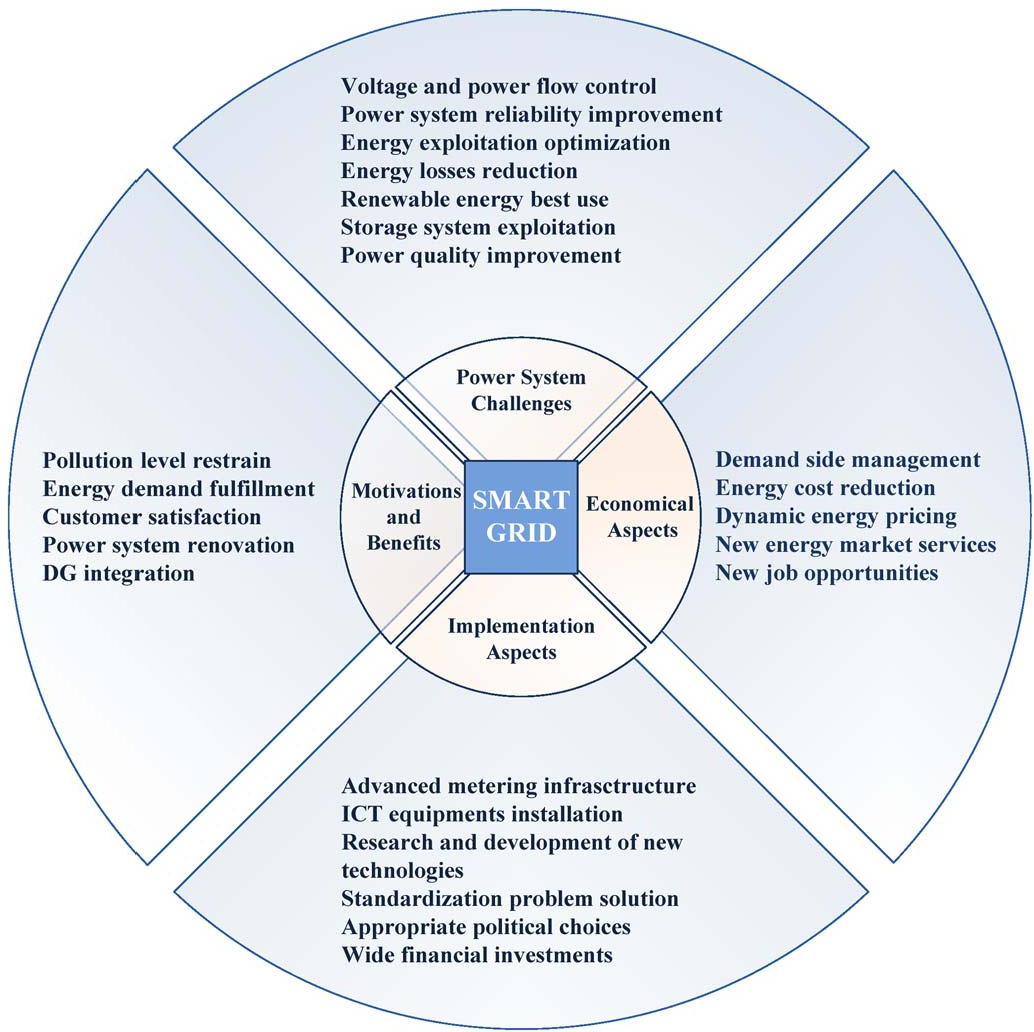 Note: The centralized EMS coordinates sensors (SCADA) and forecasts (WPMS) to dispatch setpoints to local controllers.
Experimental Validation
The authors tested their methodology on a 30-bus 11-kV radial distribution system. They contrasted two primary scenarios: one where wind turbines were limited (Scenario A) and one where three wind farms were fully operational (Scenario B).
Key Findings:
- Economic Earning: In Scenario B, during high wind and minimum load periods, the objective function reached -38 €/MWh, meaning the grid was effectively earning money via exports.
- Diesel as a Safety Net: When wind was zero during maximum load, the system automatically dispatched diesel generators to prevent thermal line violations, a feat traditional passive grids cannot achieve autonomously.
- Transient Stability: Beyond steady-state economics, the paper uses dynamic phasor models to show that when wind speeds drop suddenly (e.g., from 12 m/s to 6 m/s), the diesel generators react within 1 second to stabilize the reactive power flow.
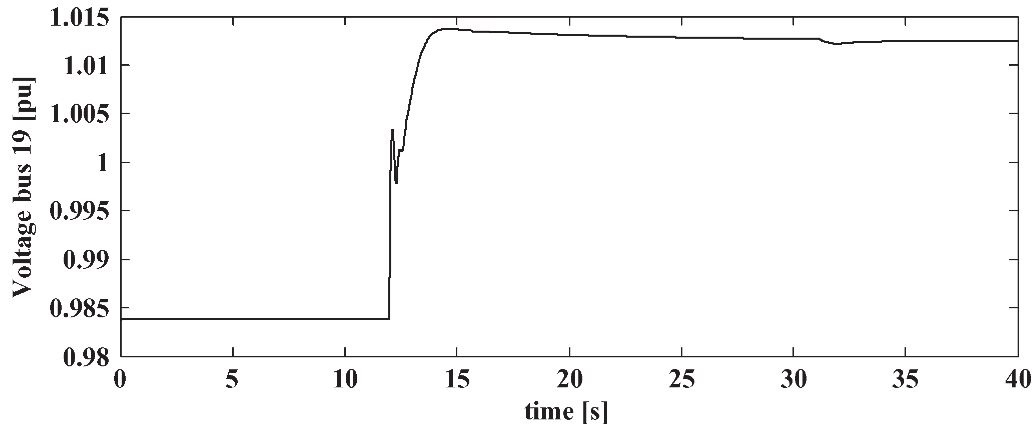 This transient analysis shows the OLTC and diesel generators working in tandem to stabilize voltage at nodes 19 and 28 during a wind fluctuation.
Critical Insight: Efficiency vs. Complexity
While many researchers propose complex meta-heuristics (Genetic Algorithms, Tabu Search), this paper argues for the efficiency of SQP. For an 8-GB RAM machine, solving the entire network's optimal state takes less than 3 minutes. This makes the method highly scalable for Distribution Network Operators (DNOs) who need to update dispatch every 15 minutes.
Conclusion & Future Outlook
The study proves that Smart Grids are more than just "adding sensors"; they require a fundamental shift toward Coordinated Active Management. By treating diesel generators as flexible assets rather than just emergency backups, and by using wind turbines for reactive power support, we can significantly lower the cost of energy.
Limitations: The primary barrier remains the standardization problem. Implementing this requires a radical upgrade of existing hardware to support IEC 61850 communication standards, which represents a massive upfront investment for utilities.