
Smart Agriculture: Bridging the Gap Between Biological Systems and Industry 4.0
Smart, Precision or Digital Agriculture and Farming - Current State of Technology
This paper provides a comprehensive survey of the current state of Smart, Precision, and Digital Agriculture. It explores the integration of IoT, remote sensing, and Soft Computing (Fuzzy Logic, Machine Learning, Evolutionary Algorithms) to optimize yields and animal welfare, identifying a market trajectory expected to reach $43.4 billion by 2025.
TL;DR
As the global population surges and climate change destabilizes traditional farming, agriculture is undergoing a digital revolution. This paper surveys the shift from intuition-based farming to Precision Agriculture (PA), leveraging IoT, UAVs, and "Soft Computing" (ML and Fuzzy Logic) to optimize resource usage and animal welfare. The goal is simple but ambitious: higher yields with lower environmental impact.
The Motivation: Why Intuition is No Longer Enough
For decades, farming was governed by the "average." Farmers applied the same amount of fertilizer and water across a field, regardless of internal variations in soil chemistry or moisture. This logic is failing because:
- Resource Scarcity: Fresh water and arable land are shrinking.
- Market Pressure: Narrow profit margins require extreme cost reduction.
- Climate Volatility: Traditional planting schedules are becoming obsolete.
The authors argue that the biological nature of agriculture makes it more complex than the automotive industry. It requires a system that doesn't just automate, but senses and adapts to micro-variations in the environment.
Methodology: The Architecture of a Digital Farm
The core of Smart Farming is the integration of Information and Communication Technologies (ICT). The paper breaks down the methodology into a layered tech stack:
- Data Acquisition: Using UAVs (drones) equipped with multispectral cameras and satellites (like ESA's Sentinel) to map crop health and soil moisture.
- Edge Sensing: IoT sensors placed in the soil or worn by livestock (monitoring everything from stomach pH to movement patterns).
- Soft Computing: This is the "brain" of the operation.
- Fuzzy Logic: Captures the "expert knowledge" of experienced farmers into digital rules.
- Machine Learning: Analyzes hyperspectral imagery to detect pests before they are visible to the human eye.
- Evolutionary Algorithms: Solves complex logistical puzzles, such as the optimal routing for harvesting fleets.
 Figure 1: The overarching vision of smart agriculture integrating IoT and cloud data.
Commercial Realities & SOTA Comparisons
The paper shifts from theory to the "real world" by reviewing commercial leaders that define the current SOTA (State of the Art):
- Precision Actuation: Companies like WaterBit and CropX provide "irrigation prescriptions," dynamically adjusting water usage based on soil sensors rather than timers.
- Livestock Welfare: JMB North America monitors individual cows for calving detection and health, drastically reducing mortality rates compared to traditional herd management.
- Autonomous Machinery: Case IH and others are pushing toward Supervised and Full Autonomy, where tractors utilize high-precision GPS and Computer Vision to eliminate "overlaps and skips" in the field.
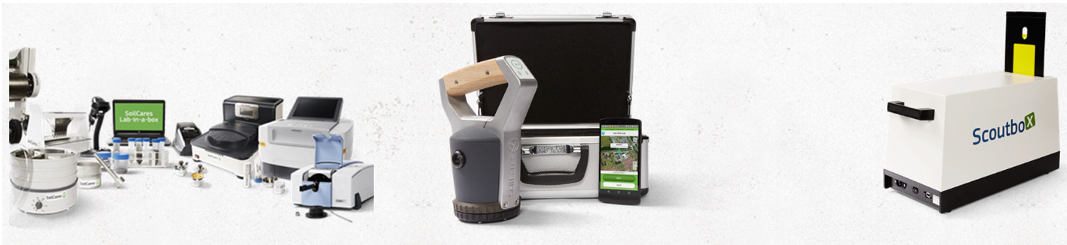 Figure 2: Tools like the AgroCares Scanner allow for instant, on-site nutrient monitoring, replacing slow laboratory delays.
Critical Analysis & The Path Forward
While the technical potential is undeniable, the paper highlights several critical hurdles:
- The "Rigid" Culture: Agriculture is historically conservative. Adoption will be gradual and requires "good practice" demonstrations.
- The Big Data Challenge: Collecting data is easy; turning it into actionable intelligence requires sophisticated processing that most small farms cannot yet afford.
- The Sustainability Paradox: Technology must be balanced. For example, precision fertilizer application is useless if traditional soil health (like deep plowing) is neglected in the name of fuel savings.
Conclusion: Smart Agriculture is not just about "fancy gadgets"—it is a fundamental restructuring of the food chain into a data-driven, closed-loop system. For researchers, the next frontier lies in Soft Computing—refining the algorithms that allow machines to understand the messy, unpredictable biological world as clearly as a factory floor.