
EMBER: Deciphering the Corporate Ladder through Email Communication Networks
Smart Roles: Inferring Professional Roles in Email Networks
This paper introduces EMBER (EMBedding Email-based Roles), a structural node representation learning method designed to infer professional roles from anonymized email networks. Tested on a massive dataset of billions of emails across thousands of companies, EMBER achieves state-of-the-art accuracy in classifying hierarchical roles (Officers, Managers, Workers) while being significantly faster than existing methods.
TL;DR
Researchers have developed EMBER (EMBedding Email-based Roles), a scalable framework that predicts an employee's professional role (e.g., CEO vs. Intern) purely by looking at how they communicate, not what they say. By treating employees as nodes in a graph and emails as directed, weighted edges, EMBER achieves SOTA accuracy while being up to 344x faster than traditional graph embedding methods.
Context: Why "Who You Know" Isn't Enough
In the world of Graph Machine Learning, most algorithms are obsessed with homophily—the idea that "birds of a feather flock together." If you are friends with a data scientist, you are likely a data scientist. However, in organizational hierarchies, professional roles are defined by structural identity. Two CEOs of different companies may never talk to each other (no proximity), but their "structural behavior"—highly weighted incoming edges from managers and heavy outgoing communication to diverse groups—is nearly identical.
The problem with existing tools is twofold:
- Privacy & Content: Third-party apps cannot legally read your email text. They only see the metadata (sender/receiver).
- Scalability: Traditional structural embedding tools like struc2vec are computationally "heavy," often crashing on real-world datasets involving millions of users.
Methodology: Capturing the "Vibe" of the Inbox
EMBER moves away from neighborhood proximity and focuses on Structural Behavior Histograms.
1. The Math of Influence
The model looks at -step neighborhoods. It doesn't just count contacts; it calculates "Path Weights." If you email a manager who emails a CEO, that 2-step path weight captures the indirect influence you hold. The system uses a logarithmic grouping scheme to bin employees based on their connectedness, ensuring the model isn't confused by slight variations in degree.
2. Scalability through Landmarks
Instead of comparing every employee to every other employee (a nightmare), EMBER uses Landmark Selection. It picks a few "representative" employees (usually those with high degrees) and defines every other employee's role based on their similarity to these landmarks.
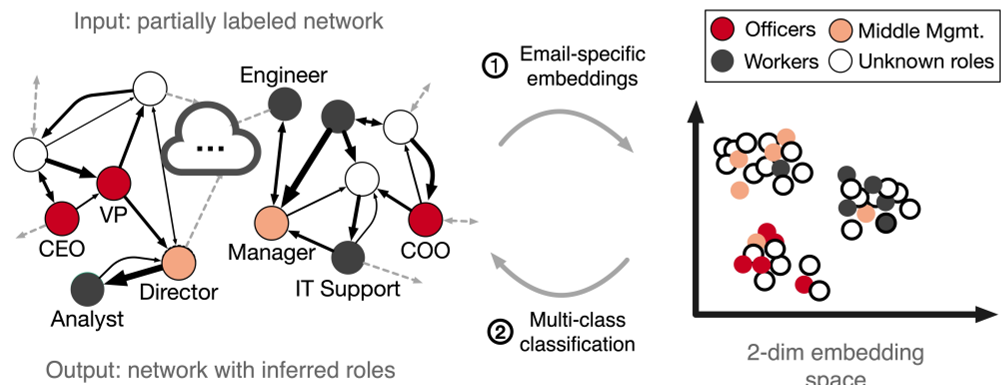 Figure 1: The EMBER workflow: from local communication volume to structural histograms, and finally to low-dimensional professional role embeddings.
Experiments: Breaking the Speed Barrier
The authors tested EMBER on the famous Enron dataset and a massive "Trove" dataset containing billions of emails.
- Accuracy: EMBER consistently hit a Micro-AUC higher than baselines like node2vec and GraphWave. In many cases, adding "directionality" and "weight" (volume of emails) gave EMBER a 2-20% edge.
- Efficiency: This is where EMBER shines. On the largest "Trove" network, EMBER finished in ~14 minutes, while popular methods like LINE or DNGR couldn't finish in 12 hours.
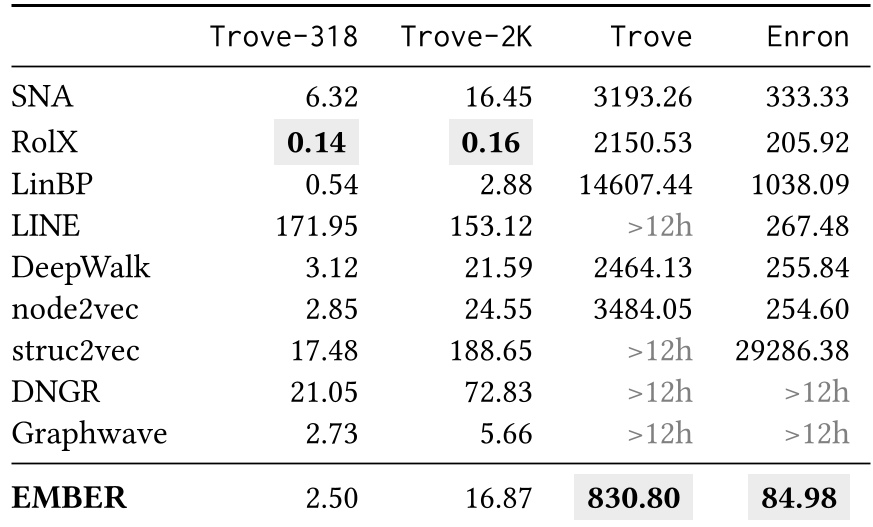 Table 1: Runtime comparisons showing EMBER's massive efficiency gains over traditional embedding methods (Runtime in seconds).
Deep Insight: The "Small Fish, Big Pond" Effect
One of the most fascinating findings in the paper is the cross-organization mapping. Using EMBER, the researchers mapped roles from small startups to large corporations.
- Insight: Employees at large companies (Trove-318) structurally "look like" Officers at smaller companies.
- Academic Comparison: Interestingly, university professors communicate like CEOs of small startups but like middle managers in large corporations. This highlights how hierarchical structure is relative to organizational scale.
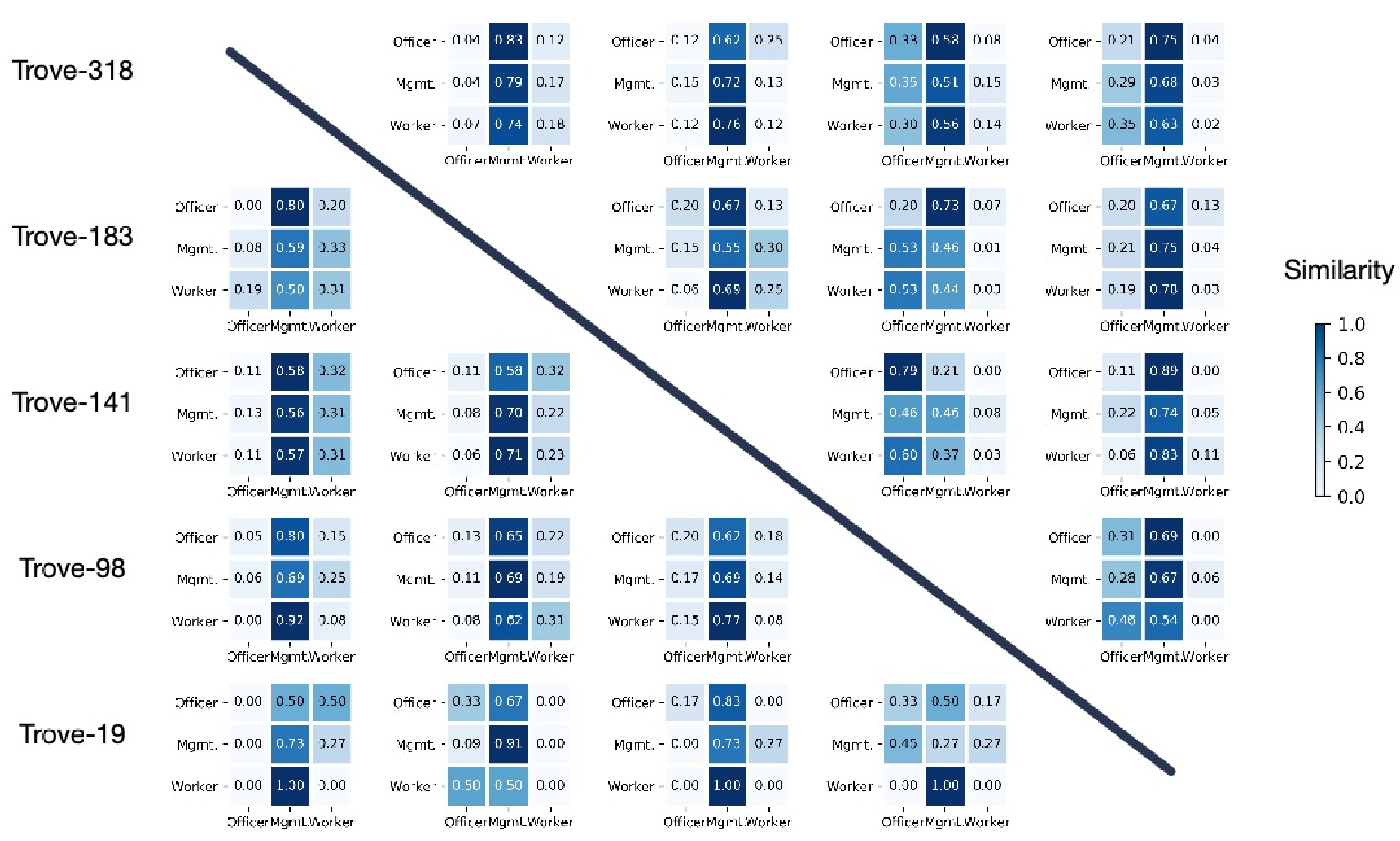 Figure 2: Heatmap showing how roles map between different sized companies. Note high correspondence between mid-sized company roles and large-company subordinates.
Conclusion & Key Takeaways
EMBER proves that structural identity—the signature of how you interact with a network—is a robust proxy for professional status.
- Product Impact: This enables email clients to automatically "star" emails from executives or prioritize contacts without ever reading a word of the email body.
- Limitations: The model is currently static; it doesn't account for how roles evolve over time (e.g., a worker getting promoted).
- Future: Extending these embeddings to dynamic, time-evolving graphs is the next frontier for "Smart" workplace analytics.