
S²aaS: Transforming Smartphones into Life-Saving Cloud Sensors
Smart Sensing based Societal Applications in Public Cloud Environment
This paper proposes S²aaS (Smart Sensing as a Service), a public cloud-based framework designed to integrate mobile phone sensors for societal applications. It specifically focuses on emergency response scenarios (accidents, natural disasters) by leveraging GPS and medical profiles to connect victims with rescuers via a centralized cloud clearinghouse.
TL;DR
This research introduces a Smart Sensing as a Service (S²aaS) framework that bridges the gap between mobile phone sensors and public cloud infrastructure. By utilizing a unique scheduling algorithm to mitigate the "energy-hungry" nature of GPS, the system provides a robust emergency response mechanism—connecting victims of accidents or disasters to the nearest help through automated medical and location data sharing.
Problem & Motivation: The Energy-Infrastructure Paradox
Modern smartphones are walking laboratories, equipped with accelerometers, gyroscopes, and GPS. However, two major hurdles prevent their use in large-scale societal safety systems:
- Cost and Fragmentation: Building dedicated sensor networks is expensive. Meanwhile, mobile platforms (Android, iOS) are fragmented, making it hard to create a unified sensing layer.
- The Battery Wall: Emergency applications require location persistence, but continuous GPS usage can deplete a phone's battery in hours, leaving users stranded when they need communication most.
The author's insight is to treat sensing not as a local app, but as a Cloud Service, where the complexity of data interpretation is offloaded, and the frequency of sensing is intelligently throttled.
Methodology: The S²aaS Architecture
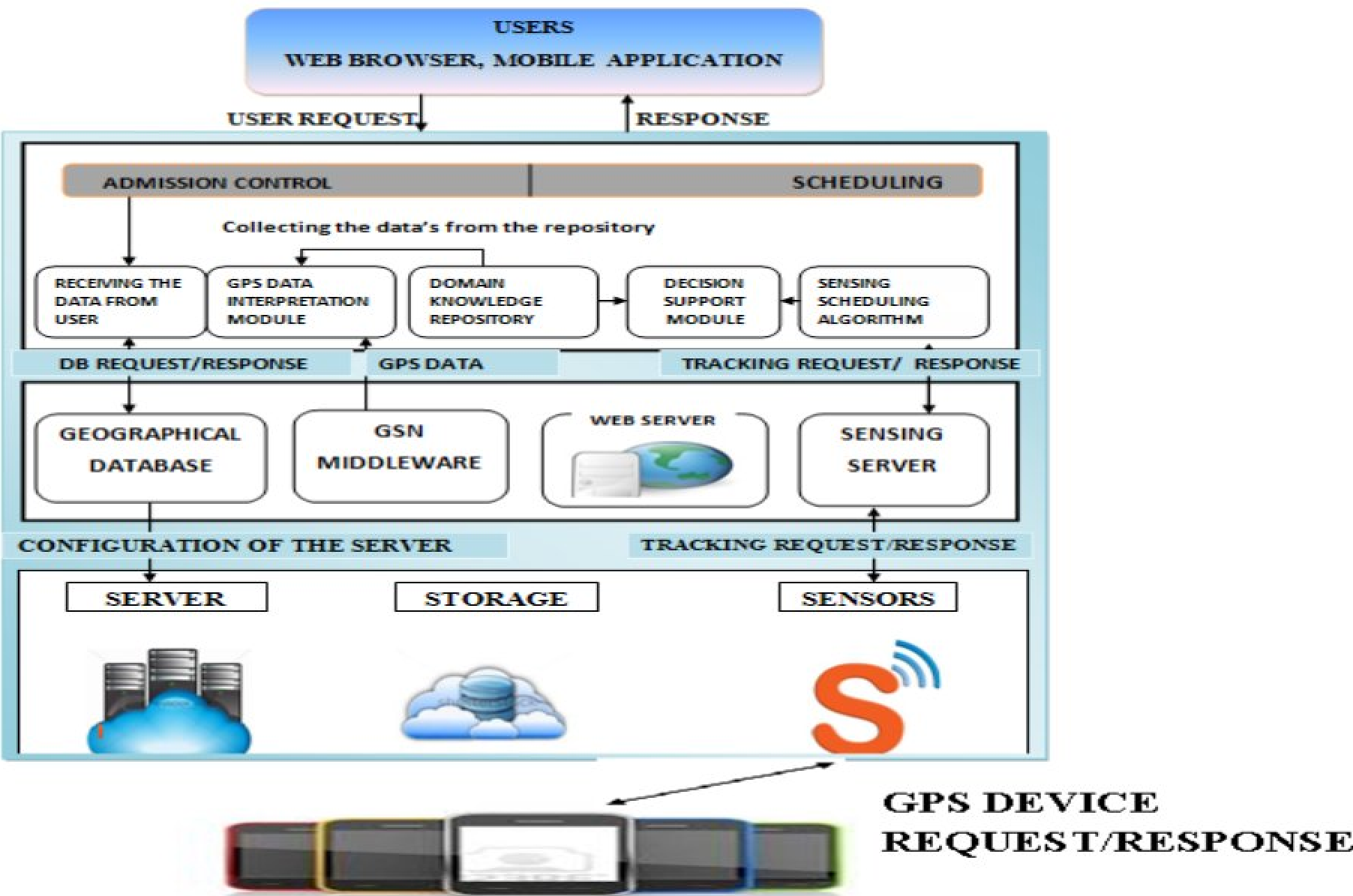
The proposed framework operates across the three classic cloud layers (IaaS, PaaS, SaaS) to transform raw sensor data into actionable emergency intelligence.
1. Data Acquisition via GSN
To solve the problem of hardware heterogeneity, the framework employs Global Sensor Network (GSN) middleware. This allows the system to collect and filter sensor data using simple XML-based languages, requiring "zero-programming" for new sensor integration.
2. Intelligent Scheduling (The Battery Saver)
Instead of constant tracking, S²aaS uses a spatial uncertainty bound approach:
- Step 1: Capture location and immediately turn off GPS.
- Step 2: Calculate a "larger circle" (uncertainty bound).
- Step 3: Re-activate GPS only when the system predicts or detects the user has exited this bound.
Core Applications: From Healthcare to Disasters
The blog highlights several "Societal Applications" enabled by this cloud-sensor bridge:
- Ubiquitous Healthcare: Monitoring senior citizens via heart rate and stove sensors, providing immediate alerts if anomalies are detected.
- Emergency SOS: In a car accident, the victim (even if unconscious) sends a request. The cloud retrieves their Medical Profile (blood group, surgery history) and Contact Profile (next of kin) and dispatches it to the nearest hospital based on GPS coordinates.
- Environmental Detection: Using phone vibration sensors to track earthquake intensity across a city in real-time.
Experimental Insights
The paper emphasizes that by moving from a standard "always-on" sensing model to a "scheduled" sensing model, mobile utility is preserved. The system's ability to interpret GPS data through GSN middleware allows it to locate the "nearest helper" by comparing the victim’s coordinates against a global domain database of medical facilities.
Critical Analysis & Conclusion
Takeaway
The shift toward Sensing as a Service is a logical evolution of the IoT ecosystem. By treating our phones as "virtual sensors" in the cloud, we can build life-saving infrastructure without laying a single mile of new cable.
Limitations
- Privacy: The paper assumes users are willing to store sensitive medical and profile data in a public cloud, which presents significant security risks.
- Network Dependency: Since it is a "Cloud Environment" solution, its efficacy during a massive natural disaster (where cellular towers might fall) remains a critical vulnerability.
Future Outlook
Future iterations of S²aaS could benefit from Edge Computing—processing location data at the local tower level to further reduce latency and save battery, ensuring that the "SOS" gets through even when cloud connectivity is intermittent.