
SSI: Breaking the Real-Time Barrier in Multimodal Emotion Recognition
Smart sensor integration: A framework for multimodal emotion recognition in real-time
The paper introduces Smart Sensor Integration (SSI), a modular framework designed for real-time, multimodal emotion recognition. It bridges the gap between offline analysis and online applications by offering a comprehensive pipeline for data acquisition, synchronization, and classification across various modalities like speech, mimics, and physiological signals.
TL;DR
Building machines that "feel" in real-time has historically been a fragmented nightmare of unsynchronized sensors and offline-only algorithms. The Smart Sensor Integration (SSI) framework provides a unified, professional-grade architecture to build Online Emotion Recognition (OER) systems. By treating every sensor—from a high-def camera to a simple Wiimote—as an abstract data stream, SSI enables researchers to move from recorded datasets to live, interactive affective computing.
Context: The Gap Between Lab and Life
In the world of Affective Computing, we have plenty of tools for "post-mortem" analysis. You record a user, spend weeks annotating data in Anvil, and run a classifier in Matlab. But for a virtual butler or an interactive art piece, the system needs to react now.
Existing frameworks like Pure Data were built for audio/video but struggle with physiological sensors (like ECG or GSR). Architecture like OpenInterface focused on ready-made components but ignored the raw "pattern recognition pipeline"—the messy work of segmentation and feature extraction that actually makes AI work.
Methodology: The Three-Layer Engine
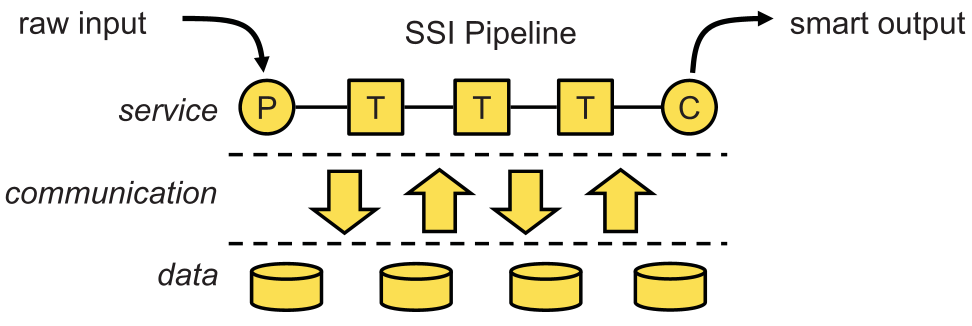
The core innovation of SSI is its abstraction of information into Streams. Whether it’s a 44kHz audio signal or a 60Hz heart rate monitor, SSI treats them as successive series of samples.
1. The Architecture
SSI operates on three distinct levels to ensure stability and synchronization:
- Data Layer: A high-speed buffer that stores snapshots of all streams, allowing multiple components to read the same data simultaneously.
- Communication Layer: The "logistics" manager that prevents read/write conflicts and ensures every sensor stays aligned with a global timer.
- Service Layer: Where the magic happens via Providers (Input), Transformers (Processing), and Consumers (Output/Classification).
2. The Logic of "Triggers"
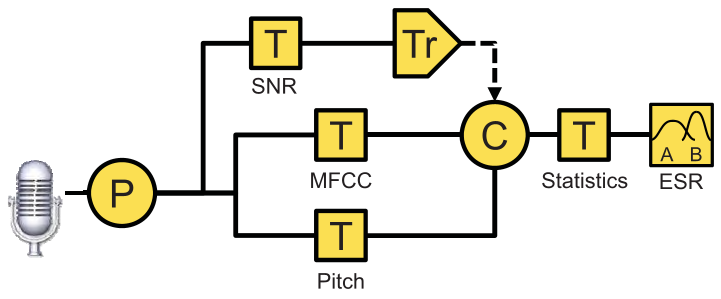
A massive hurdle in OER is automatic segmentation. How does a machine know when a sentence starts and ends? SSI uses Triggers. A trigger monitors a stream (like Signal-to-Noise ratio) and, when a threshold is hit, "clips" a segment of data and fires it off to a classifier. This allows the system to remain "always on" without drowning in data.
Multimodal Fusion: Why It Matters
Humans don't just express emotion through words; we use gestures, tone, and skin responses. SSI supports fusion at three levels:
- Feature Level: Stitching different sensor vectors together before classification.
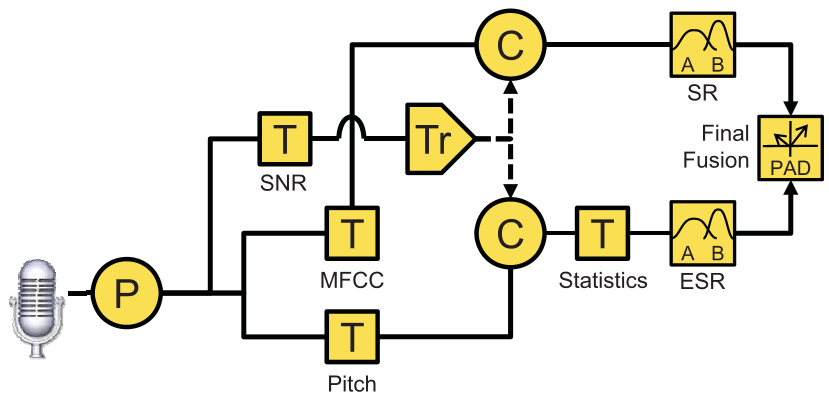
- Decision Level: Letting an Audio-classifier and a Video-classifier "vote" on the final result.
- PAD Model Fusion: A sophisticated approach where discrete emotions are mapped to a continuous 3D space (Pleasure, Arousal, Dominance), allowing various sensors to "update" the user's emotional state dynamically.
Real-World Applications: From Interactive Storytelling to Art
The paper showcases SSI's flexibility through several projects:
- EmoEmma: An interactive story where users influence the plot through the emotional tone of their voice.
- E-Tree: An AR art installation where a virtual tree grows or withers based on the user's combined voice and gesture (accelerometer) input.
- Metabo: Monitoring physiological data for diabetes patients in automotive environments.
Critical Insight & Future Outlook
The brilliance of SSI isn't just in its real-time speed, but in its Training GUI. By decoupling the recording interface from the processing engine, it allows non-experts to record and label their own emotional data. This paves the way for personalized AI—models that learn a specific user's unique way of expressing frustration or joy.
Limitations: While SSI is powerful, its reliance on threshold-based triggers can be sensitive to environmental noise. Furthermore, as we move into the era of Deep Learning, the framework must evolve to handle more computationally intensive neural architectures while maintaining its low-latency promises.
Conclusion
SSI remains a foundational framework for anyone building interactive, affect-aware systems. It moves emotion recognition out of the "offline lab" and into the "online world," proving that the future of HCI is not just smart, but emotionally intelligent.