
SIoT Framework: Bridging Humans and Objects with Semantic Virtualization
Toward a Smart Society Through Semantic Virtual-Object Enabled Real-Time Management Framework in the Social Internet of Things
This paper introduces a cognitive management framework for the Social Internet of Things (SIoT) that enables real-time management of physical and abstract objects. It leverages Semantic Virtual Objects (VOs) and RDF stream processing (RSP) to facilitate intelligent service composition and multiway interaction between humans and devices.
TL;DR
This research presents a real-time management framework for the Social Internet of Things (SIoT). By creating Virtual Objects (VOs) for hardware and Abstract Objects (AOs) for human skills, it allows for seamless, semantic-based collaboration. Using RDF Stream Processing (RSP) and MCDM algorithms, the system identifies the best candidates (human or machine) to solve user tasks in real-time.
Contextualizing the Problem: Beyond Connectivity
While the Internet of Things (IoT) has succeeded in connecting billions of devices, it remains largely "reactive." Data is collected and stored, but the ability to make intelligent, social-aware decisions in real-time is missing.
The core challenge lies in heterogeneity: How do you make a Java developer (Human), a smart tractor (Machine), and a web-service (Software) talk the same language to solve a complex task like "help me with my garden this weekend"? Previous works focused on either the Social Network or the Physical Layer, but rarely integrated human expertise as a manageable "object" within the network.
Methodology: The Five-Tier Cognitive Framework
The authors propose an architecture that moves from the physical world to the cognitive virtual world.
1. The Virtualization Pivot
At the heart of the framework is the Object Virtualization Tier. Every physical object (PO) registered in the network gains a VO counterpart. Crucially, the authors introduce Abstract Objects (AOs)—virtual representations of human skills (e.g., programming, gardening, or providing a ride).
2. Semantic Information Model
To ensure different entities can understand each other, the framework uses a complex ontology based on RDF (Resource Description Framework).
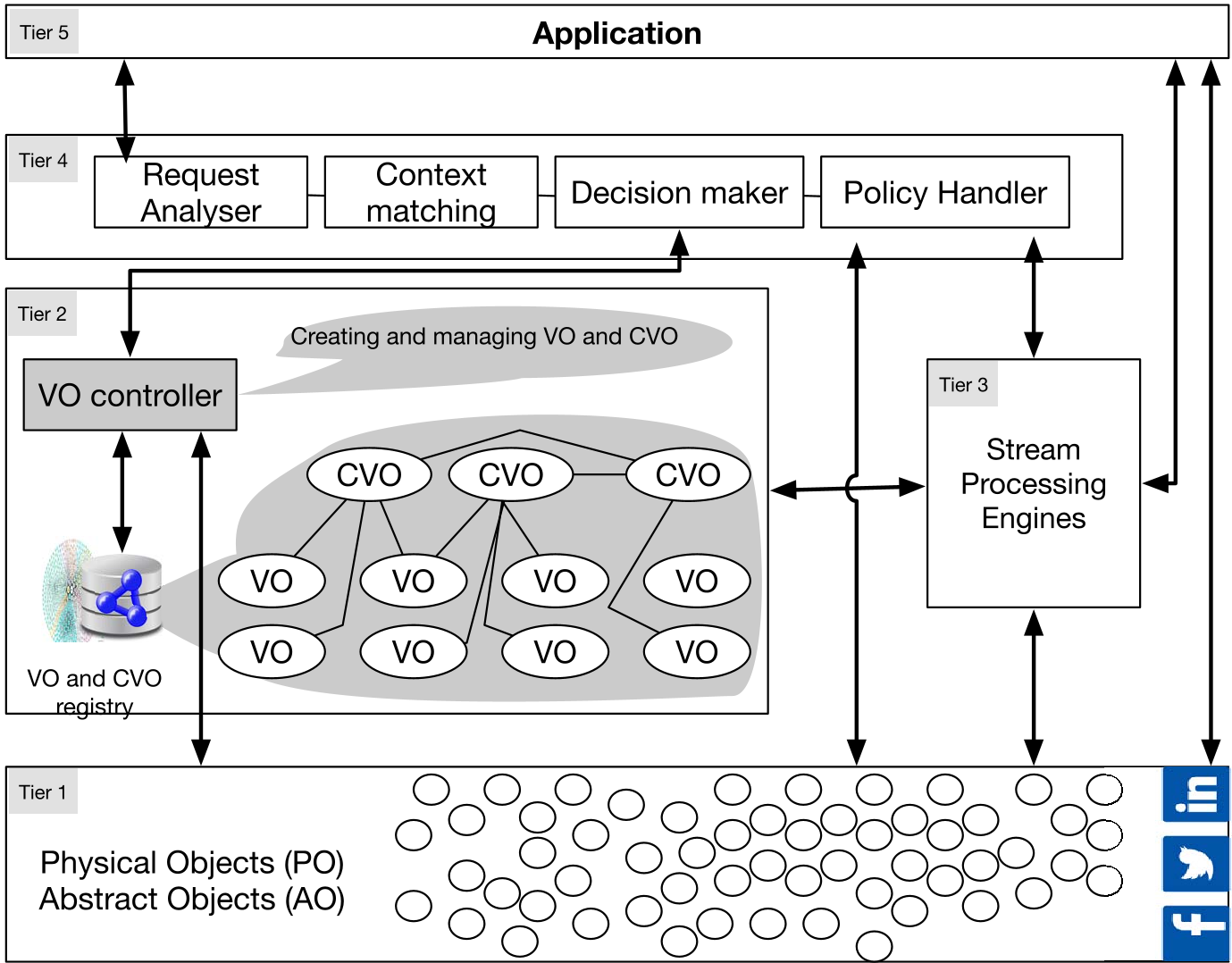
Figure 1: The SIoT Ontology linking Persons, Virtual Objects, Capabilities, and Skills.
3. Real-Time Stream Processing
Static databases are insufficient for SIoT. The framework uses RSP Engines (CQELS, C-SPARQL) to process continuous data streams. This allows the system to match a user's task request against a live stream of available objects on the fly.
Optimized Selection: The MCDM Engine
When multiple objects can fulfill a task (e.g., three available cars for a ride), how does the system choose? The paper employs a Multiple Criteria Decision Making (MCDM) approach.
The selection considers five weighted criteria:
- Price: User's budget constraints (Negative criterion).
- Reputation: Social trust within the network.
- Availability: Live status of the object.
- Success Rate: Historical performance data.
- Experience: Length of service history.
The selection logic is formalized to ensure that even with heterogeneous inputs, the output is a mathematically optimized "best fit" for the user requirement.
Performance and Evaluation
The framework was tested on a server with an Intel Xeon CPU to measure scalability.
Latency and Scalability
The tests demonstrated that the system handles up to 25.6 million objects. While latency remains low for the first 50,000 objects, it follows an exponential curve as the social graph expands, suggesting a need for distributed computing in city-scale deployments.
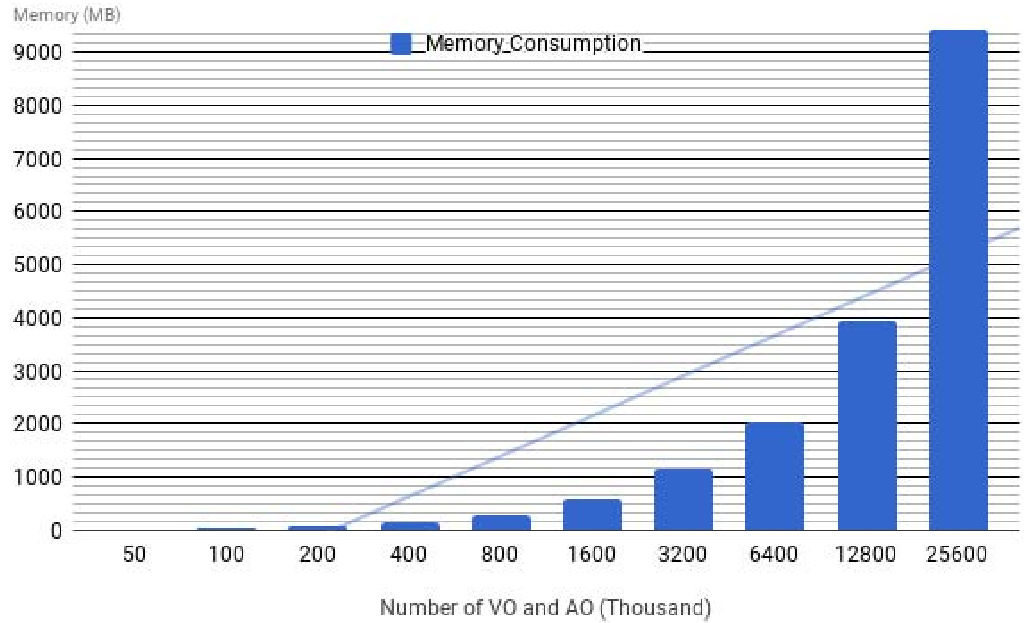
Figure 2: Latency analysis showing the computational cost as the number of VOs and AOs grows.
User Acceptance
A survey of 30 users highlighted the framework's strengths:
- Correctness (10/10): The system consistently matched the right object to the right task.
- User Experience (9.07/10): The abstraction of complex IoT interactions into a "social" interface was highly praised.
Critical Insight & Conclusion
The true innovation of this work is the democratization of services. By treating a human skill as an "Abstract Object" identical in structure to a "Virtual Object" of a machine, the framework creates a unified marketplace for value.
Limitations: The exponential growth in memory and latency (as shown in Fig 4 and 5) indicates that while the logic is sound, the implementation requires a transition from a centralized server to a Edge/Fog computing architecture to truly support a global "Smart Society."
Takeaway: This paper moves SIoT from a speculative concept to a structured, semantic reality, proving that the future of IoT is not just about "things," but about the social orchestration of skills and capabilities.