
Socially Savvy Brokers: Infusing IoT Networks with Human-Like Intelligence
Smart Topic Sharing in IoT Platform Based on a Social Inspired Broker
The paper introduces a "Broker-to-Broker Social IoT" (BBS-IoT) framework that organizes IoT brokers into a social-inspired peer-to-peer overlay using the PROSA model. It implements a smart topic-sharing mechanism based on semantic similarity and social link types (FSL, TSL, AL) to optimize message routing in M2M protocols.
TL;DR
This paper proposes a radical shift in how IoT brokers communicate: treating them like members of a social network. By leveraging the PROSA model, brokers build "friendships" based on the semantic similarity of the topics they handle. This reduces network congestion and ensures that data reaches the most relevant subscribers across different platforms without wasteful broadcasting.
Context & Motivation: The "Closed World" Problem
The Internet of Things (IoT) has traditionally operated in "closed worlds." Devices talk to a local broker, but brokers rarely talk to each other effectively. While publish-subscribe protocols (like MQTT) are great for local M2M communication, scaling them across a distributed multi-broker network usually results in a broadcast storm—where every broker shouts at every other broker just to find one interested subscriber.
The authors argue that we need a "Social Internet of Things" (SIoT). Just as humans prioritize asking friends for information before strangers, brokers should prioritize sharing data with "known" semantic partners.
Methodology: The PROSA Paradigm
The core of this work is the adaptation of the PROSA (P2P Resource Organisation by Social Acquaintances) model. In this framework, brokers maintain a BrokersList with three distinct levels of relationships:
- Full Semantic Link (FSL): A strong, proven connection where a broker has successfully answered or shared relevant data in the past.
- Temporary Semantic Link (TSL): A "memory" of interest. Even if a broker didn't have the data, we remember they were interested in that specific field.
- Acquaintance Link (AL): Ordinary, everyday interactions or random connections.
Smart Topic Routing
When a broker receives a new message, it doesn't just flood the network. It follows a social hierarchy defined in Algorithm 1:
- Check Friends First: It looks for FSL links where the semantic similarity () is high.
- Check Acquaintances: If no FSL matches, it looks at TSL links.
- Reach out to Strangers: As a last resort, it selects random AL links to keep the network's "small-world" property alive.
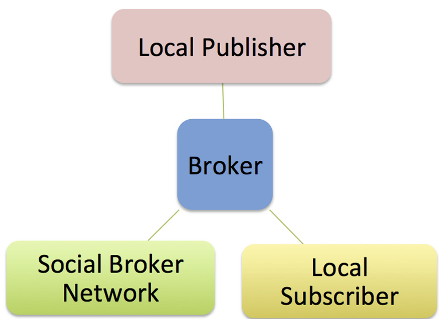 The interaction between publishers, local subscribers, and the Social Broker Network.
Calculating Similarity: Location + Meaning
The "Smart" in Smart Topic Sharing comes from a dual-pronged semantic function. The similarity between two topics isn't just about the words; it's about the Context (C) and the Measure (M).
- T(C) - Localization: The system converts relative locations (e.g., "ground floor") or descriptive names ("Rome") into absolute spatial coordinates.
- T(M) - The Measure: Using ontologies, it determines if "temperature" and "fever" are semantically close enough to warrant a link.
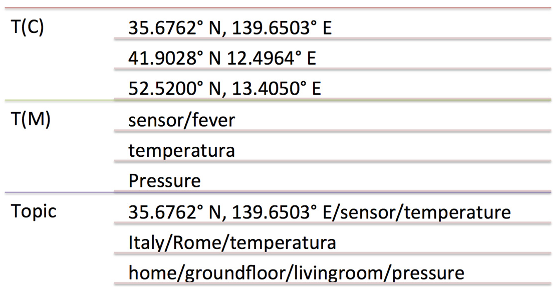 Examples of how raw topic strings are parsed into structured semantic data.
Analysis and Future Outlook
The beauty of this approach lies in its Self-Organization. The network "evolves" toward a stable configuration where brokers with high-interest overlap are topologically close. This mimics human social dynamics where communities form around niches.
Critical Limitations
As the authors honestly note, this social model introduces new challenges:
- Privacy: Sharing "interest lists" between brokers might expose sensitive user patterns.
- Security: Trust and reputation become vital. How do we prevent a "malicious broker" from faking social links to intercept data?
- Aging: To prevent the
BrokersListfrom growing indefinitely, "aging algorithms" must be implemented to prune old or useless links—much like humans forget casual acquaintances.
Conclusion
By moving away from rigid, hierarchical architectures toward a fluid, social-inspired overlay, this research provides a blueprint for a more "organic" IoT. This is a significant step toward making global IoT discovery as efficient as a well-connected social network.