
Smart TV Forensics: Uncovering the Digital Ghost in the Living Room
Smart TV Forensics - Digital Traces On Televisions
This paper establishes a comprehensive forensic procedure for Smart TVs, specifically targeting the Samsung F-series. It details physical and logical data acquisition methods and categorizes critical digital traces including app history, web browsing, and external device logs.
TL;DR
As daily life converges with the Internet of Things (IoT), the Smart TV has transitioned from a passive receiver to a sophisticated embedded system. This research by the Netherlands Forensic Institute (NFI) provides a foundational technical roadmap for extracting and analyzing digital traces from Samsung Smart TVs, proving that these devices store much more than just channel lists—including app screenshots, cloud logs, and web history.
The Forensic Motivation: Why TVs Matter
While smartphones are often called "goldmines" for investigators, Smart TVs have been largely overlooked in the digital forensic community. However, because they integrate social media, instant messaging, and web browsing, they serve as a unique witness to a suspect's home life. The authors argue that a Smart TV is essentially an ARM-based Linux computer that presents unique obstacles: proprietary file systems and hardware security that prevents simple "plug-and-play" data extraction.
Methodology: Getting Under the Hood
The research team explored three primary acquisition vectors:
- eMMC Five-Wire Method: Attempting to read signals (Vss, Vdd, Clock, etc.) directly from the mainboard. This failed because the TV's processor actively competed for memory access.
- Software Rooting (The "SamyGO" Method): Utilizing a Skype app vulnerability to gain root access and pipe data over FTP. While effective, this is an "arms race" easily defeated by firmware updates.
- Chip-Off (The Gold Standard): Desoldering the 4GiB MoviNAND flash chip and reading it with the NFI Memory Toolkit II. This proved to be the only forensically sound and "firmware-proof" method.
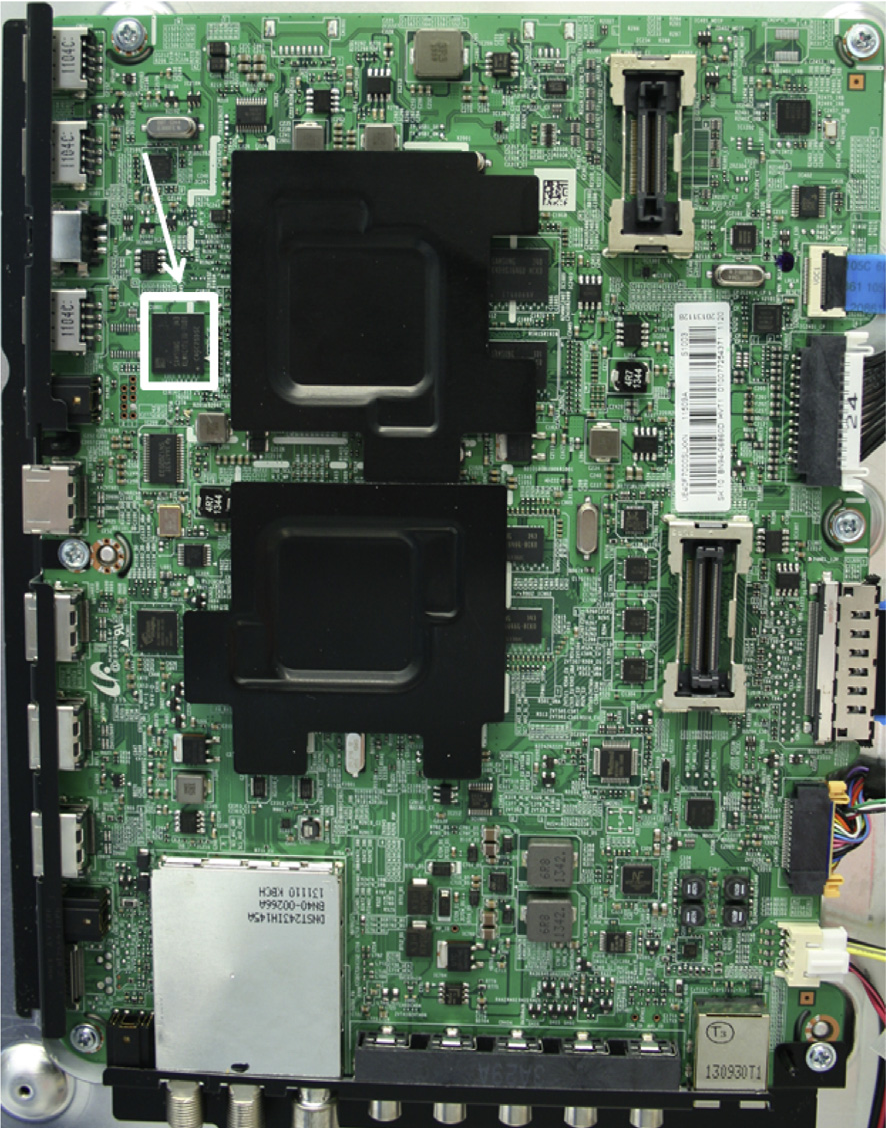 Above: The main board layout and the physical location of the target storage chip.
Decoding the "Smart" Traces
Extraction is only half the battle. The authors had to handle SquashFS (a compressed read-only file system) and eMMCfs (Samsung’s proprietary system). Once mounted, several "smoking guns" were discovered:
- The Spy in the GUI: The system maintains a directory (
p24/history/capture) containing low-resolution screenshots of the last used apps. An investigator can literally see what the user was doing. - Web & Cloud Leaks: Visited URLs and even Dropbox/OneDrive authentication traces were found in SQLite databases (
settings.db), although a system bug frequently resets timestamps to Jan 1st, 1970. - Device History: Even if a USB drive is removed, the TV logs its presence in
device0013.db.
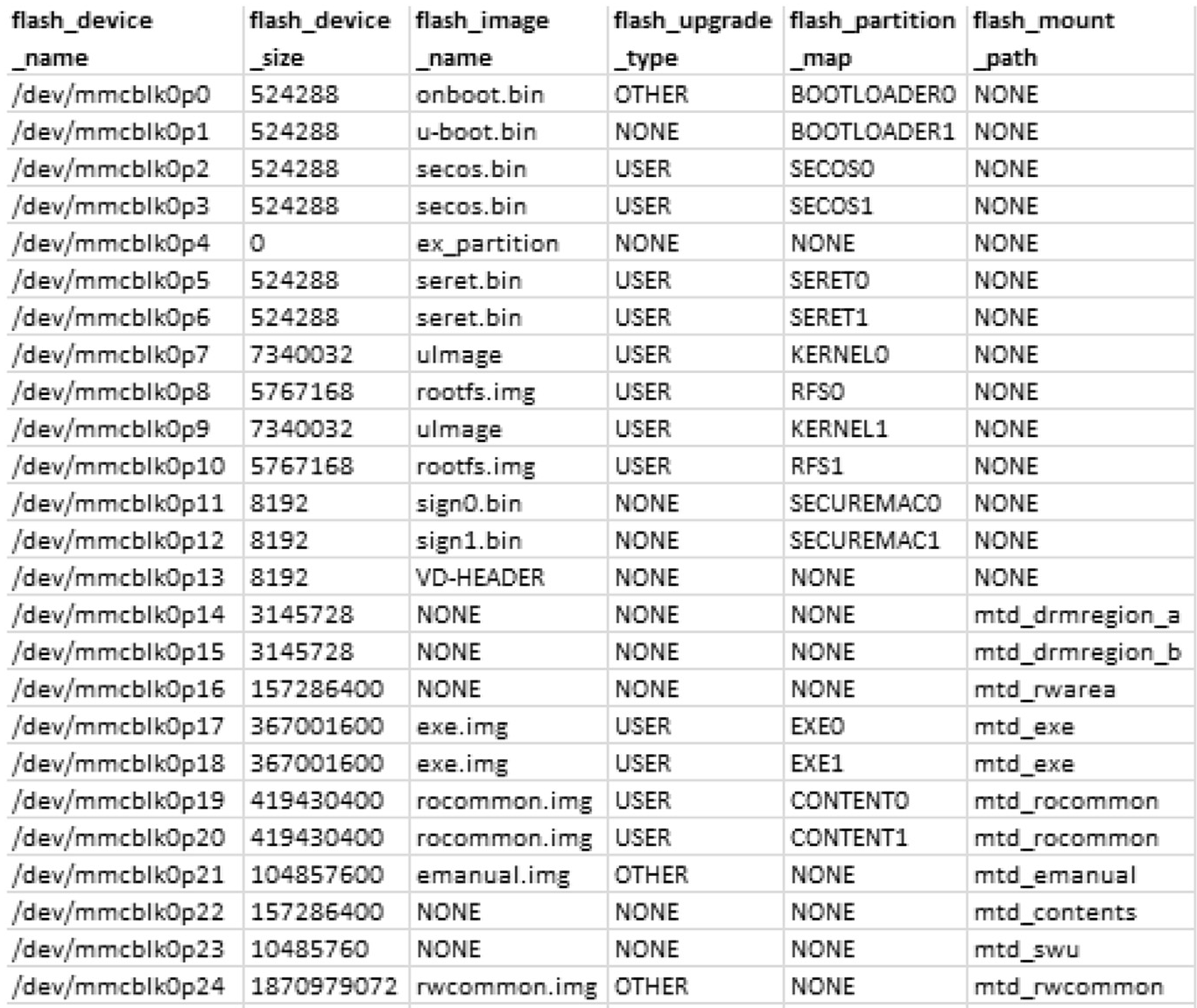 Table: The complex mapping of 24 partitions, showing redundancy designed for factory resets and firmware recovery.
Critical Analysis & Conclusion
Takeaway
The Smart TV is a high-value forensic target. The discovery of automatic app screenshots is a significant finding that provides immediate visual evidence of user activity, which is often more compelling in court than raw log files.
Limitations
- Destructive Nature: The chip-off method is highly specialized and effectively destroys the TV for consumer use, making it unsuitable for low-priority "triage" cases.
- Timestamp Reliability: The "1970" bug in the browser history limits the ability to reconstruct a precise timeline without cross-referencing other network logs.
Future Outlook
As TVs integrate more AI and voice assistants, future forensics will likely shift toward volatile memory (RAM) analysis to capture passwords and live communications before they are encrypted or deleted. This paper serves as the first major step in bringing the "big screen" into the digital forensics lab.