
Smart Urban Governance: Why Institutions Matter More Than Technology
Smart urban governance: an institutional and system perspective
The paper introduces a conceptual framework for Smart Urban Governance from an institutional and system perspective. It moves beyond technology-centric models by integrating the Institutional Analysis and Development (IAD) framework and Complex Adaptive Systems (CAS) theory to model the interplay between institutions, actors, and ICT-enabled processes.
TL;DR
To build a truly "smart" city, it is not enough to simply deploy sensors and high-speed internet. This paper argues for an Institutional and System Perspective, shifting focus from the technology itself to the rules, actors, and dynamic processes that govern urban life. By integrating the Institutional Analysis and Development (IAD) framework, the research provides a roadmap for understanding how ICTs can actually improve decision-making and citizen engagement.
Beyond the "Hard" Infrastructure: The Motivation
Most smart city discourse is dominated by "hard" infrastructure (roads, bridges, sensors) or telecommunication frameworks from industry giants like IBM or Cisco. However, urban environments are Complex Adaptive Systems (CAS).
The author, Yu-Che Chen, identifies a critical gap: existing models fail to account for the "rules-in-use"—the informal and formal guidelines that dictate how city officials, private companies, and citizens interact. Without understanding these institutional dynamics, even the most advanced technology will face resistance or fail to deliver public value.
Methodology: The Triad of Smart Governance
The paper proposes a framework where smartness is an emergent property of three interactive components:
- Institutions: These are the "rules of the game." Drawing from Elinor Ostrom’s work, the author categorizes rules into seven types—such as Boundary Rules (who gets to participate) and Information Rules (who knows what and when).
- Actors: Moving beyond just government agencies, this includes organizational actors (NGOs, private firms) and individuals (citizens). A key insight is the differentiation between Core and Peripheral actors.
- Processes: The actual actions and interactions (e.g., coalition building, service co-production) that lead to urban outcomes.
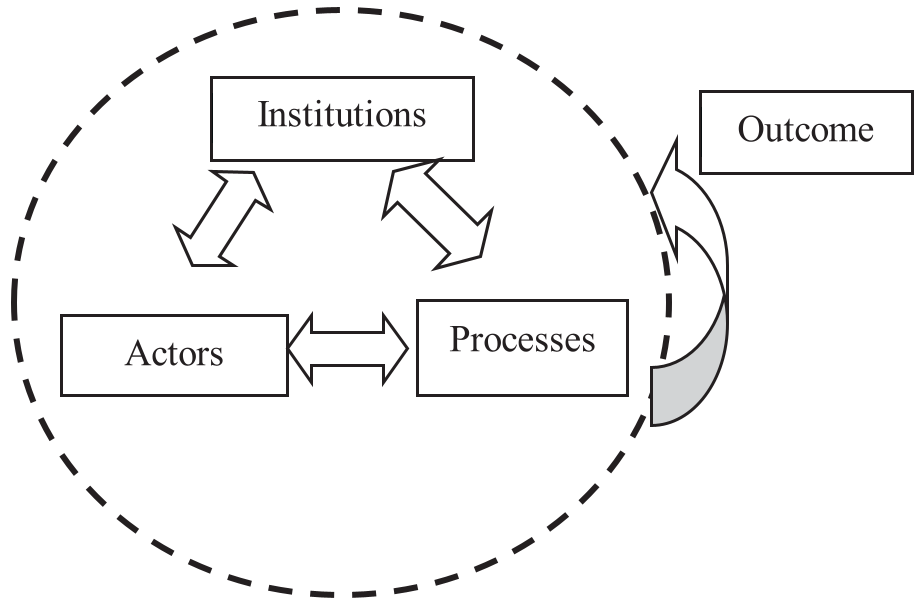 Figure 1: The dynamic feedback loop between Institutions, Actors, and Processes.
The Role of ICT Enactment
Technology is not a neutral tool; it is "enacted." The author suggests that ICTs act as a catalyst that:
- Reshapes Information Rules: Changes who has access to data, thereby shifting power dynamics.
- Activates New Actors: For example, remote water sensors in Dubuque, Iowa, turned ordinary residents into active managers of water sustainability.
- Reduces Interaction Costs: Social media and data visualization (like "Urban Observatories") allow for faster, lower-cost collaboration across sectors.
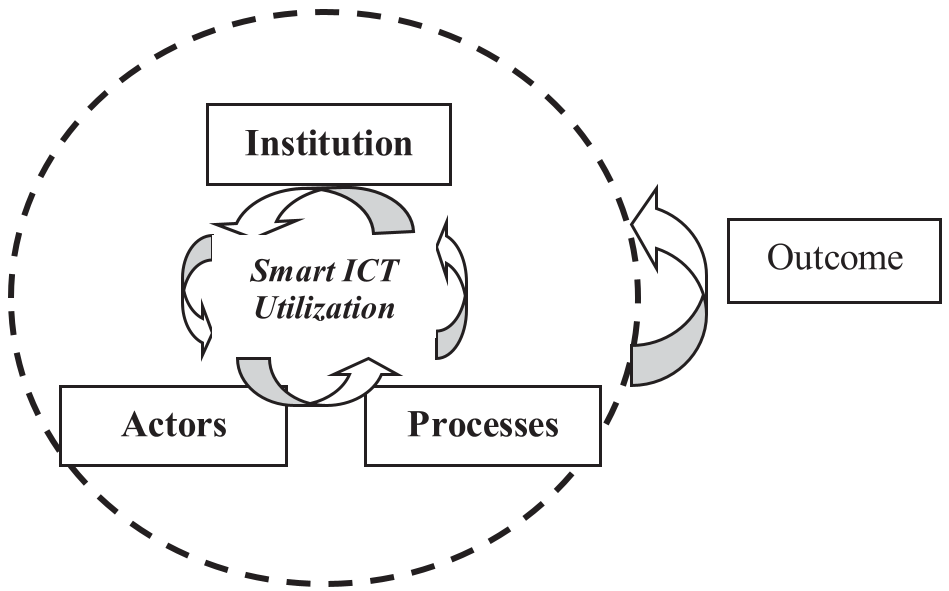 Figure 2: How ICTs interact with the core components of the governance system.
Analysis of Institutional Rules
The paper provides a rigorous breakdown of how specific rules govern a smart city. This level of granularity is rare in typical tech-heavy urban planning:
| Type of Rule | Application in Smart Governance |
|---|---|
| Information Rule | Determines which agencies get notified during an emergency. |
| Aggregation Rule | Dictates whether a water board uses consensus or majority vote for policy. |
| Payoff Rule | Defines the benefits (e.g., road funding) for participating in a regional council. |
Critical Insight & Conclusion
The core takeaway is that "Smartness" entails the strategic utilization of ICTs within a well-designed institutional framework.
The paper concludes that future research must move toward in-depth case studies of specific urban issues (like air pollution) to see how core and peripheral actors use technology to navigate institutional barriers. The limitation of the current work is its conceptual nature—it provides the "skeleton" of the model, but the "flesh" (quantitative validation) must come from empirical system dynamics modeling.
Final Thought: A city isn't smart because it has 5G; it's smart because its institutions use data to foster transparency, include citizens, and adapt to the complex challenges of the 21st century.