
Smartly Deploying WeChat Applications: Bridging Enterprise Logic with PaaS
Smartly Deploying WeChat Mobile Application on Cloud Foundry PaaS
The paper presents a framework for developing and deploying WeChat-integrated mobile applications using the Cloud Foundry PaaS and LoopBack mBaaS. It achieves a lightweight, scalable architectural model designed specifically for the Chinese mobile ecosystem, demonstrated through a real-world product maintenance system.
TL;DR
This research establishes a robust deployment pipeline for WeChat-based mobile applications by integrating Cloud Foundry PaaS and the LoopBack mBaaS framework. By decoupling the mobile front-end (hosted within WeChat) from the enterprise backend (managed via Cloud Foundry), the authors demonstrate a scalable "lightweight" approach to mobile service delivery, validated through a functional product maintenance system.
Problem & Motivation: The "Super App" Paradox
By the end of 2018, WeChat's reach in China's smart phone market surpassed 95%. For developers, this creates a paradox: the audience is massive, but building a custom backend that scales, handles media uploads, and maintains secure authentication with WeChat's proprietary protocols is technically cumbersome.
The authors identify two main pain points in traditional deployments:
- Infrastructure Rigidness: Deploying on traditional VMs leads to "vendor lock-in" and scaling difficulties.
- Integration Complexity: Manually bridging WeChat's XML-based message format with RESTful enterprise services is error-prone and slows down time-to-market.
Methodology: The PaaS + mBaaS Synergy
The core innovation lies in the architectural sandwich of Cloud Foundry and LoopBack.
1. The Architecture
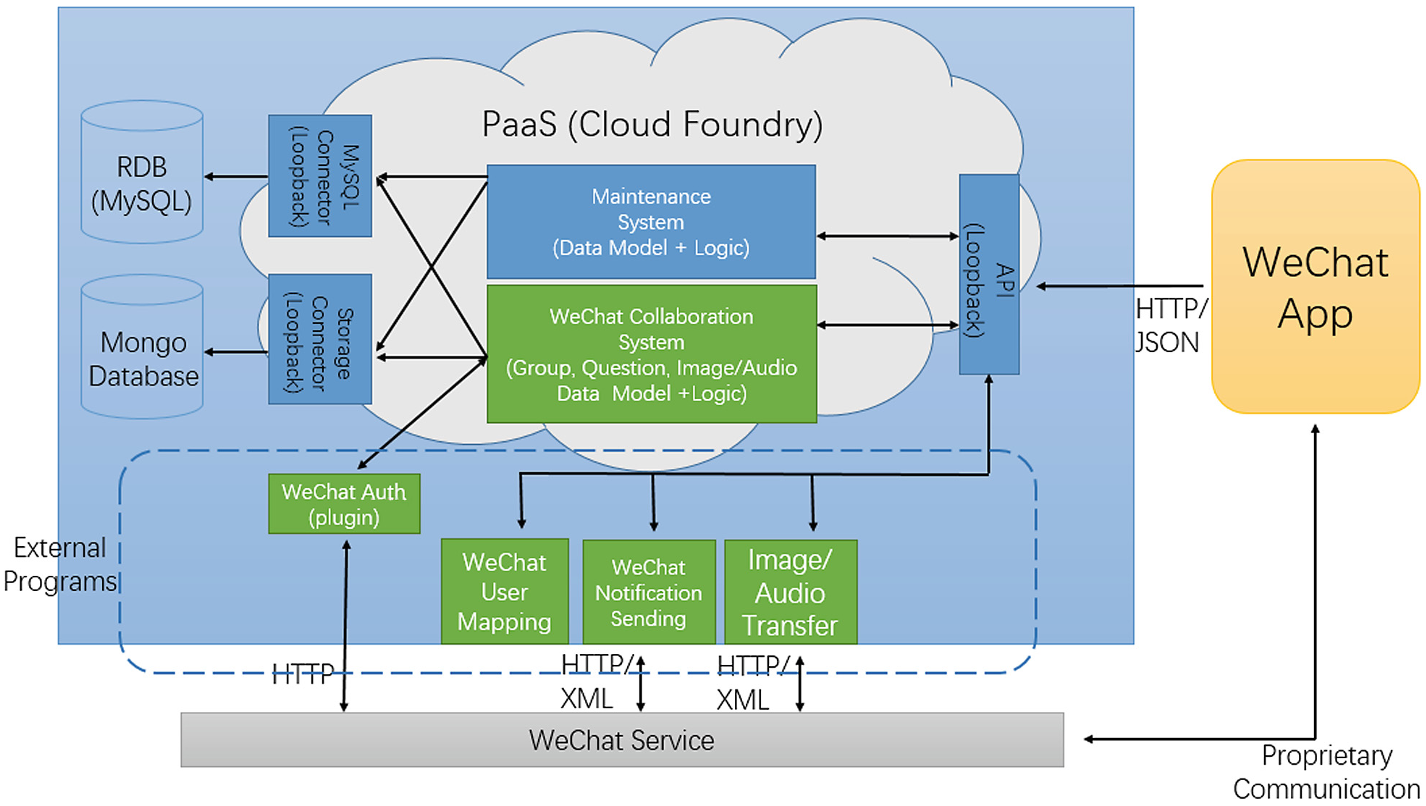
The system is divided into four critical components:
- WeChat Client: The "browser" where the WebApp resides.
- WeChat Server: The official Tencent gateway.
- WeChat Public Account Server: Deployed on Cloud Foundry to handle logic.
- LoopBack Server: Also on Cloud Foundry, acting as the API gateway to MySQL and enterprise data.
2. Intelligent Data Flow
The authors utilize LoopBack (a Node.js framework) to automatically generate REST APIs. This is a strategic choice; since WeChat interactions are event-driven and often involve high-concurrency "bursts" of messages, Node.js's non-blocking I/O is ideal.
3. Authentication & Account Mapping
One of the specific technical hurdles is mapping a WeChat OpenID (an anonymous identifier) to a real Enterprise Account. The paper describes a logic flow where:
- The URL of the application is called with the
openidas a parameter. - The application server queries the database.
- If no match is found, it triggers a "Binding" process, redirecting the user to a secure login page.
Implementation: The Product Maintenance System
The feasibility of this architecture was tested by creating a maintenance system where users can report product faults directly via a WeChat menu.
Key Technical Features:
- Media Handling: Utilizing the WeChat JS-SDK to capture audio/images, which are then proxied through the server and stored in the enterprise's private MySQL instance managed by Cloud Foundry.
- Message Lifecycle: The transition from a user's text message to a structured XML response, which is then parsed into a JSON REST call for the internal maintenance database.
Critical Analysis & Conclusion
Takeaways
The paper successfully demonstrates that PaaS (Cloud Foundry) isn't just for generic web apps—it is a powerful tool for localized "Super App" ecosystems. By abstracting the infrastructure layer, developers can focus on the specific business logic of WeChat integration (like signature verification and OpenID mapping).
Limitations & Future Work
While the architecture is sound for 2018-era WebApps, the rise of WeChat Mini-Programs (which use a proprietary DSL instead of standard HTML5) presents a new challenge. Additionally, the paper focuses largely on the deployment side; future research could delve into the auto-scaling performance of Cloud Foundry under extreme social media viral spikes.
Ultimately, this work proves that for modern mobile development, the "smart" approach is to stop building silos and start leverage existing PaaS clusters to bridge the gap between social networks and enterprise reliability.