
SmartNotes: Bridging the Gap Between Machine Intelligence and Human Nuance in Scam Detection
SmartNotes: Application of crowdsourcing to the detection of web threats
SmartNotes is a crowdsourcing-based browser extension designed to detect user-driven web threats like scams and deceptive sites. It integrates heterogeneous data from 11 sources with community feedback using L1-regularized logistic regression, achieving a high F1-score (up to 0.99) in identifying malicious domains.
TL;DR
Web security is no longer just about patching software bugs; it's about protecting users from their own actions. SmartNotes is a browser-integrated defense system that combines the wisdom of the crowd with machine learning to identify web scams. By aggregating signals from traffic rankings, domain age, and user-generated questions/answers, it calculates a "ScamScore" that provides a probabilistic safety net for web browsing.
Problem & Motivation: The Human Vulnerability
While modern browsers are excellent at blocking "drive-by downloads" and protocol exploits, they struggle with Social Engineering. Scammers use legitimate-looking templates, scientific references, and deceptive testimonials to trick users into giving up financial info.
The authors argue that existing defenses have three critical failures:
- Blacklists are too slow to react to new domains.
- Content Filters are defeated by scammers who rewrite text to avoid keywords.
- Automated Systems lack "common sense"—they can't tell if a business model seems "too good to be true."
Methodology: A Multi-Source Intelligence Approach
SmartNotes doesn't just look at the code of a website; it looks at its reputation and context. The architecture is split into a Chrome Extension, a SmartNotes Web Service (social data), and a Host Analyzer (the ML brain).
1. Data Heterogeneity
The system pulls 43 features from 11 different sources. These include:
- Longevity: Domain age from WHOIS records (new domains are riskier).
- Popularity: Traffic rankings from Alexa and Compete.
- Reputation: Community scores from Web of Trust (WOT) and McAfee SiteAdvisor.
- Geospatial: Server location coordinates.
2. The Crowdsourcing Loop
SmartNotes empowers users to act as sensors. Beyond simple voting, it includes a Question-Answering (QA) mechanism. If a novice user is unsure about a site, they can "ping" their socially-connected experts. This social layer provides high-quality labels for the ML model that automated scrapers might miss.
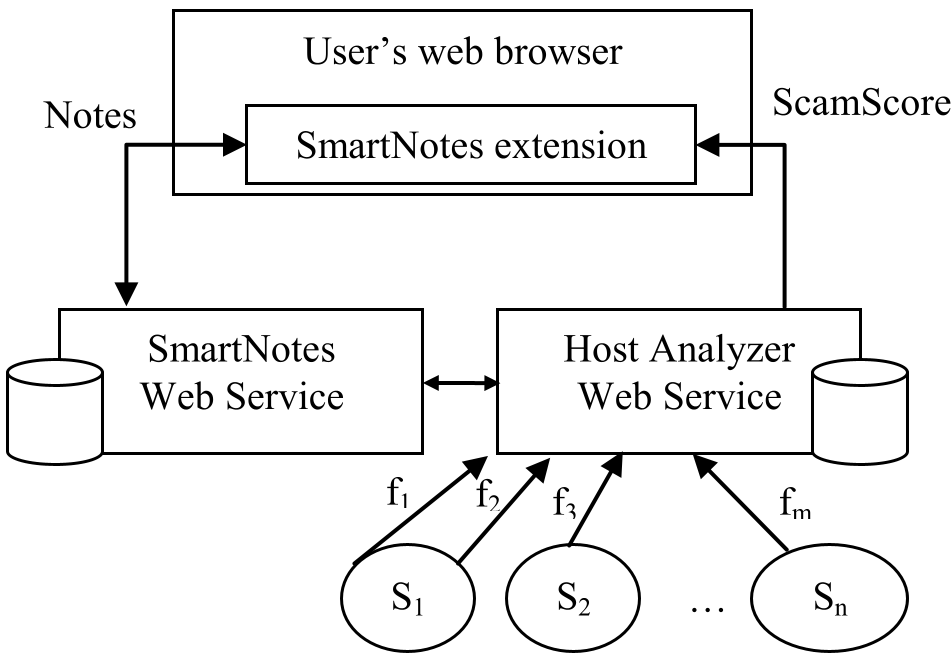 Figure 1: The SmartNotes architecture showing how the Host Analyzer integrates heterogeneous features with user notes.
Experiments & Results: Performance at Scale
To train the system, the authors built diverse datasets using search queries (e.g., "work at home" scams), spam email links, and existing blacklists. Using L1-regularized logistic regression, the system was able to perform feature selection automatically, identifying which of the 43 signals were most predictive of a scam.
| Dataset Name | Precision | Recall | F1-Score | AUC |
|---|---|---|---|---|
| Combined Data | 0.9795 | 0.9813 | 0.9803 | 0.9858 |
| Web of Trust | 0.9923 | 0.9923 | 0.9923 | 0.9990 |
The results (summarized in Table 2 below) show that the system is incredibly accurate, particularly when given community-labeled data. Even on raw spam email links, it maintained perfect precision (1.0000).
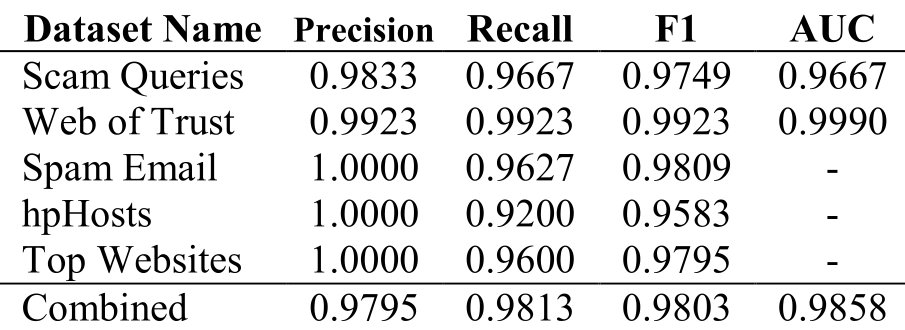 Figure 2: Experimental results across different threat types.
Critical Analysis & Conclusion
SmartNotes proves that the Security + Social model is viable. Its strength lies in its Inductive Bias: the assumption that scam websites leave "traces" in metadata (low traffic, short domain life, poor community scores) even if their front-end text looks perfect.
Takeaways:
- Expert Engagement: The QA feature solves the "expert fatigue" problem by allowing social connections to drive security inquiries.
- ML Transparency: Using ScamScore as a probability helps users make informed decisions rather than just providing a "block/allow" binary.
Limitations: The system's reliance on third-party APIs (like Alexa or Google Finance) makes it vulnerable if those services change or limit access. Furthermore, while the ML processes metadata, the "free-text" comments from users are not yet fully processed via Natural Language Processing (NLP) in this version—a key area for future improvement.
Ultimately, SmartNotes turns web browsing from a solitary, risky activity into a collaborative, defended experience.