
Deciphering Emotion through Gait: Can Your Smartphone Sense Your Mood?
Smartphone accelerometer data used for detecting human emotions
This paper introduces a non-intrusive method for detecting human emotions by analyzing smartphone accelerometer data during natural walking. Using the Circumplex Model of Affect, the authors classify emotions into two dimensions—Pleasantness and Arousal—achieving a promising 75.0% accuracy for arousal detection using an SVM classifier.
TL;DR
Researchers from the University of Oslo have demonstrated that the way you walk—as captured by the accelerometer in your pocket—can reveal your emotional state. While "arousal" (how energetic you feel) can be detected with a solid 75% accuracy, "pleasantness" (how happy you are) remains a significantly tougher nut to crack using motion data alone.
Background: The Invisible Signal in Your Pocket
Smartphones are no longer just communication tools; they are sophisticated sensor hubs. While previous research has attempted to detect mood through phone usage patterns or facial recognition, these methods are often intrusive or require weeks of data. This paper shifts the focus to Affective Computing in the wild, asking a simple question: Does our gait change when we are angry, happy, or sad?
The study utilizes the Circumplex Model of Affect, which maps emotions onto a 2D coordinate system:
- Arousal: The level of activation (e.g., Excited vs. Bored).
- Pleasantness: The valence (e.g., Happy vs. Sad).
The Methodology: From Raw Steps to Feature Vectors
To capture data without the "Observer Effect" of a laboratory, the authors built a custom Android app titled Emotions. The app was designed with a sophisticated trigger logic to ensure high-quality data:
- Motion Detection: It only records when 10 seconds of continuous movement is detected.
- Ecological Validity: It waits 2 minutes after movement starts to ensure the user is walking naturally, not just picking up the phone.
- Feature Engineering: 20-second windows were processed to extract features like Mean Jerk, Step Duration, and Power Spectral Density.
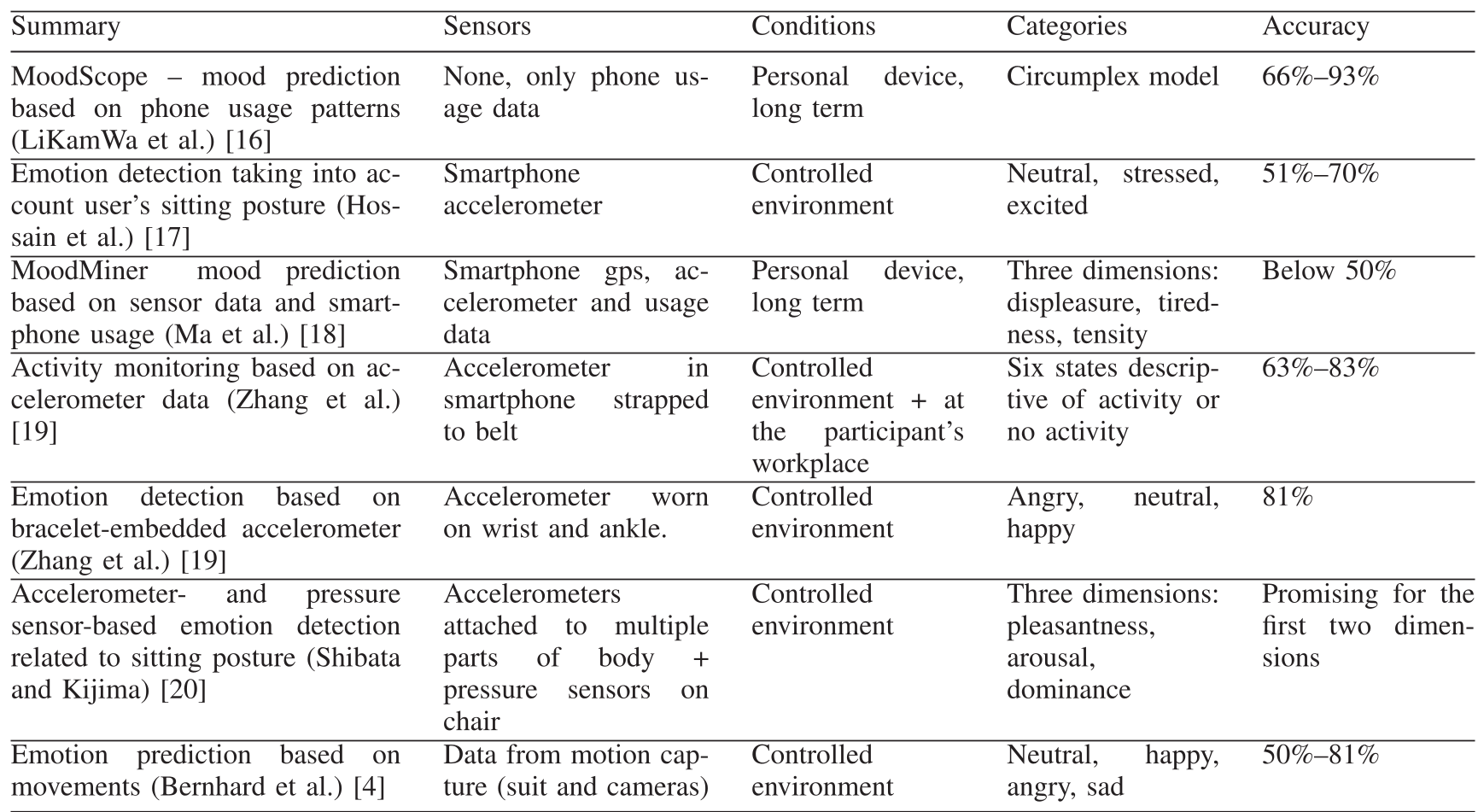 Table: Comparison of this approach versus prior controlled studies.
Analysis: Why "Energy" is Easier Than "Emotion"
The experiments compared three classic ML architectures: Decision Trees (DT), Support Vector Machines (SVM), and Multi-Layer Perceptrons (MLP).
The results revealed a fascinating technical divide. Arousal is highly correlated with the "energy" of movement—factors like mean acceleration and jerk. Consequently, the SVM was able to classify high vs. low arousal with 75% accuracy.
In contrast, Pleasantness had a dismal performance (51%). As shown in the scatter plots below, the data for pleasantness is highly overlapping, indicating that whether we are walking "happily" or "unhappily," the gait energy remains statistically similar.
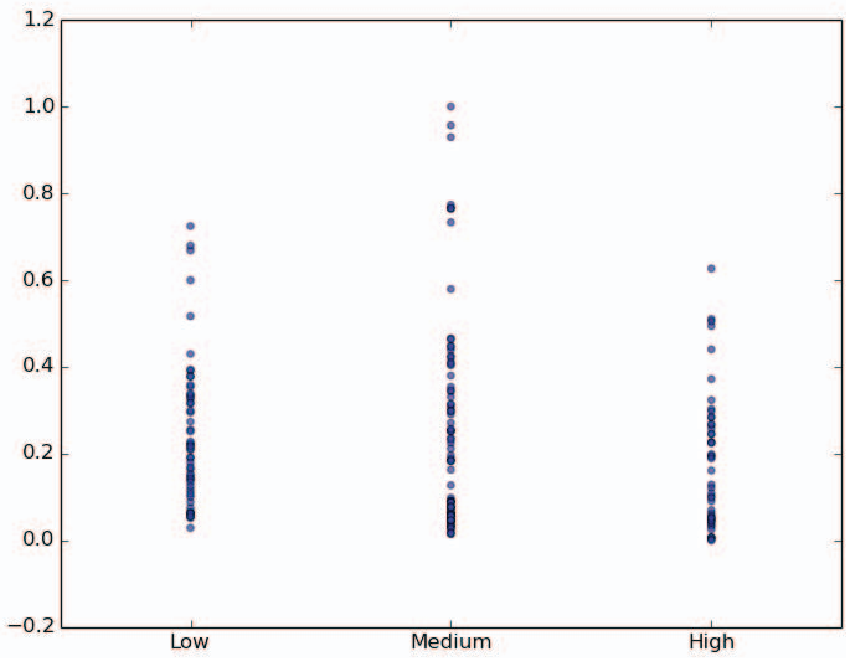 (a) Pleasantness shows high overlap in acceleration mean, explaining the low accuracy.
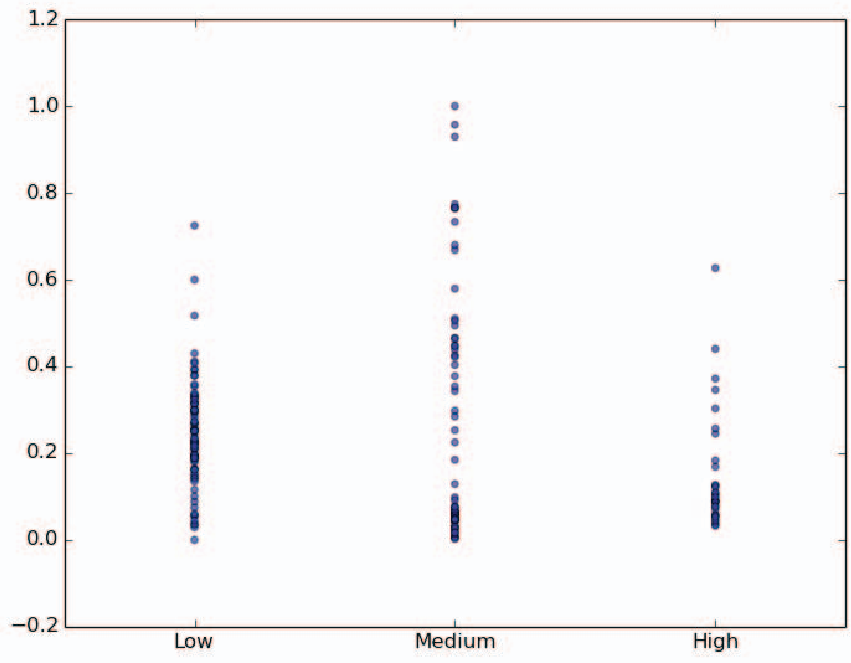 (b) Arousal shows a clearer (though still complex) relationship with movement energy.
Final Results & SOTA Comparison
The research underscores that for emotional AI to be practical, it must handle the "Personalization Gap." When the models were trained specifically on the top 3 most frequent users, accuracy improved across the board.
| Model | Pleasantness (Accuracy) | Arousal (Accuracy) |
|---|---|---|
| Decision Tree | 46.5% | 67.5% |
| SVM | 49.6% | 75.0% |
| MLP (Neural Net) | 50.9% | 72.3% |
Critical Insight: The Future of Passive Sentiment
The takeaway for the industry is clear: Accelerometers are great "Activation" sensors but poor "Valence" sensors.
To build a truly empathetic AI—one that knows you're not just moving fast, but moving fast because you're angry rather than excited—we need to fuse this motion data with other signals. This study provides the foundational proof that even "noisy" pocket-based sensors can capture the Arousal dimension of human psychology with high reliability.
Limitations
- Sample Size: The study relied on a small pool of active users (10 participants).
- Single Modality: Relying only on the accelerometer limits the ability to distinguish between "Angry" and "Excited" (both high arousal).
Future Outlook
The next frontier will likely involve Deep Temporal Models (like Transformers or LSTMs) that look at the sequence of steps rather than just statistical aggregates (mean/std dev), potentially unlocking the subtle gait nuances associated with happiness and sadness.