
Hierarchical Crowdsourcing: Solving the Weed Identification Bottleneck with Smart-Aided Human Logic
Smartphone-based hierarchical crowdsourcing for weed identification
The paper presents a hierarchical crowdsourcing system for agricultural weed identification using smartphones. It combines automated image processing with a dual-layer human network—low-cost Amazon Mechanical Turk (AMT) workers and subject-matter experts—to achieve high-accuracy identification with actionable latency.
TL;DR
Agriculture faces a dual threat: increasing weed infestations and shrinking budgets for extension services. Researchers have developed a smartphone-based system that uses a "hierarchy of intelligence"—combining automated image analysis, a crowd of non-experts (AMT), and specialized experts. By using a probabilistic engine to decide when to "escalate" a problem, the system identifies 80% of weeds within 3 hours at a fraction of the cost of traditional methods.
Background: Why AI Alone Isn't Enough for Farmers
In the laboratory, identifying a plant species seems like a solved computer vision problem. In a real cornfield, it is a nightmare. Lighting changes every hour, cameras on low-end smartphones have varying sensors, and a weed at "seedling" stage looks nothing like its "mature" version.
The authors argue that while Computer Vision (CV) can narrow down the possibilities, it lacks the cognitive robustness of a human. However, human experts (Extension Agents) are a scarce and expensive resource. The solution? A filter that uses "cheap" human brains first.
Methodology: The Hierarchical Filter
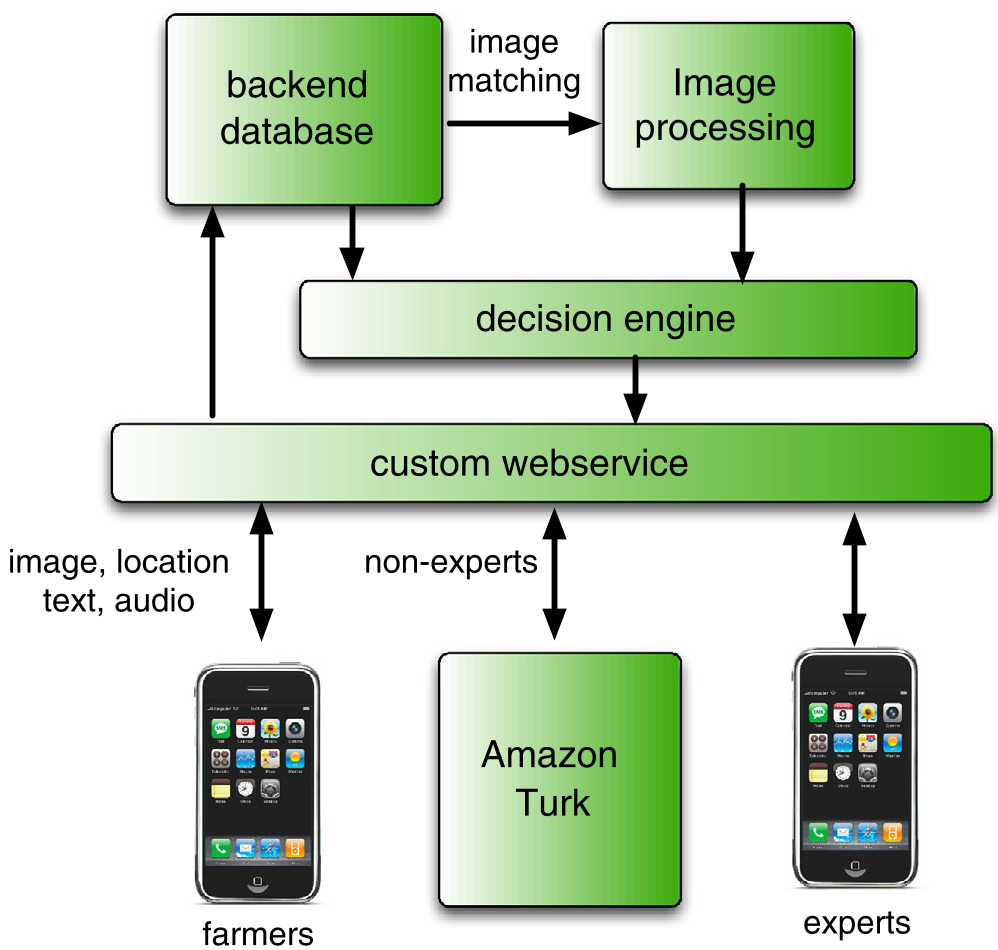
The system architecture follows a three-step flow to ensure accuracy without overloading professionals.
1. The Machine Layer (Feature Fusion)
When a farmer uploads a geo-tagged image, the backend doesn't try to find the "one true match." Instead, it uses Multi-feature Fusion—combining SIFT (shape), Color Edge (CEDD), and Texture Histograms—to suggest the Top 5 candidates.
2. The Non-Expert Crowd (AMT)
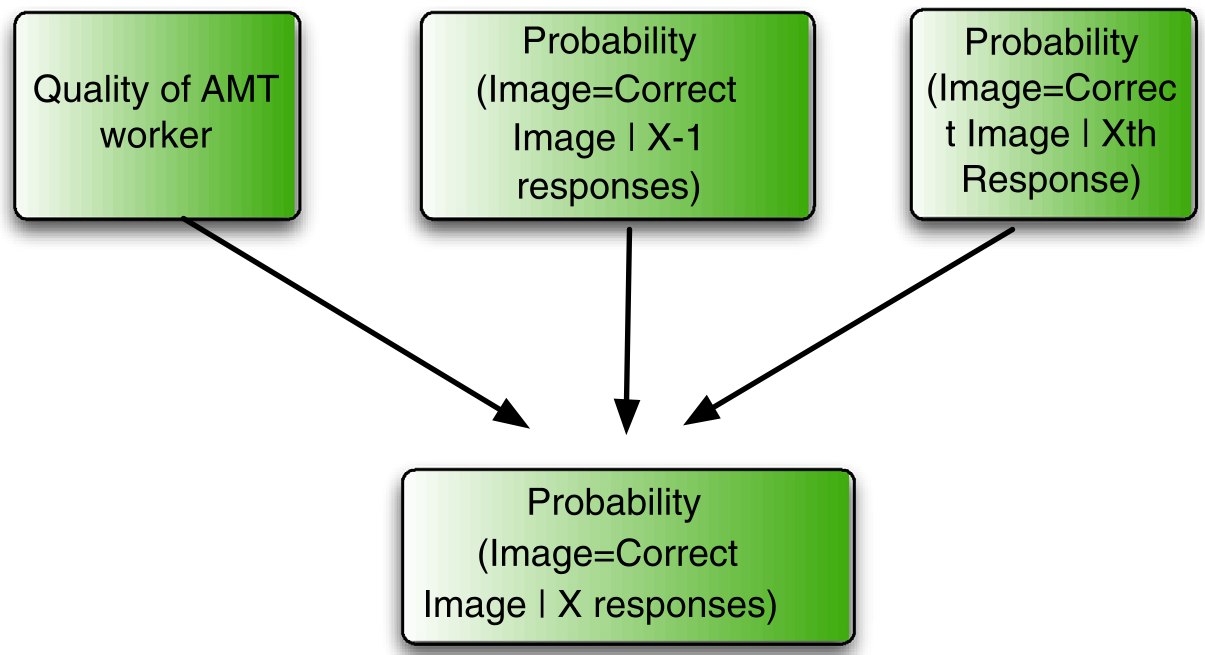
The system automatically creates a "Human Intelligence Task" (HIT) on Amazon Mechanical Turk. Five images are shown to turkers, who rank them. Crucially, the system doesn't trust every turker equally. It uses a Probabilistic Decision Engine to weigh answers based on the worker's historical performance ().
3. The Expert Escalation
If the probability of the top image being correct does not cross a 0.8 threshold (or if the farmer's time is running out), the system triggers a push notification to extension agents. This ensures experts only spend time on the truly ambiguous or "new" weed species.
Experiments & Results: Efficiency at Scale
Accuracy vs. Human Input
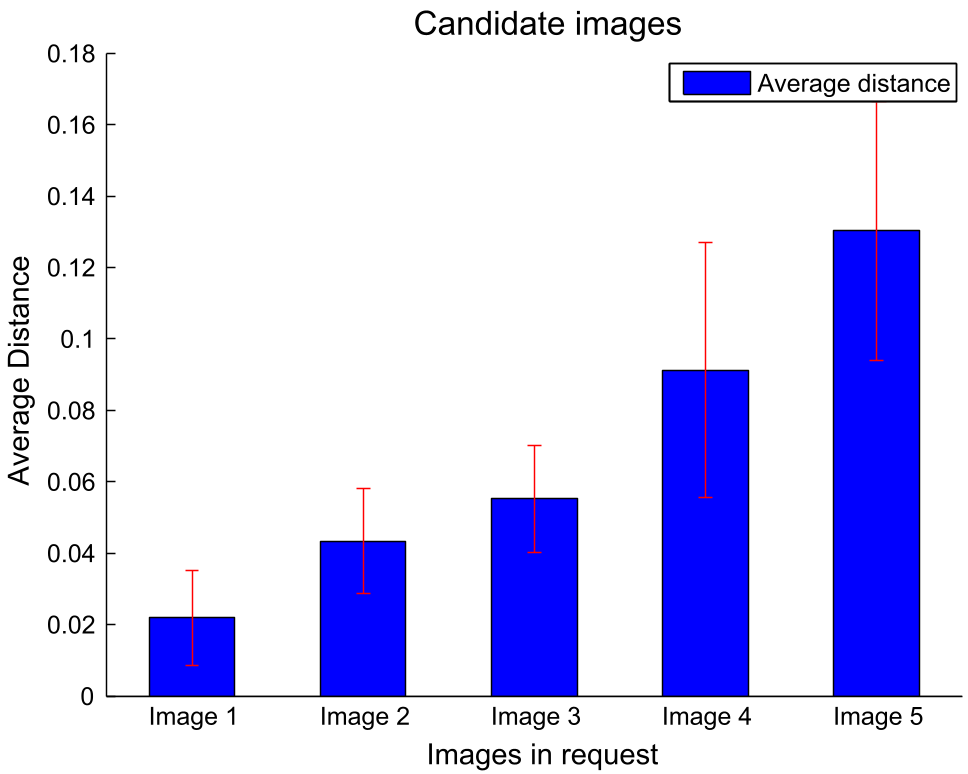
The study found that image processing alone is insufficient, as the "distance" between candidate images is often too small for a definitive machine choice. However, as more turkers weigh in, the probability stabilizes.
The researchers proved that the AMT crowd can handle the "heavy lifting":
- 80% Success Rate: 4 out of 5 identification tasks were solved by the non-expert crowd.
- Latency: Most identifications were completed within 3 hours, significantly faster than waiting for a scheduled field visit from an agent.
The Cost of Speed
The authors also explored a vital trade-off: Money vs. Time. They compared 1-cent tasks to 5-cent tasks. While the quality of the answer remained the same, the 5-cent tasks were picked up by workers 3x faster. This allows the system to prioritize urgent "outbreak" alerts by simply increasing the bounty.
Critical Insights & The Path Forward
The brilliance of this paper lies in its Inductive Bias toward human-machine collaboration rather than pure automation. By acknowledging that "AI is hard but human experts are few," it creates a pragmatic middle ground.
Limitations:
- Image Quality: The study used artificial Gaussian noise; real-world motion blur or lens flare might challenge the feature extraction further.
- Expert Costing: The paper assumes expert time is "free" for the system, but in reality, their cognitive load needs a more formal economic model.
Takeaway: As we move deeper into the era of LLMs and advanced CV, the Smartphone-based Hierarchical Crowdsourcing model remains a gold standard for specialized domains where the cost of error is high. It teaches us that the best "AI" might sometimes just be an algorithm that knows when to ask a human for help.