
Smart Lockdown: Leveraging Smartphone Sensors and Machine Learning to Balance Health and Economy
A Smartphone Enabled Approach to Manage COVID-19 Lockdown and Economic Crisis
The paper introduces a smartphone-based digital contact-tracing and lockdown management system designed to mitigate COVID-19 transmission. It utilizes GPS for outdoor tracking, Bluetooth for indoor proximity sensing, and a K-Means clustering algorithm to predict neighborhood-level lockdown requirements.
TL;DR
The global response to COVID-19 was defined by a binary choice: total lockdown or economic collapse. This paper proposes a third way—a smartphone-enabled framework that automates contact-tracing via GPS and Bluetooth and employs K-Means clustering to predict "smart lockdowns" at the neighborhood level. By analyzing real-time proximity data, the system allows authorities to lift mass quarantines in low-risk zones while maintaining strict control over viral hotspots.
The Problem: The Inefficiency of Manual Intervention
Traditional contact-tracing relies on human memory and manual interviews, which struggle with "incidental contacts" (e.g., a stranger in a mall). Academically, this is a problem of latency and coverage. If tracing takes days, the reproduction number () remains high. Furthermore, blanket lockdowns are an "economically blunt" instrument that fails to account for spatial variations in infection rates.
Methodology: Sensor Fusion and Unsupervised Learning
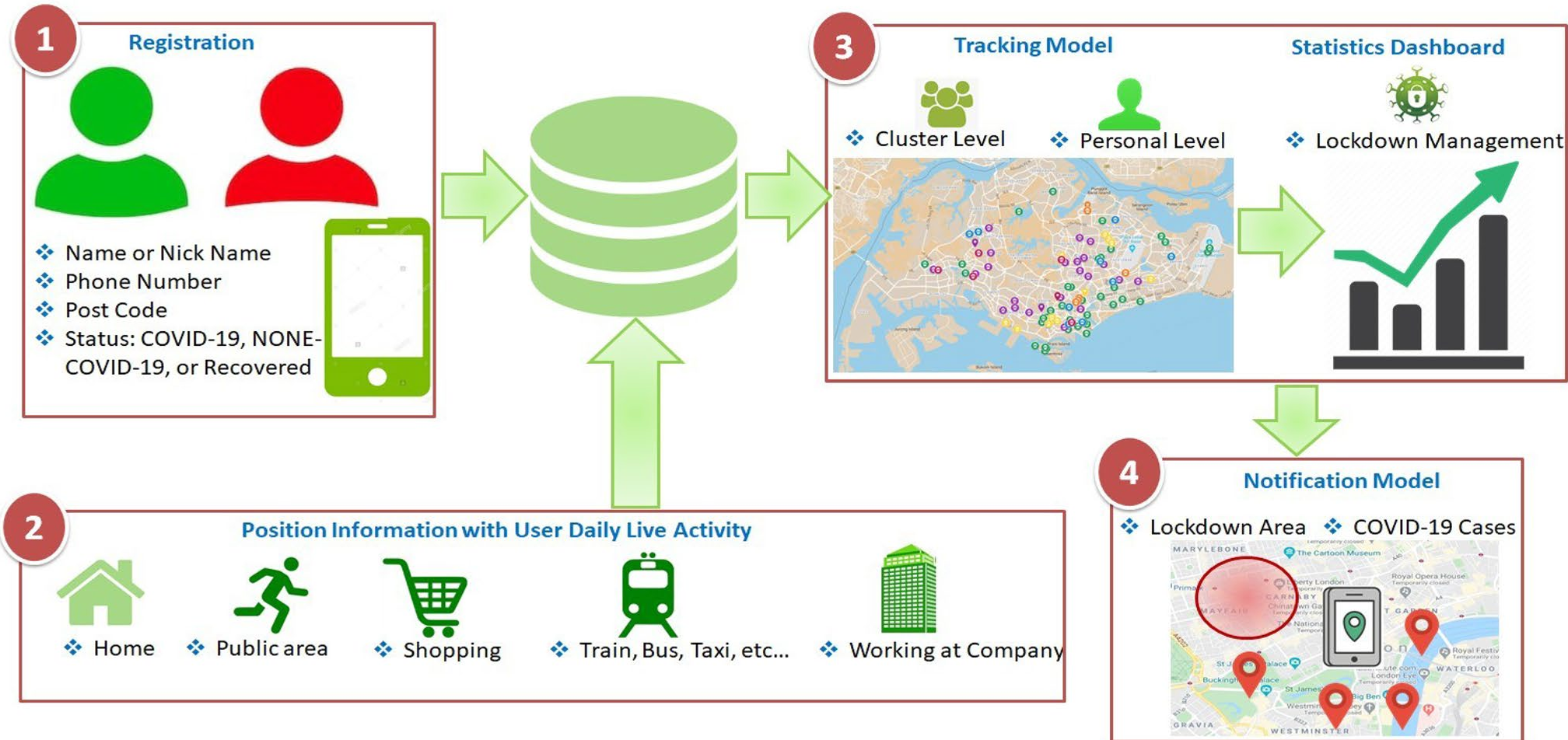
The proposed framework operates on a client-server architecture:
- Dual-Environment Sensing:
- Outdoor: Uses GNSS (Global Navigation Satellite System) to track coordinates.
- Indoor: Employs Bluetooth Low Energy (BLE) to scan for MAC addresses in the vicinity, bypassing the need for satellite signals in shielded buildings.
- K-Means for Smart Management:
The server processes geographic trajectories through a K-Means clustering algorithm. Instead of just identifying individuals, it identifies clusters of high-density interactions.
- The DASV seeding method is used to optimize centroid selection.
- The system calculates Approaching Events Occurrence (AEO)—a metric of how many times users came within 5 meters of one another.
Experimental Validation
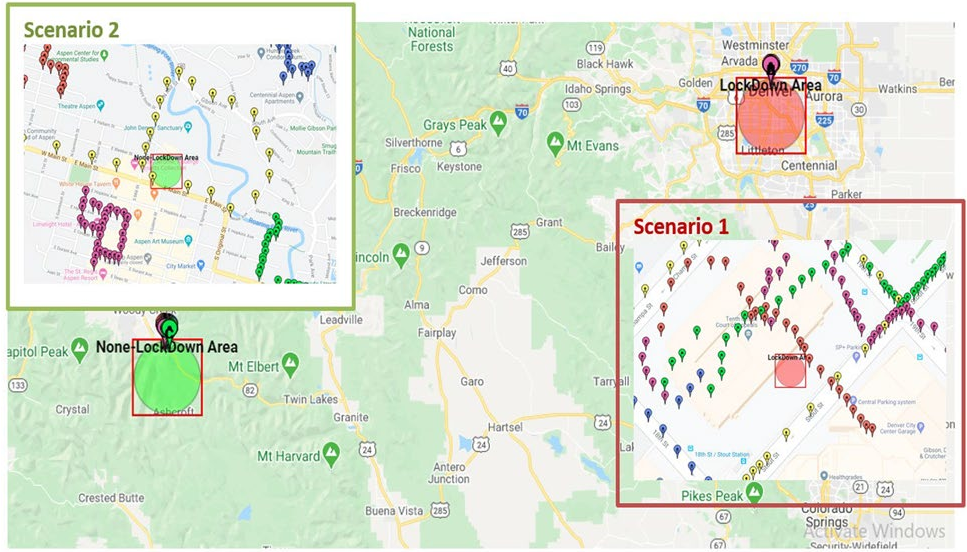
To test the "smart lockdown" logic, the authors simulated scenarios in Denver and Aspen, USA. Five users walked for 60 seconds, sending location updates every second.
- Scenario A (Denver): High density/frequent proximity. The AEO reached 55, far exceeding the threshold of 10. The system correctly flagged the area for lockdown.
- Scenario B (Aspen): Users maintained distance. The AEO stayed below 10, indicating the area could safely remain open.
Critical Analysis: Privacy vs. Utility
While the technical efficacy is clear, the authors acknowledge a significant inductive bias: the system currently requires centralized storage of location data, which poses privacy risks. In the academic coordinate system, this work sits between early "brute-force" tracking apps and more modern decentralized privacy-preserving protocols.
Key Takeaways for Future Research
- Scalability: While K-Means is efficient (), applying it to mega-cities like London or New York would require more robust distributed computing.
- Algorithmic Evolution: Moving from K-Means to Deep Learning (e.g., RNNs for trajectory prediction) could allow for proactive rather than reactive lockdown measures.
Conclusion
This smartphone-based approach transforms the smartphone from a communication tool into a "biosensor" for urban management. It demonstrates that with the right combination of ML and ubiquitous hardware, we can navigate global health crises without halting the gears of the global economy.