
Smartphone Fingerprinting: Linking Anonymous Profiles via Camera Hardware Imperfections
Smartphone Verification and User Profiles Linking Across Social Networks by Camera Fingerprinting
The paper introduces a method for smartphone camera fingerprinting using Photo-Response Non-Uniformity (PRNU) and the BM3D denoising algorithm. It achieves state-of-the-art performance in smartphone verification (96.48% sensitivity) and cross-platform user profile linking (99.49% sensitivity) across Facebook, Google+, and WhatsApp.
TL;DR
Researchers from the University of Bologna have developed a forensic method that can identify the specific smartphone used to take a photo, even after it has been compressed and resized by apps like Facebook or WhatsApp. By extracting a unique "hardware fingerprint" from the camera sensor's noise, they can link separate (and potentially fake) social media accounts to the same physical device with over 99% accuracy.
Background: The Invisible Signature of Hardware
In the world of online forensics, metadata (like GPS or timestamps) is easily forged or stripped. However, the physical hardware of a smartphone camera contains flaws that are impossible to hide. During manufacturing, no two CMOS sensors are perfectly identical. These "imperfections" create Photo-Response Non-Uniformity (PRNU)—a deterministic pattern noise that is baked into every pixel of every photo you take.
Think of it as a "digital ballistic signature." Just as a gun leaves unique grooves on a bullet, a smartphone sensor leaves a unique noise pattern on a JPEG.
Methodology: Extracting the Noise from the Signal
The challenge is that this noise is extremely subtle and often masked by the actual image content and the random "shot noise" (graininess caused by low light).
The authors proposed a two-step forensic pipeline:
- Pattern Noise Extraction: Using the BM3D (Block Matching 3D) denoising algorithm, they separate the image signal from the residual noise. By averaging the residuals of multiple images (around 100), they filter out random noise, leaving behind the permanent, unique hardware fingerprint ().
- Cross-Platform Correlation: They convert images to the YCbCr color space and focus on the Y (Luminance) channel, which carries the most high-frequency noise information. They then use normalized correlation to match the noise from an "unknown" social media image against a known device's fingerprint.
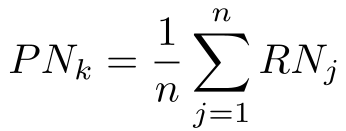 The mathematical representation of Pattern Noise () as an average of noise residuals ().
Defeating Social Media Compression
The most impressive part of this work is its resilience. Platforms like WhatsApp aggressively downscale and compress images to save data, which usually destroys fine details.
The authors tested their method against three different "real-world" scenarios:
- Original-by-Original: 100% Sensitivity.
- Social-by-Social: Verifying a device using only images from the same platform (e.g., matching a Facebook photo to a Facebook-derived fingerprint).
- Cross-Social (The "Holy Grail"): Matching a low-quality WhatsApp photo to a high-quality fingerprint derived from Google+ or the original device.
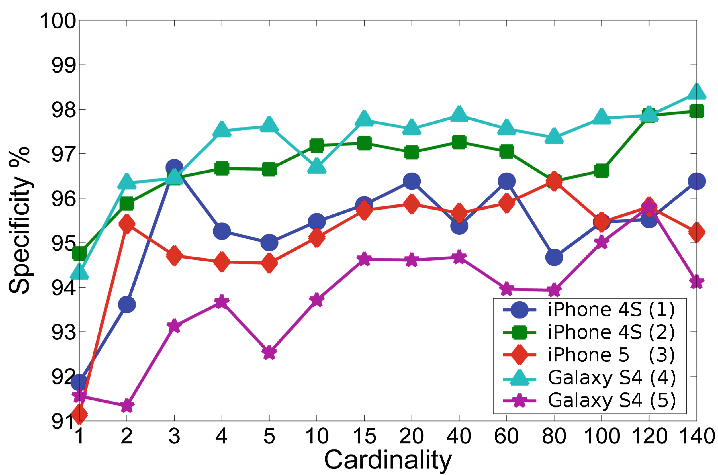 Figure: Comparison of Sensitivity (ability to match correctly) and Specificity (ability to reject incorrect matches) across different Social Networks.
Key Findings & Results
- Google+ images, being the least compressed, yielded the best forensic results (97.56% specificity).
- WhatsApp was the toughest challenge due to high compression, yet the system still achieved over 92% sensitivity.
- Profile Linking: The method proved it is possible to verify if two profiles on different networks belong to the same person by simply analyzing their posted photos—achieving an average success rate of 99.49%.
Critical Insight: Why This Matters
This research shifts the power dynamic in online investigations. It proves that even if a malicious user uses different nicknames, hides their IP, and strips their metadata, their hardware sensor remains a snitch.
However, there are limitations. As sensors get smaller and software processing (computational photography) gets more aggressive, the "raw" hardware noise may become harder to isolate. Additionally, the authors note that identifying a specific device among millions (rather than the five used in the study) remains a scaling challenge for future work.
Conclusion
This work provides a robust framework for Online Forensics. By moving beyond software-based identity (which is plastic) to hardware-based identity (which is fixed), we gain a powerful tool to bridge the gap between anonymous digital personas and physical reality.
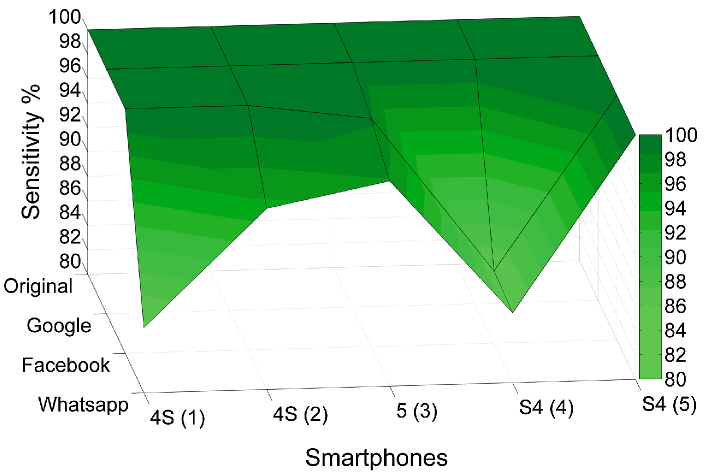 Visual summary of cross-social results, showing high reliability across Facebook (f), Google+ (g+), and WhatsApp (o).