
Smartphones Get Emotional: Real-Time Neural Source Reconstruction in Your Pocket
Smartphones Get Emotional: Mind Reading Images and Reconstructing the Neural Sources
The paper presents a mobile brain-imaging system that combines a consumer-grade wireless EEG headset with a smartphone to detect and visualize emotional responses in real-time. By utilizing Bayesian source reconstruction (Minimum Norm method), the system successfully differentiates between pleasant, unpleasant, and neutral emotional states based on ERP components like EPN and LPP.
Executive Summary
TL;DR: Researchers from DTU Informatics have developed a mobile system that can "read" your emotional state by processing EEG signals directly through a smartphone. By combining a wireless headset with sophisticated Bayesian source reconstruction, the system identifies the neural signatures of pleasant and unpleasant feelings with Lab-level precision, all while visualizing the 3D brain activity in real-time.
Positioning: This work is a seminal bridge between Affective Computing and Mobile Neuroimaging, moving EEG analysis out of controlled labs and into randomized, real-world environments.
Problem & Motivation: The Stationary Lab Constraint
Historically, understanding how the human brain processes emotion required being tethered to a wall. High-density EEG caps (with 128+ electrodes) and "silent rooms" were mandatory to filter out the noise of the real world.
The authors argue that to truly understand embodied cognition, we must observe the brain where life happens. However, this poses two massive technical hurdles:
- Signal Sparsity: Consumer headsets (like the Emotiv used here) have very few electrodes (14 vs 129).
- Processing Power: Reconstructing the "source" of a signal (the inverse problem) is computationally expensive and mathematically "ill-posed"—there are infinite possible brain activity patterns that could produce the same scalp reading.
Methodology: Bayesian Inference Meets Mobile Processing
The core innovation lies in the Client-Server Architecture and the Source Reconstruction algorithm.
1. Neural Source Reconstruction (The "Why" and "How")
Instead of just looking at raw squiggly lines (scalp potentials), the authors used a Bayesian Minimum Norm (MN) approach.
- The Intuition: Imagine hearing a sound through a wall. You don't just want to know how loud it is; you want to know where in the room the person is standing. MN estimation uses a prior (Gaussian distribution) to find the most likely configuration of 3D brain activity that fits the observed 14-channel data.
2. The Hardware Pipeline
The system uses a Nokia N900 running in USB host mode to decrypt raw binary EEG data. Heavy computations happen server-side, with the 3D results (1028 vertices) pushed back to the phone for a 30fps fluid visualization.
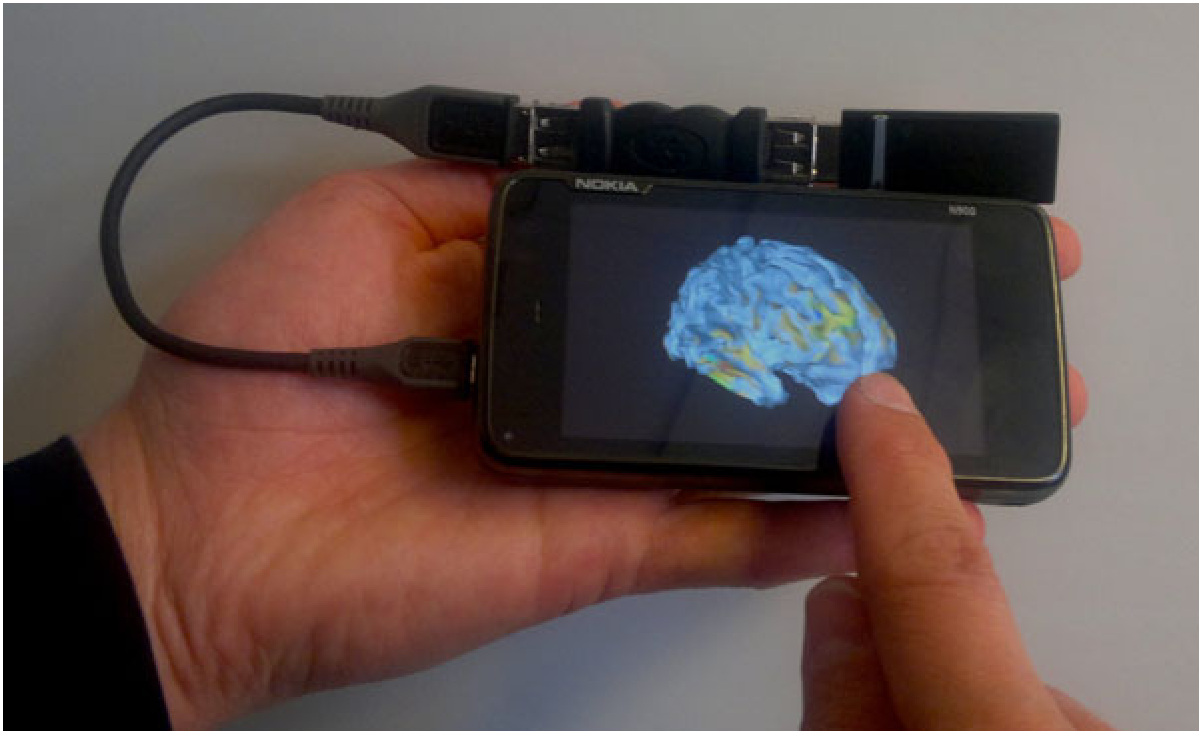 Figure 1: The mobile setup utilizing the Emotiv headset and a smartphone for stimulus presentation.
Experiments & Results: Replicating the Lab on a Phone
The study used the International Affective Picture System (IAPS)—a standardized set of images designed to trigger specific emotional responses (e.g., erotic couples for pleasure, mutilated bodies for unpleasantness).
Key Findings:
- ERP Components: The system successfully captured the Early Posterior Negativity (EPN) around 150ms and the Late Positive Potential (LPP) around 450ms.
- Hemispheric Lateralization: Pleasant content showed enhanced activation in the left hemisphere, while unpleasant images moved toward the right—aligning perfectly with clinical literature.
- Alpha Oscillations: The team found a frequency-based "emotional bias." Unpleasant images increased 11-13 Hz (high alpha), while pleasant images triggered 8-11 Hz (low alpha).
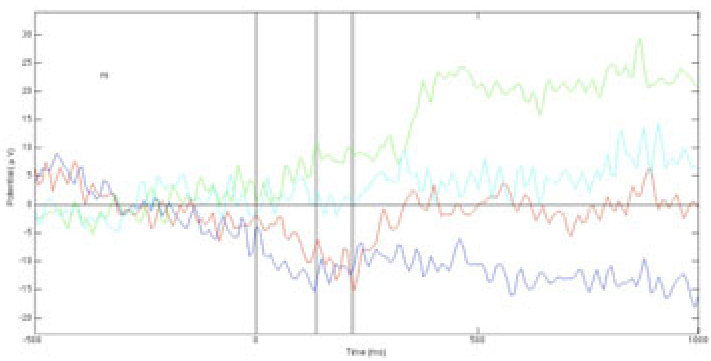 Figure 2: ERP amplitudes showing distinct statistical separation (p < 0.05) between arousing, unpleasant, and neutral imagery.
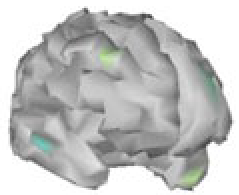 Figure 3: Reconstructed 3D brain activity at the EPN window (150ms). Note the increased activity for pleasant pictures (rightmost) compared to neutral.
Critical Analysis & Conclusion
The Achievement: The authors proved that cheap, "noisy" hardware can still yield high-quality neuroscientific data if the mathematical modeling (Bayesian priors and ICA clustering) is robust.
Limitations:
- Head Shape Sensitivity: The headset fit varies by user, potentially shifting electrode placement compared to fixed clinical caps.
- Latency: While 150ms is "real-time" for humans, it is still a lag in terms of high-speed neural dynamics.
Future Outlook: This paper is a precursor to the modern "Brain-Computer Interface" (BCI) era. By proving we can reconstruct 3D sources on a mobile device, it opens the door for bio-feedback apps where users could train themselves to control their emotional states by watching their own brains "lights up" on their screen while they wait for a bus or sit in a meeting.
Final Takeaway
Emotions are no longer invisible. With the right algorithms, your smartphone can act as a mirror for your limbic system, mapping the journey from visual perception to emotional reaction in the palm of your hand.