
FarmDroid: Transforming Rural Agriculture through Social Connectivity and Smartphones
Empowering Smallholders and Local Food Markets with Smartphones and Social Networks
This paper introduces "FarmDroid," a social network-based Android application designed to empower smallholder farmers in low-income countries. By leveraging low-cost smartphones, the platform provides real-time market prices, weather data, and a virtual trading floor to enhance regional food market transparency and fairness.
TL;DR
Agriculture in low-income countries is the backbone of the economy, yet smallholders are often trapped by information asymmetry and isolation. This paper proposes FarmDroid, an Android-based social network platform that moves beyond simple SMS price updates. By combining real-time market dashboards, virtual trading floors, and community chat, it empowers farmers to synchronize planting, negotiate better prices, and share localized climate adaptations.
The "Digital Divide" is More Than Just Access
While 80% of the developing world has mobile access, previous efforts like SMS-based price alerts have often fallen short. The authors identify three critical flaws in existing SOTA (State of the Art) solutions:
- Technological Simplicity: SMS is expensive, character-limited, and struggles with low literacy levels.
- Social Isolation: Most apps treat farmers as individualized actors, ignoring the "neighborhood effect" where farmers are more likely to adopt new seeds if they see a peer's success.
- Top-Down Bias: Current systems favor industrialized, one-way information flows from "experts" to farmers, rather than fostering a local, circular knowledge economy.
Methodology: The FarmDroid Ecosystem
The core innovation of FarmDroid is its Methodological Framework that treats market data as a social asset. Unlike a static database, it creates a dynamic feedback loop between the backend infrastructure and the smartphone application.
1. The Multi-Dimensional Dashboard
The app's center is a high-fidelity dashboard that replaces text logs with visual indicators. It aggregates:
- Market Dynamics: Local trading volumes and price trends.
- Environmental Data: Geographically specific weather and pest alerts.
- Social Feedback: Aggregated plans of regional farmers to prevent overproduction.
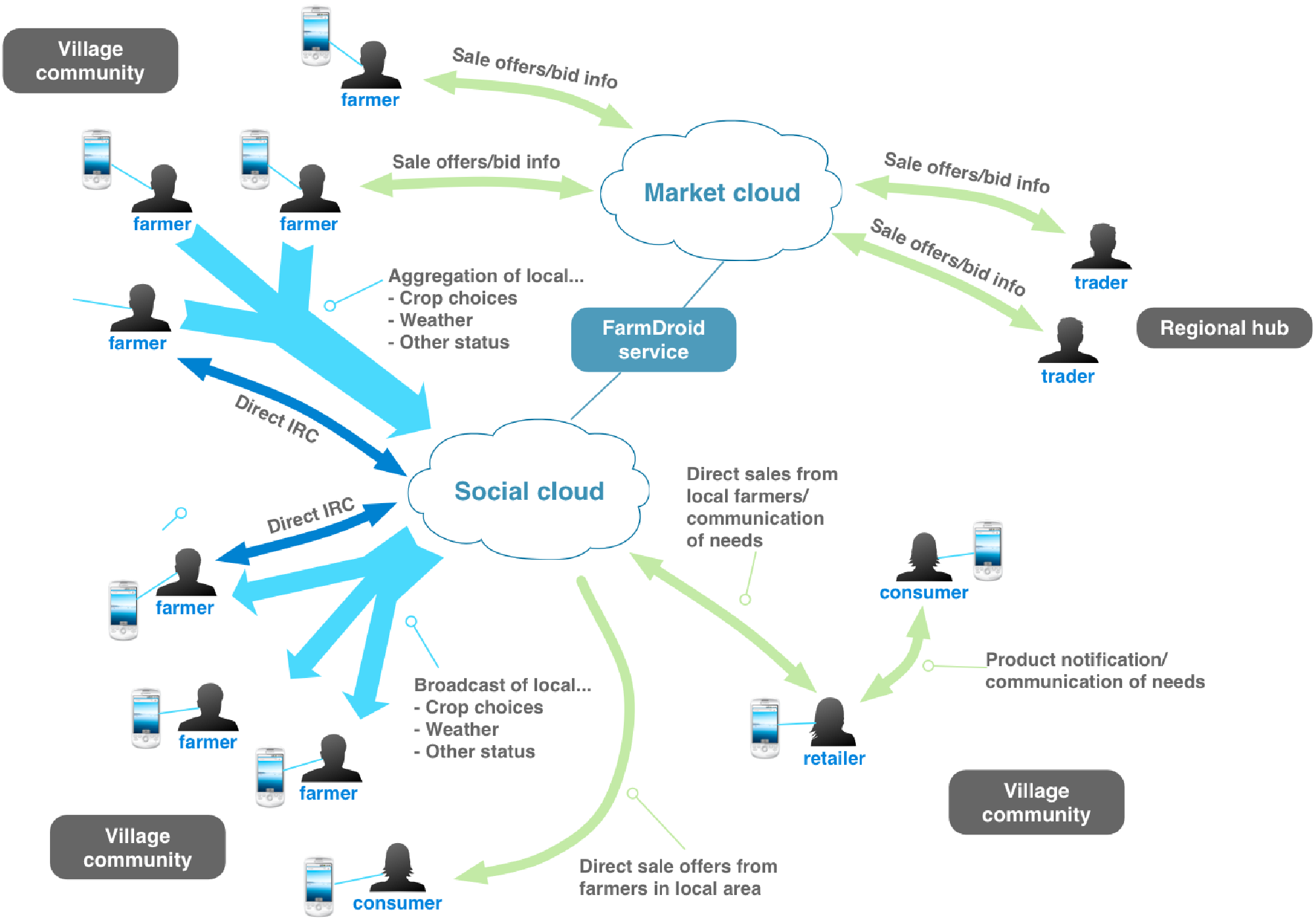 Fig 1: The architecture illustrates a shift from "Broadcast" to "Networked" information flow.
2. Virtual Trading Floor & Social Contracts
One of the most powerful features is the geographically-constrained marketplace. Farmers can upload photos of their crops (thanks to the smartphone camera) to solicit bids. While the final transaction is face-to-face, the app creates a "social contract," giving farmers the leverage to negotiate with certainty before they even start the journey to the market.
 Fig 2: The virtual trading floor allows farmers to signal intent and discover local price parity.
Why "Social" Matters: The Use-Case Analysis
The paper provides a compelling narrative of a farmer using the app. By seeing a neighbor's successful millet crop via image sharing, she can decide to pivot away from maize. By checking the Regional Indicators Pane, she sees only 15% of peers have planted millet, indicating a high probability of good prices due to low supply. This "herd intelligence" was previously impossible through simple SMS queries.
Critical Insights & Future Outlook
The transition from "Feature Phones" to "Smartphones" in the Global South is an inflection point for precision agriculture.
- Overcoming Literacy: The use of icons, images, and maps (Fig 2) circumvents the literacy barriers inherent in text-only systems.
- Data over SMS: GPRS and 3G/Edge networks allow for significantly more data throughput at lower costs than the "exorbitant" per-unit cost of SMS.
- Future Integration: The authors envision an API-driven ecosystem where developers can plug in low-cost IoT sensors (humidity, soil moisture) that sync directly with the FarmDroid backbone.
Conclusion
FarmDroid isn't just an app; it's a structural intervention. By fostering sustainable and fair regional markets, it allows smallholders to reclaim their bargaining power from large central hubs. The future of global food security may not lie in larger industrial farms, but in smarter, more connected smallholder networks.