
SMS: Bridging the Semantic Gap in Service Discovery via Social Collective Intelligence
SMS: A Framework for Service Discovery by Incorporating Social Media Information
This paper introduces SMS, a novel service discovery framework that enhances API retrieval by incorporating crowdsourced social media information from Twitter. By leveraging Latent Semantic Indexing (LSI) on Twitter Lists and modeling nonfunctional factors (popularity, activity, decay), it optimizes service ranking through a supervised weight learning algorithm.
TL;DR
The SMS (Social Media-based Service discovery) framework transforms how we find APIs by moving beyond static documentation. By mining Twitter Lists for semantic context and analyzing social signals like follower count and tweet frequency, it creates a ranking system that aligns with actual developer usage. It achieves a 35% higher Precision@10 than traditional provider-based search engines.
Background: Why Provider Metadata Isn't Enough
In the world of Service-Oriented Architecture (SOA), service discovery has historically been "provider-centric." We relied on what the creator said their API did. However, this poses a major challenge: information insufficiency. Providers might use jargon, or their descriptions might be 5 years old.
The authors' insight is profound: Users know better than providers. By looking at "Twitter Lists," we gain access to how the community categorizes these services (e.g., a "Career" list for the LinkedIn API). This collective knowledge provides a dynamic, social-level semantic label that static documentation lacks.
Methodology: The Four Pillars of Social Factors
The framework (SMS) doesn't just look at keywords; it models the "vibe" and "health" of an API through four distinct metrics:
- Functional Semantics (LSI on Twitter Lists): Using Latent Semantic Indexing to map queries and Twitter List descriptions into a conceptual space. This ignores word-for-word matching in favor of topical matching.
- Popularity (Follower Count): Normalized log-scale counts of followers indicate how "entrenched" a service is in the ecosystem.
- Activity (Tweet Number): A proxy for maintenance. An active account posting updates suggests the service is well-maintained and currently functional.
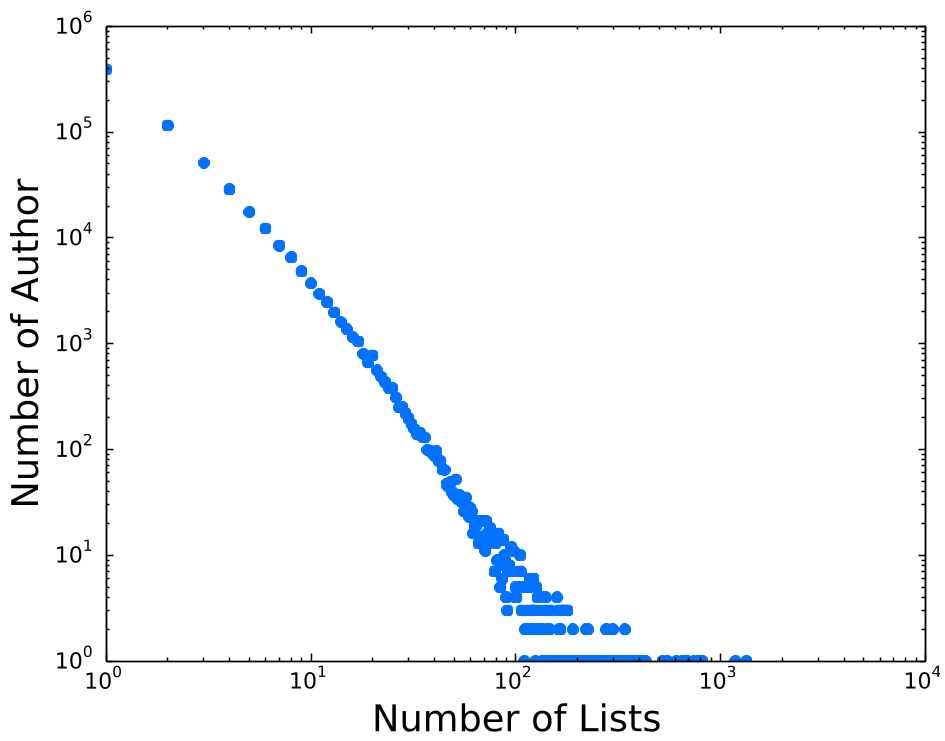
- Decay Factor (List Density): A unique insight that penalizes services appearing in too many generic lists, which helps filter out noise and overly broad "utility" accounts.
Learning the "Goldilocks" Weights
How much should we trust popularity vs. semantics? SMS solves this with a Weight Learning Algorithm. Instead of arbitrary constants, it uses "triplets" (Query, Pos_Service, Neg_Service) to train a linear model that maximizes the margin between relevant and irrelevant results using a hinge-loss function.
Experimental Results: SOTA Performance
The researchers tested SMS against the industry standard (ProgrammableWeb/PW descriptions).
- Precision Gains: SMS consistently beat the baseline. For example, for a query like "enterprise," while the baseline struggled, SMS leveraged community labels to find relevant services with high accuracy.
- The Power of Lists: Simply using Twitter Lists (List Only) outperformed traditional documentation, proving that crowdsourced data is fundamentally richer.
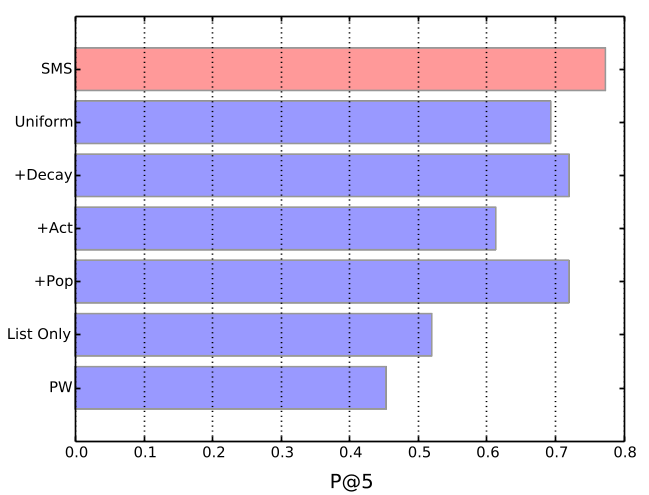
Fig: SMS shows clear dominance across Precision and nDCG metrics compared to Uniform weighting or single-factor models.
Case Study: "Athlete" and "School"
In a direct comparison, searching for "Athlete" in traditional systems returned Australian postal services (due to keyword noise in descriptions). In contrast, SMS returned Active.com, TrainingPeaks, and MapMyRun—exactly what a developer looking for sports APIs would want. This success stems from the fact that Twitter users had already grouped these together in "Fitness" and "Sports" lists.
Critical Insight & Conclusion
The SMS framework proves that social media is not just for marketing; it is a repository of latent architectural metadata.
Takeaway: If you are building a discovery platform, stop focusing solely on indexing your own database. Start indexing the conversations and groupings happening around your entities in the social sphere.
Limitations: The framework depends on services having an active social presence. For internal enterprise services without public Twitter accounts, alternative "social" signals (like internal Slack mentions or Jira tags) would need to be synthesized.