
SMS: Leveraging the Social Pulse of Twitter to Revolutionize API Discovery
SMS: A Framework for Service Discovery by Incorporating Social Media Information
The paper introduces SMS (Social Media based Service Discovery), a framework that enhances RESTful API discovery by integrating crowdsourced social signals from Twitter. It models functional semantics using Latent Semantic Indexing (LSI) on Twitter Lists and combines these with three nonfunctional social factors (popularity, activity, and decay) via a weight-learning algorithm to outperform traditional documentation-based matching.
TL;DR
The SMS (Social Media based Service Discovery) framework moves beyond stagnant API documentation by mining Twitter Lists for functional semantics and social signals (popularity, activity). By using a triplet-based weight learning algorithm, it identifies the most relevant and "alive" services, significantly outperforming traditional methods in retrieval accuracy.
The "Static Data" Trap in Service Discovery
In the Service-Oriented Architecture (SOA) world, discovery is the heartbeat of development. However, we have long relied on the "Official Description"—a single, often dry, and rarely updated document provided by the service owner.
The Problem:
- Semantic Insufficiency: Official docs use a narrow vocabulary that doesn't always match how developers actually search.
- Echo Chamber Effect: Documentation doesn't tell you if a service is dying, if it's currently popular, or if the developer is actively responding to the community.
The Insight: Social Media as Distributed Documentation
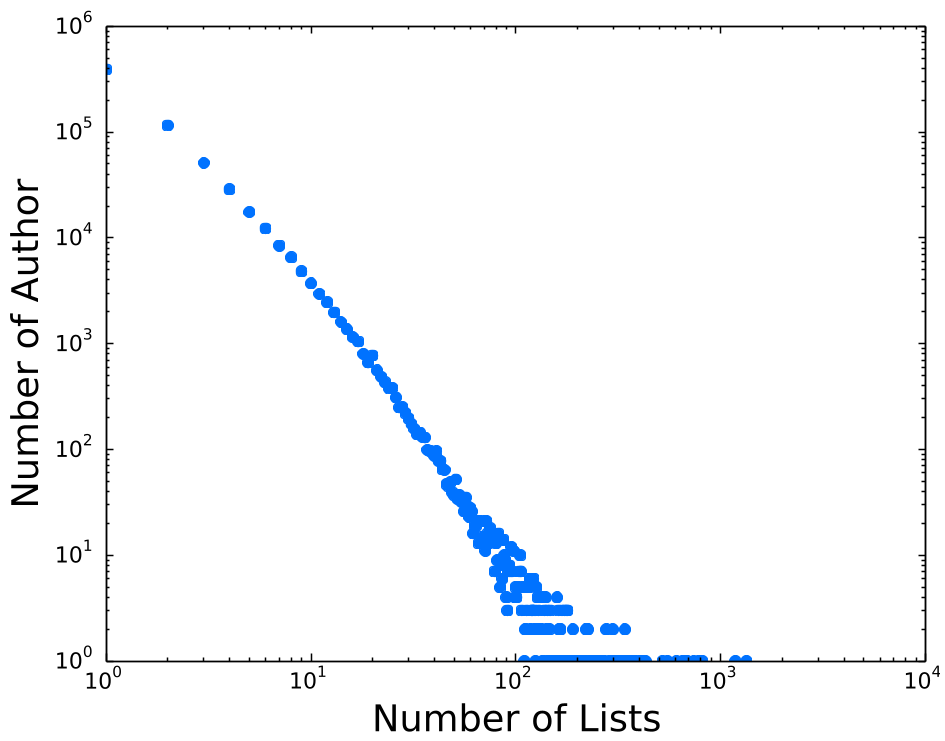
The authors identified that Twitter (now X) serves as a goldmine for "Collective Knowledge." Specifically, they focus on Twitter Lists. When a user adds an API's official account to a list named "High-Stakes Financial Tools," they are essentially providing a crowdsourced semantic tag.
Methodology: High-Dimensional Social Dynamics
The SMS framework models discovery through four distinct social lenses:
- Functional Semantics (LSI): By applying Latent Semantic Indexing to the meta-data of Twitter Lists, SMS maps APIs and queries into a conceptual space. This handles synonymy (different words for the same thing) and polysemy (same word, different meanings) better than literal keyword matching.
- Popularity Factor: Measured by the log-normalized number of followers.
- Activity Factor: Derived from tweet frequency—a high-frequency account suggests an active, maintained service.
- Decay Factor: A clever mechanism to damp the influence of services that are too general (included in too many lists), ensuring niche relevance isn't drowned out.
The Secret Sauce: Weight Learning
How much should "Popularity" count compared to "Semantic Similarity"? Instead of guessing, the authors use a Weight Learning Algorithm. By feeding the model Triplets (where API A is clearly a better match for Query X than API B), the system learns a ranking function that minimizes a hinge loss objective.

Experimental Results: Crowdsourcing Wins
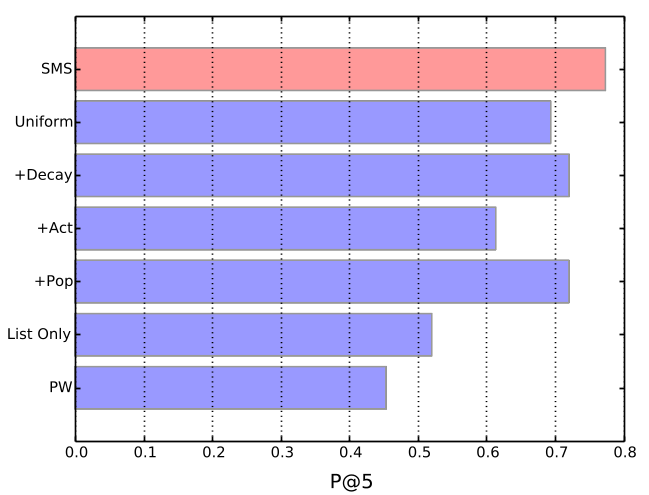
The team crawled nearly 4,000 APIs and over 1 million Twitter lists. The results were clear: using social information alone (List Only) outperformed the traditional ProgrammableWeb (PW) baseline.
- Precision@10: SMS achieved 0.57, compared to the baseline's 0.42.
- Diversity & Relevance: In case studies for queries like "Athlete," SMS successfully filtered out noise (like shipping or science APIs) that happened to have similar keywords, focusing instead on high-authority sports services like Active.com and MapMyRun.
Critical Insight: The Value of the Crowd
The most striking takeaway is that crowdsourced tags are often more accurate than developer descriptions. Users categorize services based on actual use cases, whereas developers describe them based on technical specifications. By bridging this "Intention Gap," SMS offers a roadmap for the next generation of intelligent, context-aware service marketplaces.
Future Outlook
While Twitter’s API landscape has changed since this research, the underlying principle—Social Signal Integration—remains vital. Future work could extend this to GitHub stars, StackOverflow mentions, or even real-time usage telemetry to create a truly global, self-updating service ecosystem.
Summary (Takeaway): SMS proves that the collective intelligence of the web is the ultimate index for our ever-growing digital service components.