
SNAG: Breaking Social Barriers Through Gamified Networking
SNAG: social networking games to facilitate interaction
The paper introduces SNAG (Social Networking and Games), a mobile and web-based gaming suite designed to facilitate professional networking. Its flagship game, Snag’em, utilizes a "human scavenger hunt" mechanic to encourage attendees at conferences or universities to interact, successfully engaging 28% of participants in a real-world pilot study.
TL;DR
SNAG (Social Networking and Games) is a research-driven initiative aimed at fostering inclusive professional communities. By turning networking into an interactive "human scavenger hunt" via the Snag’em mobile platform, the authors successfully incentivized conference attendees to move beyond their comfort zones. The project demonstrates that structured, game-based missions can significantly increase participation and a sense of belonging among diverse groups.
The Networking Gap: Why "Just Mingling" Doesn't Work
In academic and professional circles, a sense of community is highly correlated with career retention and satisfaction. However, social interaction is rarely "plug-and-play." Factors like extroversion, language barriers, and systemic social inequalities mean that traditional networking often leaves out women and minorities.
The authors argue that social interaction must be intentionally designed. Without a framework to lower the "activation energy" of meeting someone new, many individuals remain isolated, anxious, and unwilling to take the risks necessary for professional growth.
Methodology: The Mechanics of Snag’em
Snag’em functions as a pervasive game that bridges the digital and physical worlds. The core loop is built upon three pillars:
- Tag-Based Identity: Users sign up with tags representing their roles, hobbies, and expertise.
- Mission-Driven Interaction: Instead of aimless small talk, the game generates missions like "Snag someone who works in the Games and Learning lab."
- Verification and Integrity: To complete a mission, a player must find the target person and obtain their unique 4-digit SnagID. Incorrect entries result in point deductions, forcing players to engage in genuine conversation rather than just "hunting IDs."
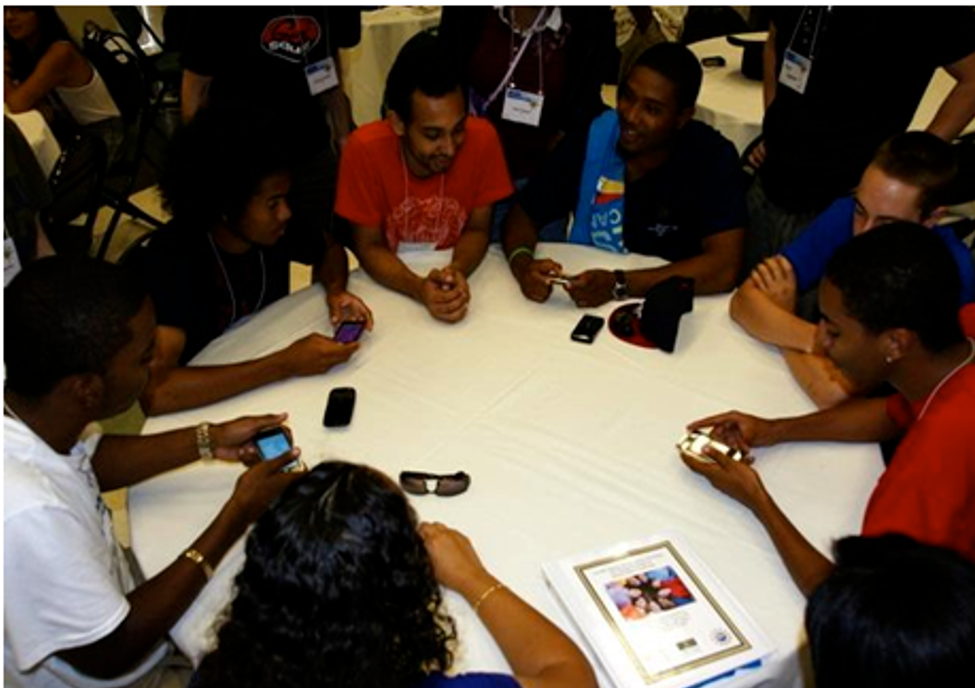
The "Connectivity Bonus" Insight
A brilliant mechanical addition is the Network Connectivity feature. The game distinguishes between "Weak Connections" (one-way snags) and "Friends" (mutual snags). By offering point multipliers for mutual connections and for snagging people outside one's usual social cluster, the game mathematically incentivizes the growth of a "cohesive, strong network" rather than just a list of random contacts.
Experimental Results: Real-World Resilience
The system was tested at the STARS Celebration 2009, yielding impressive engagement metrics:
- Participation: 80 out of 280 attendees (28%) actively played.
- Engagement Depth: 35% of players completed two or more missions.
- Time Span: Activity was recorded from 8:30 AM to 10:00 PM, far outlasting the official conference sessions.
Interestingly, the game environment proved robust to human nature; even when players attempted to "hack" the database or when the server crashed, the community’s enthusiasm led them to resume play immediately upon restoration.
Critical Insight & Future Outlook
While Snag’em was a success as an icebreaker, the authors acknowledge the need to measure relationship longevity. The next phase of research focuses on whether these gamified interactions lead to lasting study groups, office hour visits, and sustained professional mentorship.
Takeaway for Practitioners
If you are designing a community-focused platform, the lesson from SNAG is clear: Gamification is not just about points; it's about providing a "social script." By giving people a mission and a clear goal, you remove the awkwardness of the first "Hello," effectively engineering the serendipity required for a healthy, inclusive ecosystem.
References
- McCarthy, J., et al. (2004). Augmenting the social space of an academic conference. CSCW.
- Tinto, V. (1999). Taking retention seriously: Rethinking the first year of college. NACADA journal.