
SnapTask: Solving the "Invisible Wall" Problem in Indoor Crowdsourced Mapping
SnapTask: Towards Efficient Visual Crowdsourcing for Indoor Mapping
SnapTask is an efficient participatory visual crowdsourcing (VCS) system designed for indoor 3D mapping and 2D floor plan generation. It utilizes a novel task generation algorithm and Structure-from-Motion (SfM) techniques to guide users toward data-sparse areas, achieving 100% wall reconstruction and increasing model coverage by up to 34.45% compared to unguided methods.
TL;DR
Building indoor maps via smartphone photos (Visual Crowdsourcing) usually results in redundant data of "hotspots" and total gaps in quiet corners or glass-walled rooms. SnapTask introduces a guided system that tells users exactly where to go and utilizes a clever "artificial texture" trick to map glass walls that are normally invisible to computer vision. It achieves near-perfect coverage with significantly less data than traditional methods.
The "Blind Spots" of Human-Led Mapping
Most crowdsourced mapping projects rely on Opportunistic Sensing (users taking random videos) or Unguided Participatory Sensing (users taking photos they think are useful). This leads to two critical failures:
- Redundancy vs. Scarcity: Users cluster in the same open areas, creating massive processing overhead for the same views, while back hallways remain unmapped.
- The Glass Ceiling (and Walls): Standard Structure-from-Motion (SfM) algorithms rely on "features" (texture, corners). If you try to map a modern office with glass partitions, the algorithm sees nothing, resulting in maps where users might "walk through" literal walls.
Methodology: Active Guidance and Texture Imprinting
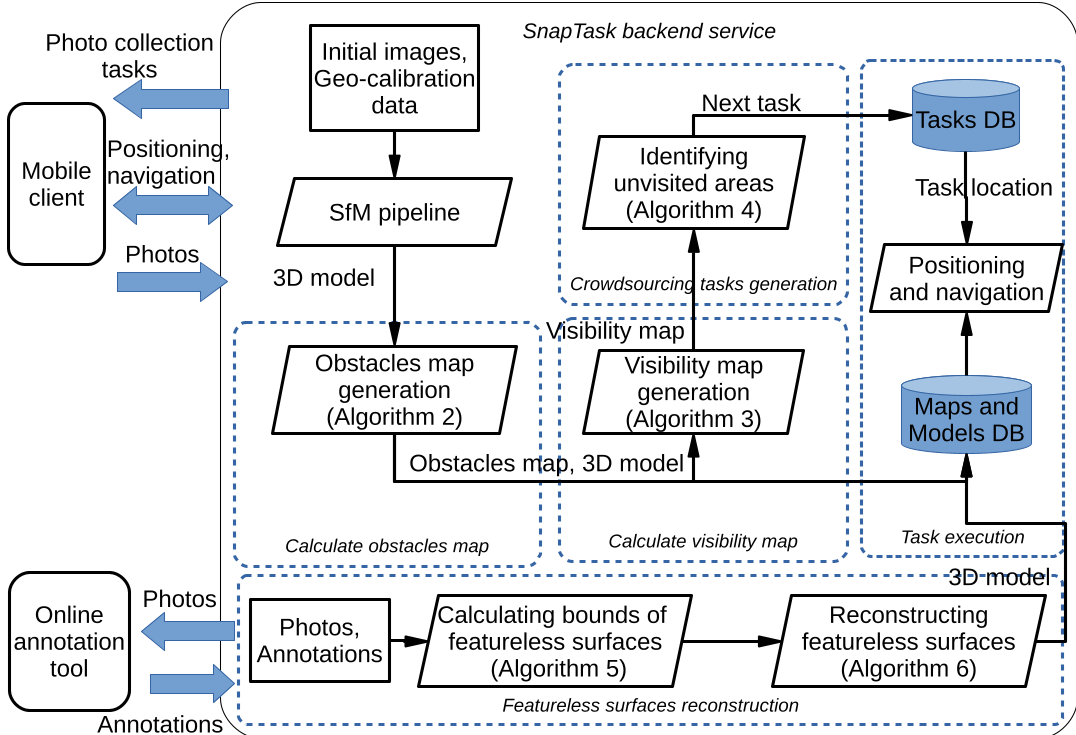
SnapTask treats mapping as an iterative loop. It doesn't just collect data; it evaluates the "Quality-of-Information" (QoI) of existing data to decide what’s next.
1. Visibility and Obstacle Mapping
The system maintains two matrices:
- Obstacle Map: Where are the physical objects (bookshelves, walls)?
- Visibility Map: Which areas have been "seen" by enough cameras (at least 3) to be considered verified?
The system uses a Flood Fill search to find "unvisited" cells—areas that have no obstacles and low visibility—and issues a new navigation task to the next available participant.
2. Making Glass Visible
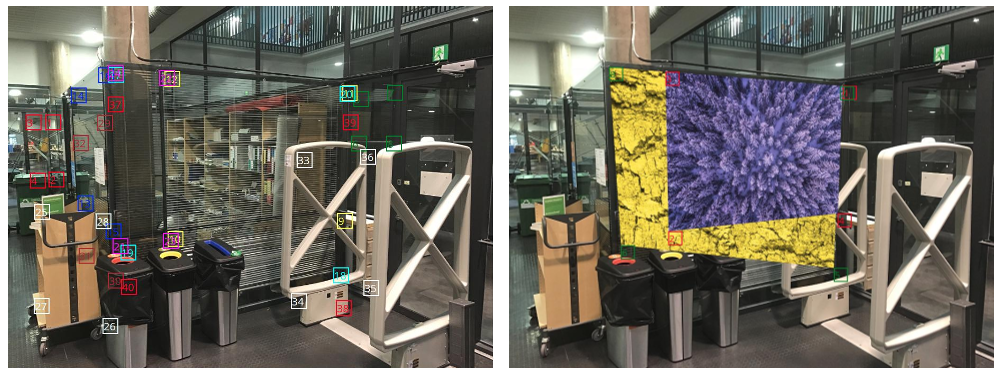
When a participant encounters a featureless surface (like a glass door) that SfM fails to reconstruct, SnapTask triggers an Annotation Task.
- Users mark the 4 corners of the glass in 2D photos.
- The system "imprints" these areas with unique, artificial digital textures.
- The SfM pipeline now perceives these textures as high-contrast features, allowing it to calculate the 3D position of the glass and add it to the obstacle map.
Experiments: Superior Quality with Minimal Data
Tested in a library at Aalto University, SnapTask was compared against unguided methods. The results were stark: with 600-700 photos, SnapTask reached 98.12% coverage, whereas opportunistic sensing plateaued at 63.67%.
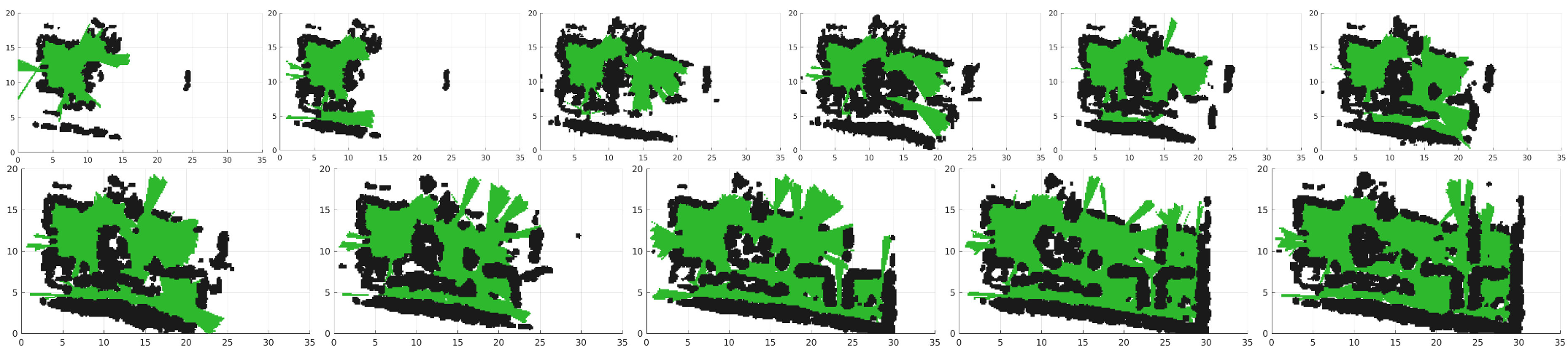
The experiment proved that "More Data" is not "Better Data." Efficient task generation (knowing where the holes are) is more valuable than thousand of redundant frames.
Critical Insight: The Future of Spatial Crowdsourcing
SnapTask’s primary contribution is shifting VCS from a passive data-collection role to an active, closed-loop system. By quantifying "Information Gain" using visibility and obstacle maps, it provides a blueprint for efficient large-scale mapping.
Limitations: Currently, the system relies on human participants for the 2D marking of glass. While effective, a future iteration could utilize semantic segmentation (AI) to automatically detect featureless surfaces, further reducing human effort.
Conclusion
SnapTask demonstrates that by combining user guidance with targeted 2D-to-3D annotations, we can map complex indoor environments—glass walls and all—with unprecedented accuracy and efficiency.