
SNARF: Transforming Social Networks into a Distributed Cloud for Mobile Offloading
SNARF: A Social Networking-inspired Accelerator Remoting Framework
SNARF is a social networking-inspired accelerator remoting framework designed to selectively offload compute-intensive tasks from mobile devices to remote resources. It leverages SocialVPN for secure, virtualized TCP/IP networking and integrates UPnP for seamless resource discovery across local and wide-area networks.
TL;DR
SNARF (Social Networking-inspired Accelerator Remoting Framework) is a research milestone that envisions your social network as a giant, distributed hardware accelerator. By combining SocialVPN for secure connectivity and UPnP for automatic resource discovery, it allows mobile devices to "borrow" processing power from friends' PCs or cloud nodes seamlessly. For heavy tasks like image processing, it not only speeds up execution but also preserves critical battery life.
Background & Motivation: The Mobile Bottleneck
Despite the evolution of mobile SoCs, the "energy-performance" gap remains a fundamental constraint. We generally solve this in two ways: Device Specialization (fixed-function hardware) or Cloud Offload. However, specialization is inflexible, and traditional cloud offloading is often "static"—you hardcode a server address.
The authors argue for an Aggregated Platform approach. Why can't your phone see a friend's idle gaming PC or a nearby cloud instance as a local co-processor? The barriers are network complexity (NATs, firewalls) and the lack of a unified discovery protocol that works outside a local Wi-Fi.
Methodology: Bridging the Gap with SocialVPN
The core innovation of SNARF is layering a standard discovery stack (UPnP) on top of a specialized virtual network (SocialVPN).
1. The Architecture
The framework consists of several layers that hide the "remoteness" of the resource from the developer:
- Offload Infrastructure: Manages the registry of available local and remote devices.
- SocialVPN Substrate: This is the "secret sauce." It creates a Peer-to-Peer (P2P) overlay. If you are "friends" on a social network, your devices automatically establish a secure tunnel, even if both are behind restrictive NATs.
- Universal Plug-and-Play (UPnP): By tunneling multicast traffic through the SocialVPN, SNARF allows the phone to "hear" service advertisements from a PC thousands of miles away as if they were on the same LAN.
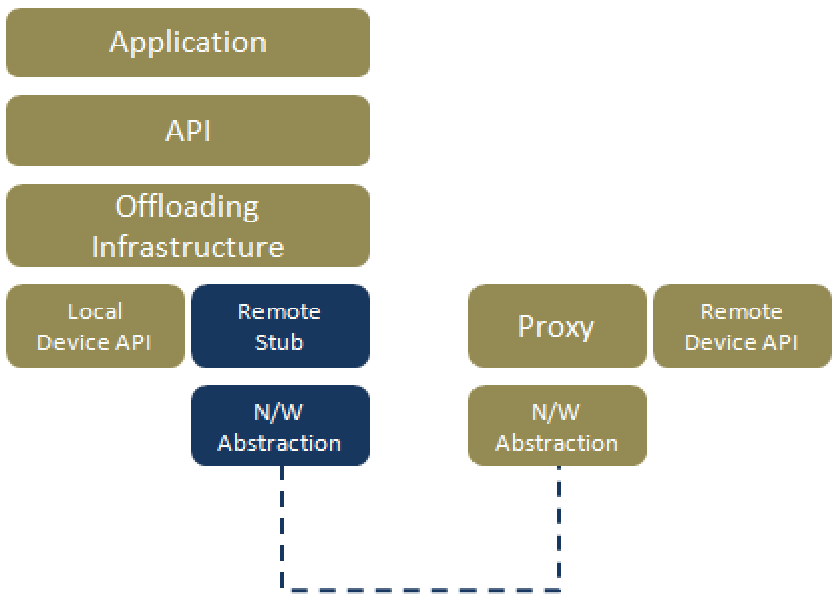 Figure 1: The SNARF Block Diagram showing the abstraction layers between the Application and Remote Device.
2. The Programming Model
SNARF provides different levels of "assistance" for the programmer, ranging from Minimum Assistance (manual remote/local versions) to Maximum Assistance (dynamic runtime offloading), making the framework flexible for various development needs.
Experimental Validation
The authors tested SNARF using a Sobel Filter (an image edge-detection algorithm) offloading from a Samsung Galaxy Tab to a local workstation and an Amazon EC2 GPU node.
Performance & Energy Gains
The results reveal a "cross-over" point in offloading efficiency:
- Small Tasks: Offloading a tiny image (26KB) actually increases energy consumption due to the network overhead and GPU setup time.
- Large Tasks: For a 1.7MB image, offloading to a workstation was significantly faster and more energy-efficient than local execution.
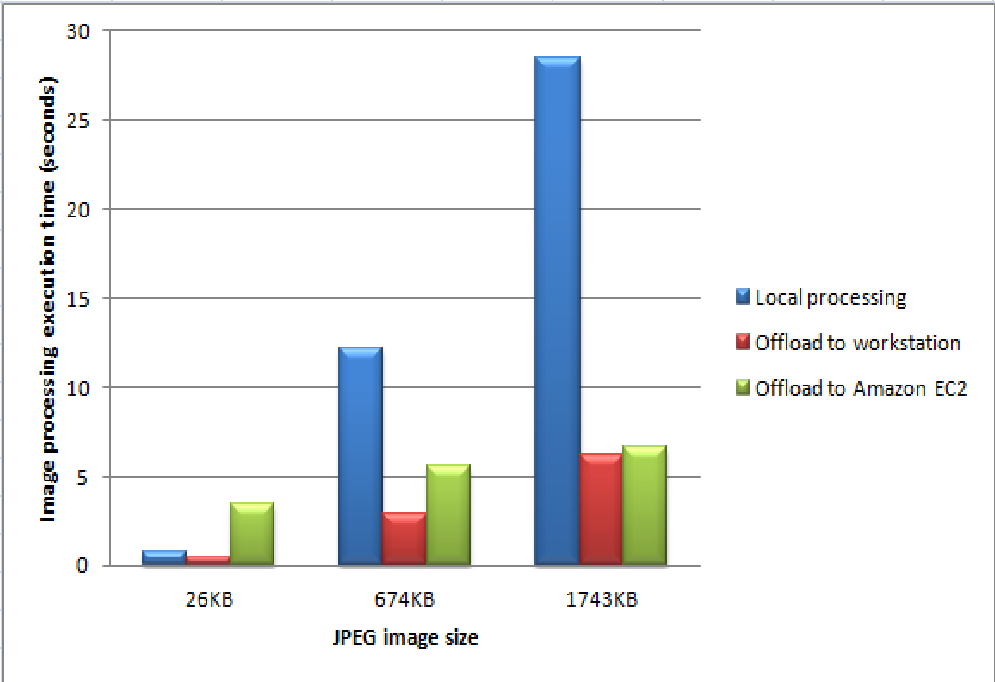 Figure 2: Execution time comparison. Note how the benefits of offloading scale with the workload size.
Discovery Latency
One of the most impressive results was the WAN discovery capability. Using FutureGrid resources across the US, the framework discovered 100 remote servers in under 60ms, proving that virtualizing the network layer doesn't necessarily introduce a massive bottleneck for resource enumeration.
Critical Insight: The Wi-Fi Power Trap
An interesting finding in the paper is that offloading to the Cloud (EC2) consumed more energy than offloading to a Local Workstation, even when the cloud was faster. Why? The Wi-Fi radio stays in a "high-power state" longer because cloud packets are spread out (due to WAN latency and TCP ACKs). This highlights that for mobile efficiency, latency is energy.
Conclusion & Future Impact
SNARF was a visionary work that anticipated the current trend of Edge Computing. By leveraging social trust as a security model for resource sharing, it proposed a decentralized alternative to centralized cloud providers.
While modern frameworks now use more advanced technologies like Kubernetes and gRPC, the fundamental idea of SNARF—using network virtualization to turn the Internet into a local-feeling bus for hardware accelerators—remains a cornerstone of distributed mobile systems research.
Key Takeaways for Future Systems:
- Workload Granularity Matters: Offloading is only a "win" when the computation cost significantly outweighs the data transfer and setup overhead.
- Network Abstraction is Key: Supporting legacy protocols like UPnP through tunneling is a powerful way to enable "zero-config" systems.