
SNDocRank: Leveraging Social DNA to Revolutionize Video Search
SNDocRank: a social network-based video search ranking framework
This paper introduces SNDocRank, a social network-based video search ranking framework. It integrates traditional textual relevance (tf-idf) with a novel Multi-level Actor Similarity (MAS) algorithm to provide personalized search results by measuring the social proximity between the searcher and document owners.
TL;DR
SNDocRank moves beyond generic search by injecting a "social signal" into the ranking process. By using a new algorithm called Multi-level Actor Similarity (MAS), it identifies videos uploaded by people socially "close" to you, making search results significantly more relevant to your personal interests than standard keyword matching.
Background: The Limits of Content-Only Search
Current multimedia retrieval is largely content-centric. Whether it’s visual feature extraction or metadata indexing (tags, titles), the system treats every searcher as a nameless entity.
However, the authors point out a critical flaw: Ambiguity. If you search for "John Smith," are you looking for the famous athlete or your college roommate? Without knowing who you are and who you know, the algorithm simply guesses based on global popularity. SNDocRank posits that "birds of a feather flock together"—we share interests with our social circle, and our social connections are the best lens through which to filter the digital deluge.
Methodology: The MAS Algorithm
The core innovation is the Multi-level Actor Similarity (MAS). While algorithms like Cosine Similarity only look at direct neighbors (friends in common), and the LHN vertex similarity is too computationally expensive for large networks (), MAS finds a middle ground through Hierarchical Clustering.
1. Hierarchical Decomposition
The algorithm first breaks the social network into clusters (communities) and represents them as abstract nodes. This creates a "backbone" network.
2. Weighted Similarity
Instead of calculating similarity across the whole flat network, MAS calculates it within sub-trees. If two users are in different communities, the system calculates:
- The similarity between the user and their community.
- The similarity between those two communities in the backbone.
- The similarity between the target user and their respective community.
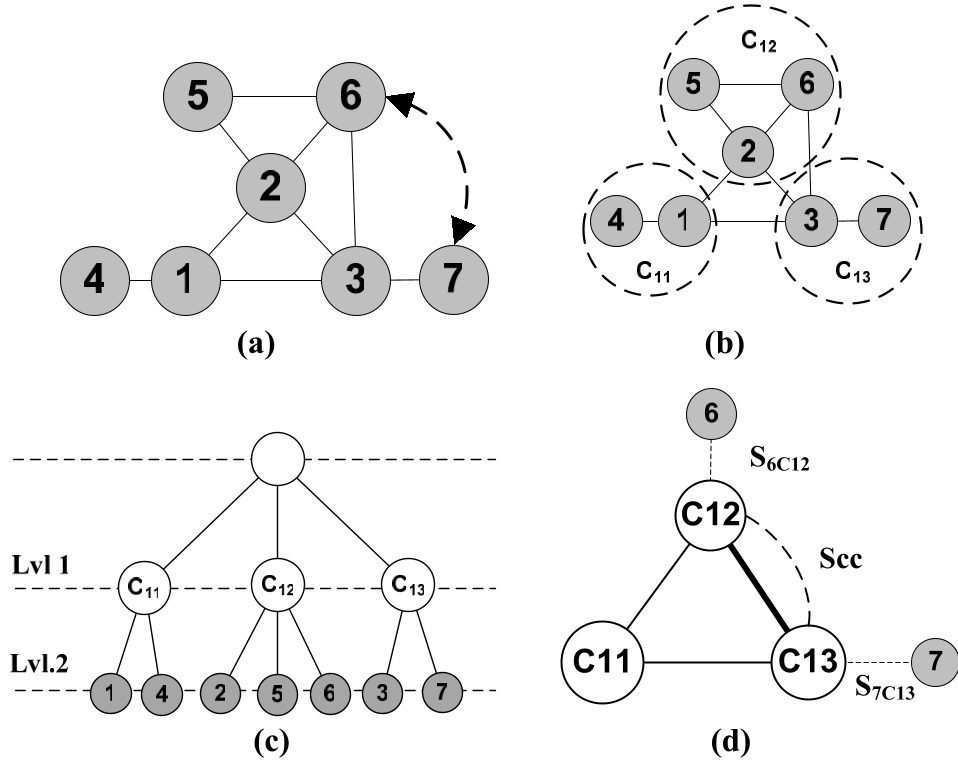 Figure 1: The SNDocRank architectural flow, integrating social network analysis with traditional document ranking.
3. Complexity Win
By using this multi-level approach, the authors reduced the complexity from to approximately , making it feasible for platforms with thousands or millions of users.
Experiments and Results
The authors tested SNDocRank using real data from YouTube (over 16,000 users and 37,000 videos). They compared it against standard tf-idf (text only) and Cosine-based social ranking.
Key Metric: Interest Match Score (IMS)
IMS measures how many of the top 30 results actually match the user’s predefined interests (e.g., Music or Sports).
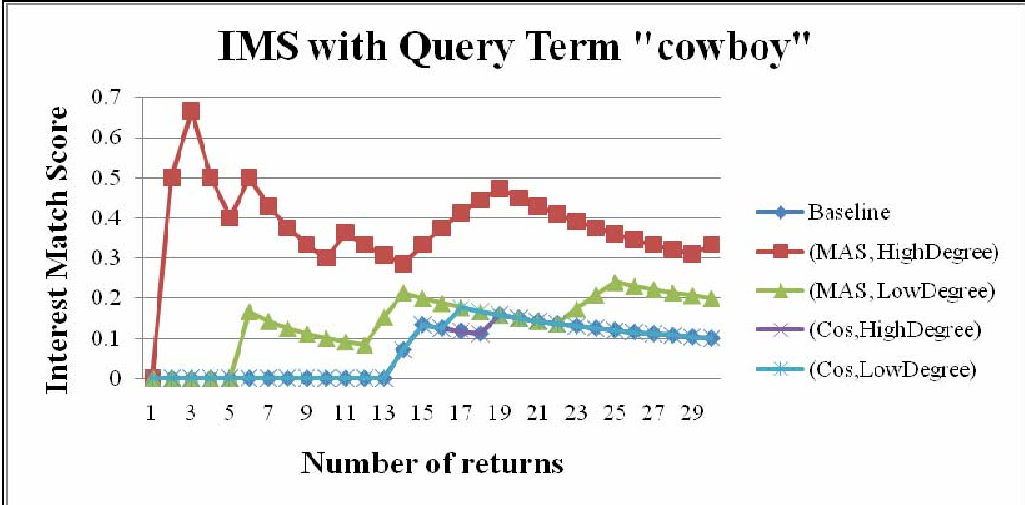 Figure 2: MAS consistently outperforms Cosine and tf-idf in matching user interests across different social degrees.
Findings:
- The "Popularity" Boost: Performance is generally better for "high-degree" users (those with more friends). This suggests that the more active you are socially, the better the algorithm can "triangulate" what you like.
- Beyond Neighbors: MAS outperformed Cosine similarity significantly, proving that "friends of friends" and community-level structures are vital signals that simple neighbor-counting misses.
Critical Analysis & Conclusion
SNDocRank is a pioneer in Social Search. It acknowledges that our digital identity is defined by our relationships.
Limitations:
- Data Sparsity: If a user is a "lone wolf" (low degree), the social signal is weak, and MAS reverts to something closer to standard ranking.
- Bias: As noted in the paper, the algorithm can struggle with "biased" information if the overall community interest is heavily skewed toward one category (like Music on YouTube).
Future Outlook: The next step for such frameworks is the integration of Visual Content Detection (Computer Vision) alongside social signals. Imagine a search engine that knows you like hiking not just because your friends do, but because it recognizes the mountains in the videos they upload. SNDocRank provides the structural foundation for this socially-aware future.