
Beyond the Binary: Using Fuzzy Logic to Detect Social Isolation (Incels)
SNEFL: Social network explicit fuzzy like dataset and its application for Incel detection
This paper introduces SNEFL (Social Network Explicit Fuzzy Like), the first social network dataset incorporating "fuzzy likes" to measure the intensity of user appreciation. Leveraging this unique multi-dimensional data, the authors develop a rule-based algorithm for Incel (Involuntary Celibate) detection, achieving a significant 68.75% accuracy among users with fuzzy like data.
TL;DR
Researchers have moved past the simple "Like" button to introduce SNEFL, a dataset that captures the intensity of human interest through Fuzzy Likes. By analyzing the gap between the affection men give versus the high-intensity affection they receive, the authors created the first computer science framework to detect Involuntary Celibates (Incels), outperforming traditional popularity metrics by over 60%.
The "Like" Problem: Why Binary Data Fails
In the world of social media analytics, we often treat every "Like" as equal. However, the emotional weight of a "Like" from a casual acquaintance is vastly different from one representing deep attraction.
The authors argue that this lack of granularity makes it impossible to identify specific psychological groups, such as the Incel community. Prior work focused on "popularity" (how many likes you get), but the authors discovered a startling paradox: Many self-identified Incels actually receive many likes. They aren't "unpopular" in the traditional sense; they are unreciprocated at the specific intensity level they desire.
Methodology: The SNEFL Dataset & Fuzzy Logic
The authors collected data from Gegli.com, a social network that features a "Fuzzy Like" bar. Users don't just click "Like"; they slide a bar to indicate a level between 0 and 100, mapped to linguistic variables like "Acceptable," "Attracted," or "Love it."
The Incel Detection Algorithm
The core of the methodology is a rule-based approach that focuses on the reciprocity of intensity.
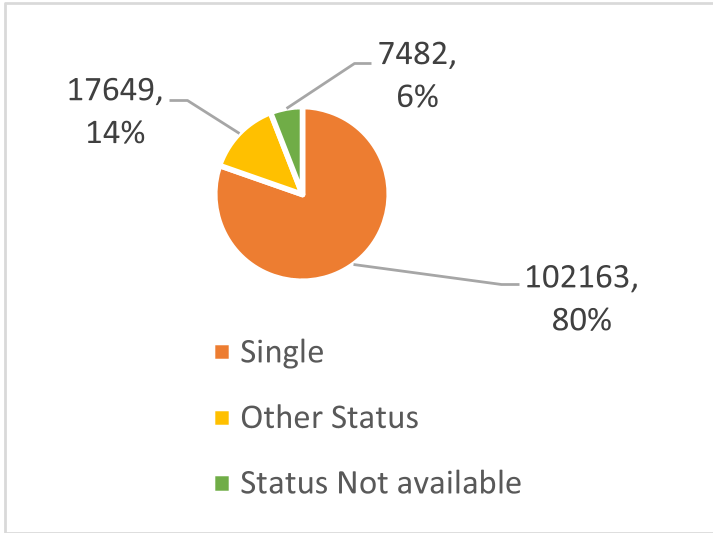
- Identify the Demographic: Specifically target single male users.
- Quantify Outgoing Affection: Count "High Fuzzy Likes" (Love it) sent to women.
- Measure Reciprocation: Compare these to "High Fuzzy Likes" received from women.
- Flag the Gap: If a user is highly active in sending "Love it" signals but receives zero high-intensity signals in return, they are flagged as a potential Incel.
 The logic flow: Differentiating between classic likes and the high-intensity 'Fuzzy' likes required for accurate detection.
Experiments: The Statistical Smoking Gun
To validate the model, the authors conducted a survey asking users: "Do you feel women are not attracted to you?"
The results revealed a massive flaw in standard metrics:
- Classic Likes (Binary): Incels received an average of 20.39 likes, while non-Incels received 27.27. The difference was not statistically significant. This explains why standard algorithms can't find them.
- Fuzzy Likes (High Intensity): The difference here was significant (p=0.04). Incels are specifically deprived of high-level attraction, not just general engagement.
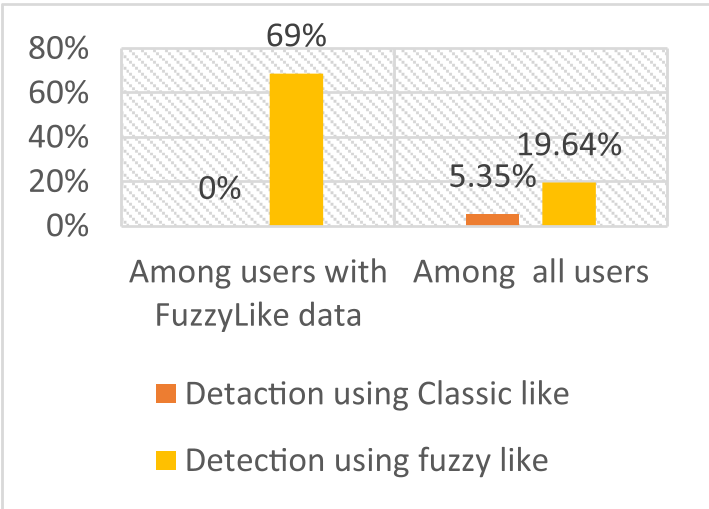 Performance Contrast: The Fuzzy Like algorithm (68.75% accuracy) vs. the Classic Like algorithm (0% accuracy in the targeted group).
Critical Insight: Data Privacy and Ethics
One of the standout features of the SNEFL dataset is its approach to privacy. Unlike datasets leaked or scraped via APIs (which are prone to de-anonymization), SNEFL was anonymized directly from the database level, with randomized timestamps and categorized demographic data (age/height/weight) to prevent re-identification while remaining useful for researchers.
Summary & Future Outlook
This work pushes social network analysis into the realm of computational psychology. By proving that "intensity of interaction" is more valuable than "count of interaction," the authors have opened doors for:
- Early Intervention: Detecting radicalized communities before they turn to violence.
- Better Recommendations: Matching users not just based on similar interests, but on similar "emotional scales."
- Lurker Analysis: Understanding users who receive attention but never participate.
The SNEFL dataset stands as a unique benchmark for any researcher looking to move beyond surface-level social media metrics into the complex, fuzzy reality of human emotion.