
SNOWL: Breaking the Silos of Social Networks through Semantic Unification
SNOWL model: social networks unification-based semantic data integration
The paper introduces SNOWL (Social Network OWL), a semantic data integration model designed to unify data across isolated social media platforms like Facebook, Twitter, and YouTube. Utilizing the UPON Lite methodology and RML mapping, it transforms heterogeneous social data into a standardized RDF/OWL knowledge base for unified querying and reasoning.
TL;DR
The social media landscape is a fragmented archipelago of "data islands." SNOWL is a novel semantic framework that uses ontologies and the RDF Mapping Language (RML) to unify data from Facebook, Twitter, and YouTube into a single, searchable knowledge graph. It allows researchers to query cross-platform social data using a unified language (SPARQL), bypassing the nightmare of incompatible APIs.
The Problem: The "Island" Nature of Social Data
Currently, if a brand wants to analyze its reputation, it must deal with three separate technical nightmares:
- Isolated Platforms: Data on a Facebook Page and a Twitter handle are structurally disconnected.
- API Heterogeneity: Facebook uses the Graph API (JSON), while Twitter and YouTube have and their own idiosyncratic schemas.
- Semantic Ambiguity: A "Reply" on Twitter is a "Comment" on Facebook.
The authors note that data scientists spend nearly 80% of their time just cleaning and preparing this data. SNOWL's motivation is to move this burden from the human to the machine.
Methodology: Building the SNOWL Ontology
The authors didn't just build a database; they built a worldview for social data. Using the UPON Lite methodology, they identified six core clusters that define any social network:
- User/Author: The "Who" (Person, Organization, or Group).
- Generated Content: The "What" (Post, Video, Tweet).
- User Relationships: The "Connection" (Follows, Friends, Subscribes).
- User Metrics: The "Popularity" (Follower count, connectivity).
- Content Properties: Values like image resolution, text length, and hashtags.
- User-Content Interaction: Specific actions like Like, Dislike, or Share.
Architecture & Mapping
The brilliance of SNOWL lies in its use of RML (RDF Mapping Language). Instead of writing custom code for every API, RML provides a generic template to map hierarchical JSON/XML data directly into RDF triples.
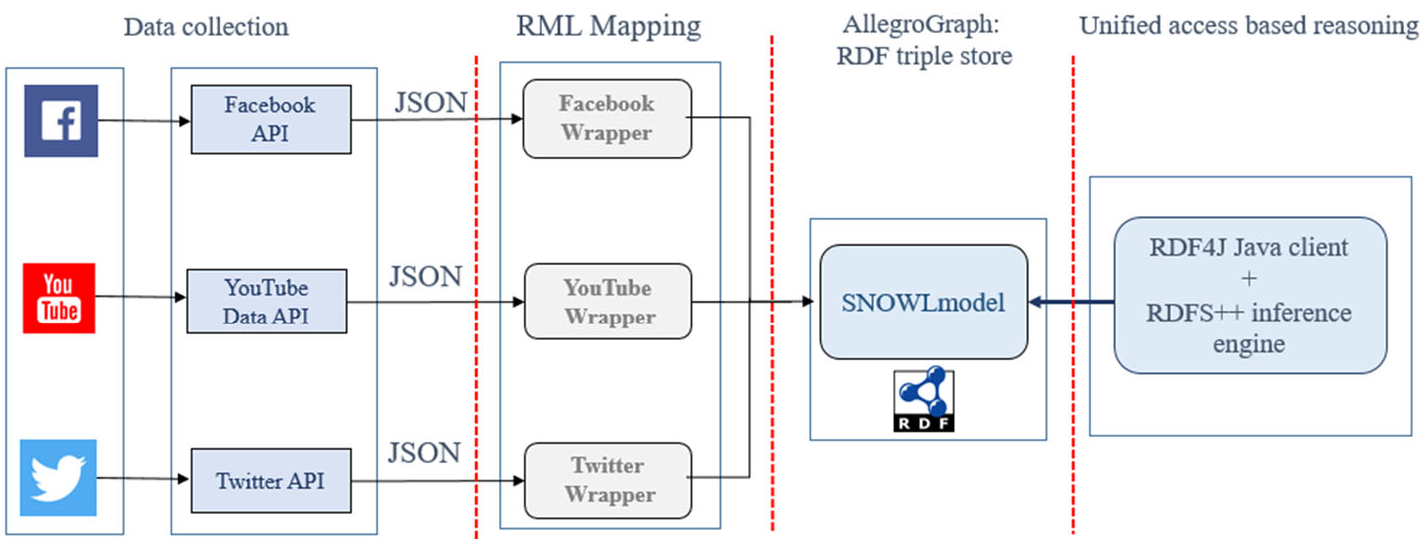 The four-layer architecture: Collection, Mapping, Storage (AllegroGraph), and Unified Access via SPARQL.
Experiments and Unified Reasoning
By mapping data into a semantic format, the researchers can perform "Reasoning." For example, the system can automatically infer that if User A "follows" User B, they have an established social connection, regardless of whether that happened on Twitter or YouTube.
The authors integrated Marl (Opinion Ontology) and Stanford Core NLP to enrich the data. This allows for powerful cross-platform queries:
"Find all users who expressed a 'Positive' opinion on either a YouTube Video or a Tweet related to a specific product."
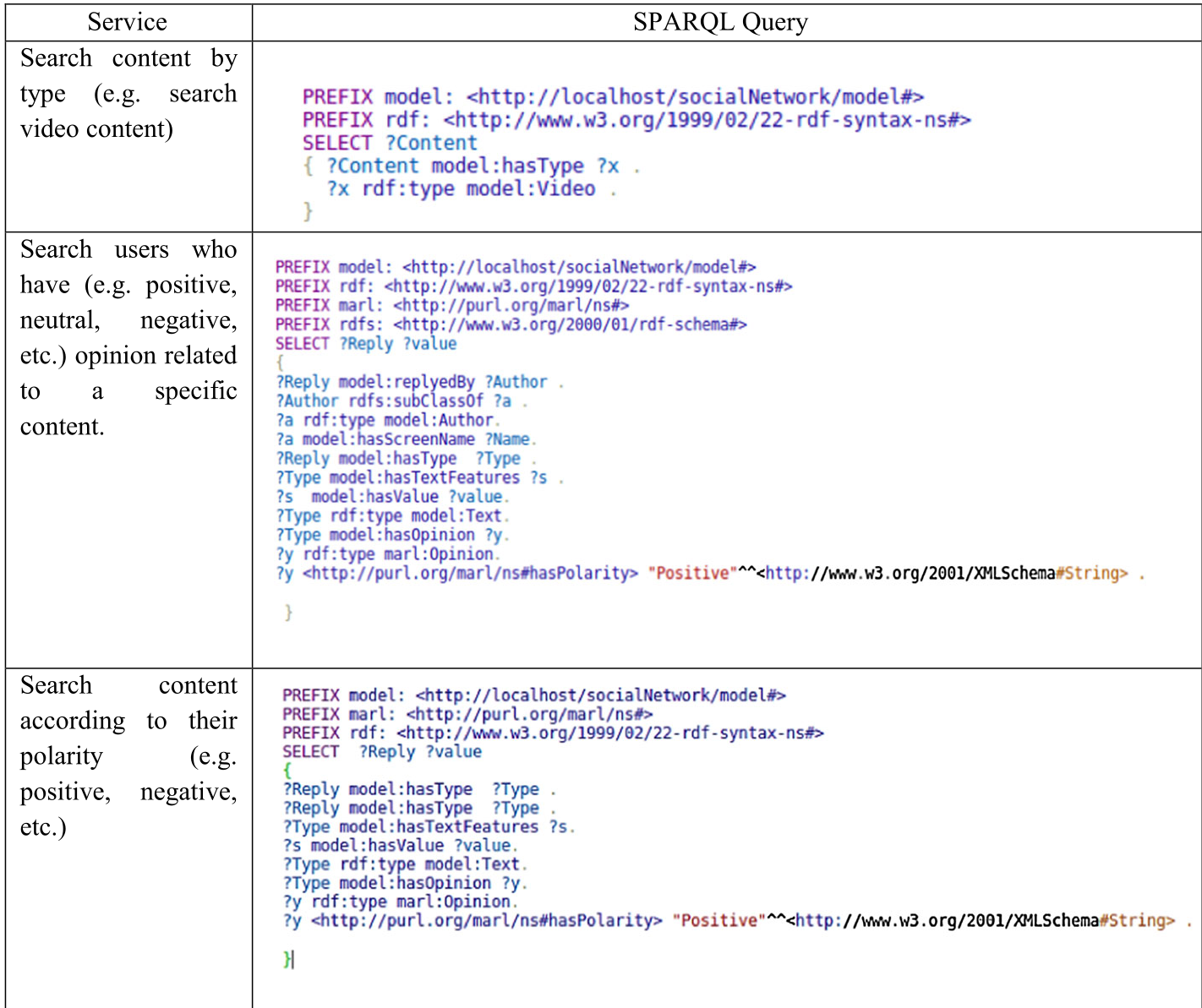 Standardized SPARQL queries allow for content retrieval by type and sentiment across disparate platforms.
Critical Insight: Beyond Simple Integration
While many works have tried to model social profiles (like FOAF), SNOWL's unique contribution is the unification of content visibility and popularity metrics. By formalizing "Reputation" as an ontological property, SNOWL allows for a more nuanced analysis of influence that spans multiple platforms—something traditional SQL-based integration struggles to handle at scale.
Conclusion
SNOWL is a significant step toward a truly interoperable Social Web. By treating social interactions as a formal graph rather than a series of isolated API responses, it paves the way for advanced Big Data analytics and automated sentiment tracking.
Future Outlook: The next logical step for this research is to scale the SNOWL ontology into distributed "Semantic Big Data" environments to handle the "Colossal Content" generated by billions of users in real-time.