
Linking Strangers through Altruism: An SNS for Implicit Regional Relations
An SNS Based on Implicit Beneficial Social Relations in A Regional Community
This paper introduces a novel Social Networking Service (SNS) designed to strengthen regional communities by surfacing "implicit and beneficial social relations." The system automatically connects local volunteers (contributors) with residents who benefit from their work (beneficiaries) based on shared geographic trajectories.
TL;DR
Researchers have developed a prototype SNS that doesn't care who your friends are. Instead, it uses your physical movement patterns to connect you with strangers who are performing voluntary acts (like gardening or cleaning) in your neighborhood. By making these "invisible" benefits visible, the system fosters a sense of trust and community gratitude.
Background: The Gap in Social Media
Current social media platforms are built on Explicit Social Graphs—you follow your friends, family, or celebrities. However, in physical regional communities, we are often supported by the silent work of strangers. Until now, there was no digital infrastructure to bridge the gap between a volunteer cleaning a local station and the commuter who benefits from that clean environment. This paper introduces the concept of Implicit and Dynamic Beneficial Social Relations.
Problem & Motivation: The Loneliness of the Local Volunteer
The authors identify a critical friction point in community sustainability:
- Implicit Nature: Most community benefits are experienced without knowing the source.
- Dynamic Decay: A clean park is a temporary benefit that disappears if not maintained.
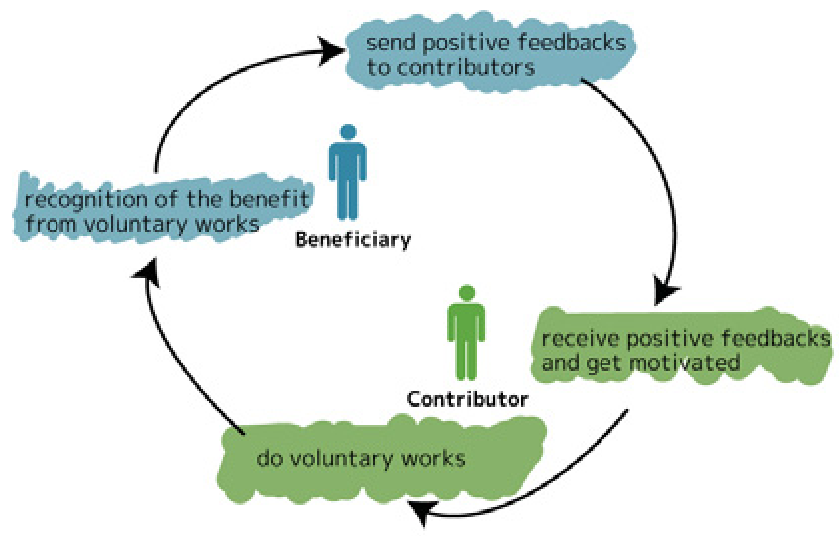
- The Motivation Gap: Without feedback, volunteers (Contributors) lose steam, and residents (Beneficiaries) remain disconnected from their community's social capital.
Methodology: Mapping Gratitude to Geolocation
The heart of this SNS is a method for detecting beneficiaries without requiring manual "follows" or "friending."
1. The Mesh Score System
The world is divided into 250-meter mesh squares. By utilizing user trajectory data, the system calculates a userMScore, representing how much time a user spends in a specific mesh.
2. The Matching Logic
When a contributor performs a task, the system identifies all users whose "Living Area" overlaps with that specific mesh. These users are automatically tagged as Beneficiaries.
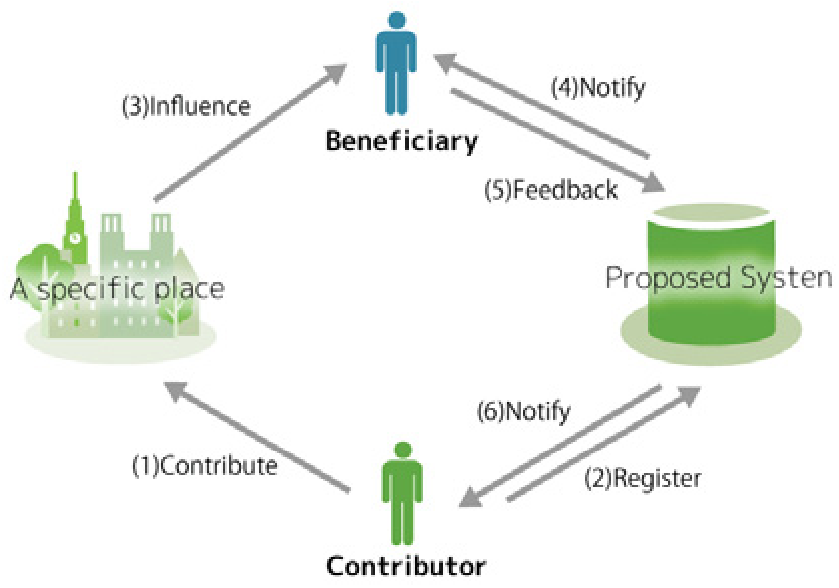 Figure: The process flow from volunteer action to beneficiary feedback.
3. Creating the Feedback Loop
Beneficiaries receive a notification (email/HTML5 interface) showing what was done in their area. They can then hit an "Appreciation" button, sending a shot of dopamine and social recognition back to the contributor.
Experiments: Does Local Content Actually Matter?
The researchers compared their Proposed Method (location-based) against a Random Method (sending info about activities anywhere).
Key Findings:
- Engagement: Users were twice as likely to read notifications if the activity happened in their "Living Area" (58.7% vs 26.7%).
- Perceived Value: When asked "Is this information valuable?", the proposed method scored significantly higher on a 6-point Likert scale.
- The Fatigue Factor: Interestingly, the frequency of "Appreciation" button presses decreased over time, suggesting that daily notifications might lead to "notification fatigue."
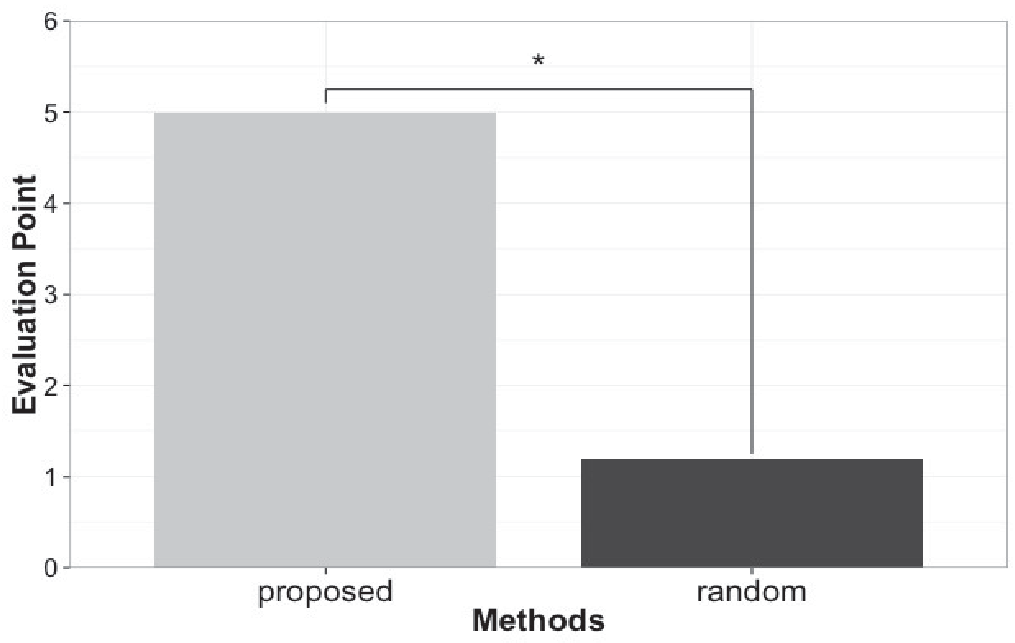 Figure: Subjective evaluation showing the higher perceived value of localized information.
Critical Insight: The Future of "Social Capital"
This paper serves as a vital proof-of-concept for Social Capital 2.0. By algorithmically surfacing the "Externality of Mind" (the positive influence of altruistic acts), we can simulate the tight-knit trust of a small village in a sprawling modern city.
Limitations & Moving Forward
- The Contributor Perspective: This study focused on the beneficiaries. The next step is proving that volunteers actually feel more motivated when they receive these digital "thank yous."
- Privacy: Using GPS data (Moves API) raises significant privacy concerns that will need robust anonymization in a commercial-scale product.
- Variety: For the system to survive, it needs a continuous stream of diverse volunteer acts, not just the "pre-prepared" activities used in this trial.
Conclusion
The study confirms that we value the "kindness of strangers" much more when that kindness happens in our own backyard. By automating the recognition of these implicit relations, technology can move beyond "likes" and "retweets" toward creating real-world regional resilience.