
SNS4D: Bridging the Digital Divide via SMS-Powered Social Networking
SNS4D: An OnLine Social Network System for Developing Countries
SNS4D is a hybrid social networking architecture designed for developing countries, bridging the digital divide by integrating cellular SMS services with standard Web interfaces. The system leverages the OpenSocial API and Apache Shindig to offer full social networking capabilities—including group management and account creation—even for users without consistent Internet access.
TL;DR
While the West enjoys high-speed 5G, many developing regions remain "Internet-starved" but "Cellular-rich." SNS4D (Social Network System for Developing Countries) is a clever architectural bridge that allows users to perform 100% of social media tasks—creating accounts, joining groups, and sharing news—entirely via SMS, while remaining fully synchronized with a Web-based backend.
The Motive: Why Web-Only Models Fail in Emerging Markets
The "Digital Divide" isn't just about owning a device; it's about the reliability of the pipe. In countries like Benin, Internet penetration was as low as 3% during the study's inception, while cellular subscriptions were nearly ubiquitous at 73%.
Existing giants like Facebook offered SMS notifications, but they were often "passive" or "read-only." You couldn't create a complex family group or manage your profile without eventually needing a browser. SNS4D was born from a specific vertical need: enabling an extended family with disparate access levels to maintain a cohesive social presence.
Methodology: Decoupling the Interface from the Engine
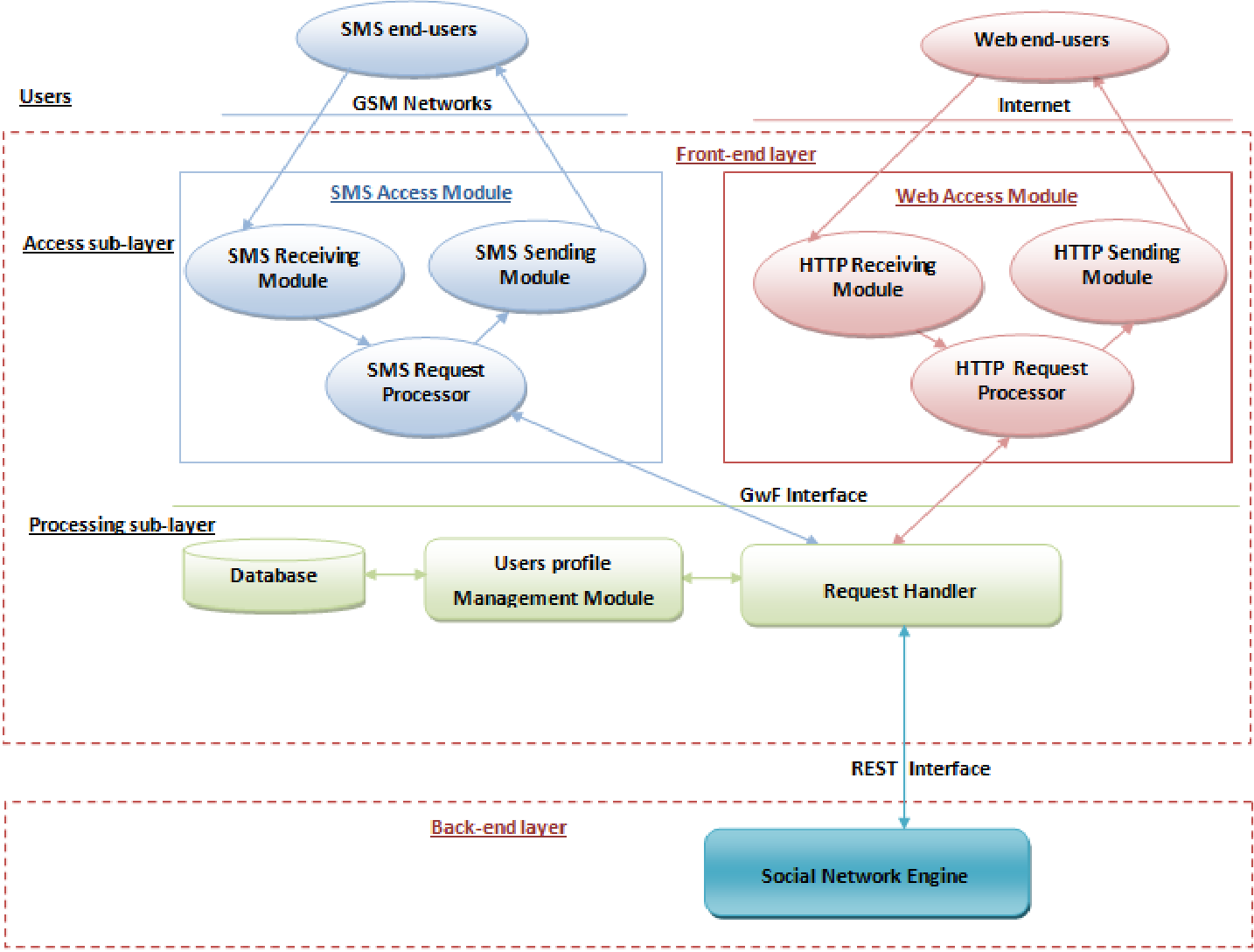
The core innovation of SNS4D lies in its Two-Layer RESTful Architecture. Instead of building a siloed "SMS-only" app, the authors built a translation layer on top of standard Web protocols.
1. The Front-End Layer
This layer acts as a translator. It hosts two access modules:
- Web Access: Standard HTTP/Browser interaction.
- SMS Access: Intercepts "raw" text commands (e.g.,
pub add MyGroup Hello World) and converts them into RESTful API calls.
2. The Back-End Layer
By using Apache Shindig and the OpenSocial API, the creators ensured that SNS4D doesn't just store data in a flat file. It functions like a real social network engine, managing "Resources" (Users, Groups, Invitations) that can be addressed via URIs.
The "High Abstraction" SMS
To solve the UX nightmare of typing long command strings, the authors developed a J2ME (Java 2 Micro Edition) application. For users with basic feature phones, this app provided a GUI (buttons, forms) that automatically formatted the SMS messages in the background.
Experiments: Real-World family Scenario
The prototype was tested using a Huawei GSM modem as the gateway. The "Acid Test" involved a scenario where a user, Christian, lived in a city with Web access, while his relatives, Abdel and Frejus, were in rural areas with only SMS.
- Result: When Christian posted a status via the Web, the SNS4D request handler checked the recipient profiles. It immediately sent an SMS notification to Abdel and Frejus.
- Interactivity: Abdel was able to "comment" on the post via SMS, which Christian then viewed on a standard Web dashboard.
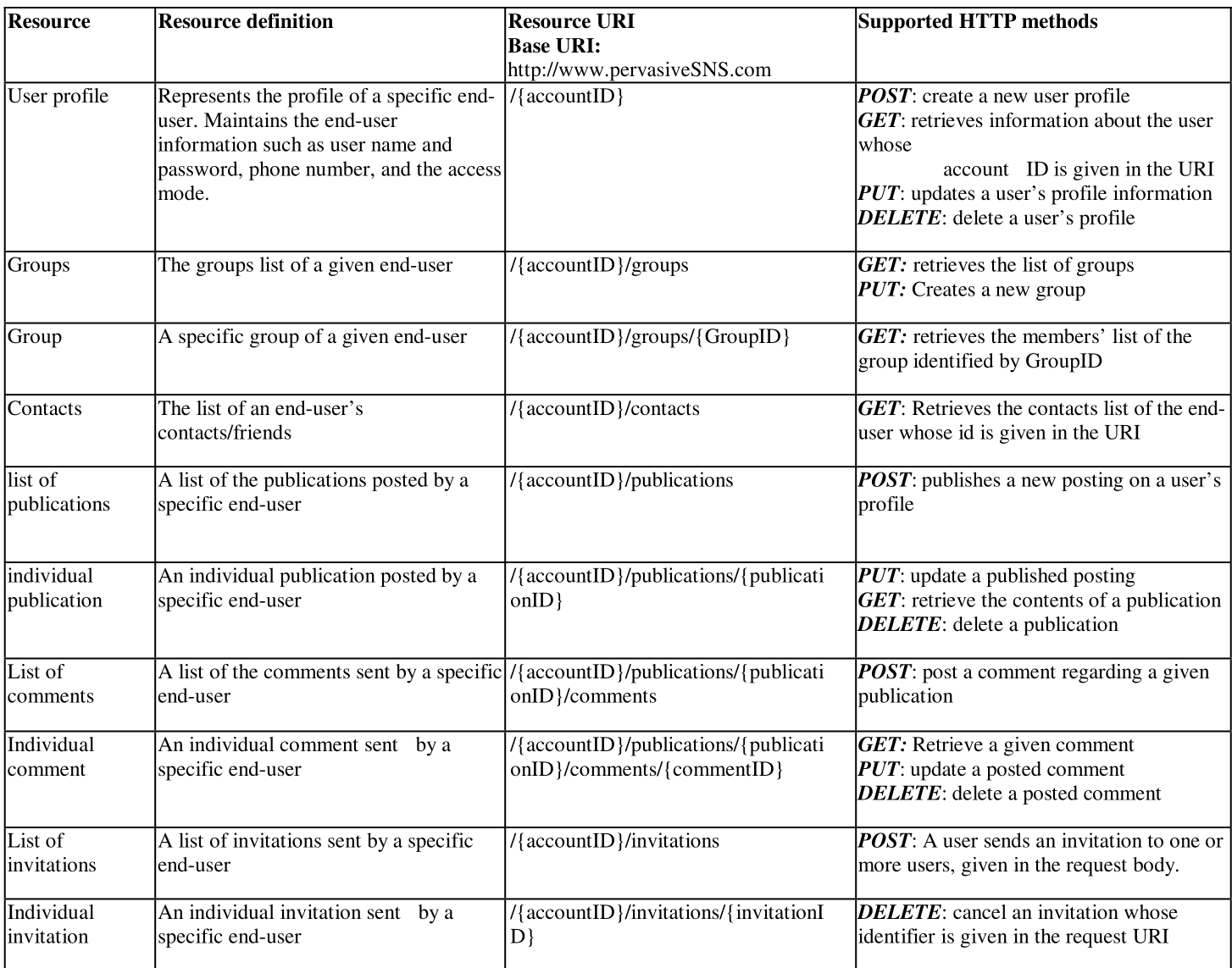 Above: The mapping of social actions to RESTful methods (POST/GET/PUT).
Critical Insight: Parity is the Key
Most "lite" versions of apps are crippled. SNS4D’s success is rooted in Feature Parity. By treating an SMS as just another "request packet" similar to an HTTP packet, the system ensures that an SMS user is a first-class citizen of the network, not an afterthought.
Future Outlook & Limitations
While SNS4D solves connectivity, it faces the hurdle of SMS Costs. In many regions, sending a text is more expensive than a few kilobytes of data. Future iterations would likely explore USSD (Unstructured Supplementary Service Data)—often free in developing countries—to lower the barrier further.
However, as a structural proof-of-concept, SNS4D proves that with the right API-first design, we can build pervasively accessible systems that don't leave rural populations behind.
Takeaway for Engineers: When designing for extreme environments, identify the "Highest Common Denominator" of connectivity (in this case, SMS) and build a translation layer rather than a separate, inferior product.