
E-SOAF: Bridging the Gap Between User Preferences and Social Service Discovery
A SOAF model extension for incorporating user feedback and preference to improve social service discovery
This paper introduces E-SOAF (Extended Service of a Friend), a semantic model designed to improve social service discovery by augmenting traditional FOAF-based structures with user feedback and QoS preferences. By integrating evaluations and quality constraints into a bipartite graph of users and services, it achieves highly personalized and efficient discovery.
1. Executive Summary
TL;DR
E-SOAF is an extension of the "Service of a Friend" (SOAF) model that transforms social service discovery from a simple keyword matching task into a preference-aware semantic process. By embedding user feedback and specific Quality of Service (QoS) metrics—such as cost, availability, and response time—directly into the social network ontology, the model delivers more relevant results with lower computational latency.
Background Positioning
In the landscape of Service-Oriented Computing (SOC), this work represents an evolutionary refinement of semantic discovery. It moves beyond the structural connectivity of SOAF and FOAF to incorporate the "human element"—subjective satisfaction and objective quality constraints—into a unified bipartite graph.
2. Motivation: Why Conventional Discovery Fails
The explosion of web services on social platforms has created an information overload. Current discovery mechanisms often treat users as static entities categorized by keywords. However, user needs are dynamic and multi-dimensional:
- Contextual QoS: One user might prioritize low cost, while another requires high availability for a mission-critical application.
- Social Trust: Traditional registries ignore the "wisdom of the crowd" and personal social circles.
- Historical Feedback: Without a feedback loop, systems continue to recommend poorly-performing services simply because they match keywords.
Developing a model that captures these nuances within a standard semantic framework is the core challenge addressed here.
3. Methodology: The E-SOAF Architecture
The authors propose the E-SOAF Module, which enriches the link between a Person and a Service.
The Semantic Extension
While the original SOAF defined relations like uses and provides, E-SOAF introduces a specific vocabulary to handle:
- Evaluations: Quantitative ratings based on previous invocations.
- QoS Preferences: A four-tuple representing Accessibility, Cost, Response Time, and Availability.
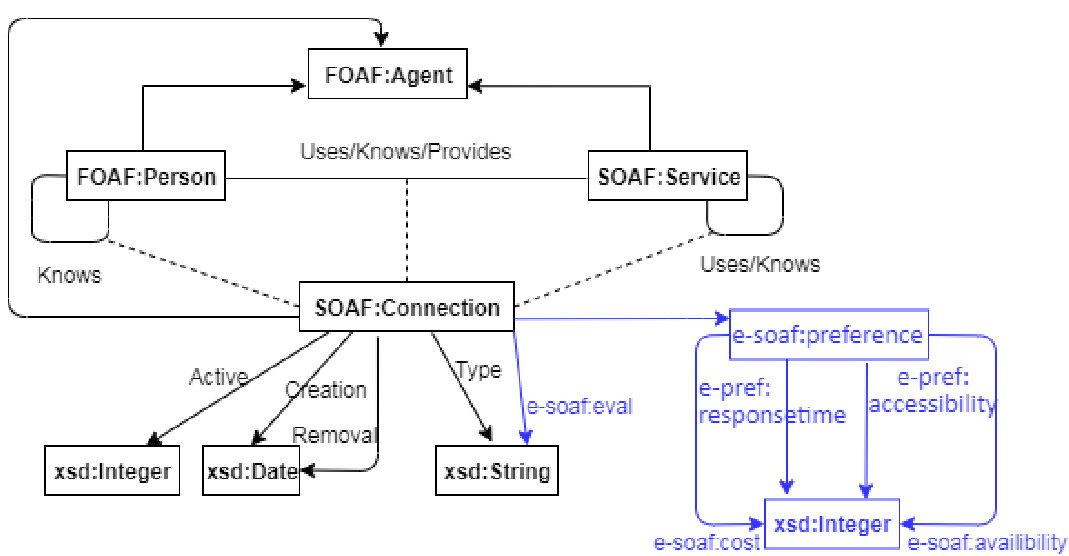 Figure 1: The Extended SOAF model illustrating new properties for QoS and Feedback.
The Discovery Logic
The framework operates on a bipartite graph . When a query is initiated:
- Step 1 (Egocentric Filtering): It identifies services used by the requester and their immediate social connections.
- Step 2 (Pruning): It uses the new
<e-soaf:eval>property to eliminate services with negative feedback and applies QoS thresholds to ensure the final list matches the user's technical constraints.
4. Experiments & Results
The model was validated using the SNAP Stanford Epinions dataset, integrated with over 1,000 social web services across domains like education and travel.
Performance Metrics
Two key dimensions were analyzed: Relevance (Service Count) and Efficiency (Response Time).
- Precision thru Reduction: As shown in the results, E-SOAF returns a smaller, more refined set of services compared to SOAF. By eliminating services that fail user-defined QoS thresholds early, it prevents "recommendation noise."
- Computational Speedup: Interestingly, adding complexity (preferences) actually decreased response time. This is because the feedback parameters act as pruning predicates, reducing the search space before the heavy discovery algorithms run.
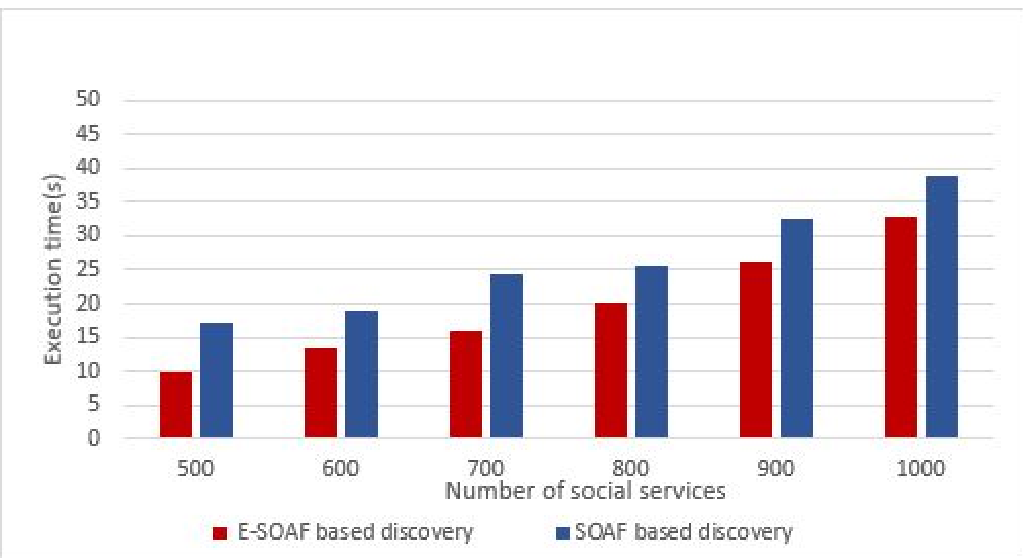 Figure 2: Execution time variation vs. number of social services.
5. Critical Analysis & Conclusion
Takeaway
E-SOAF proves that meta-data enrichment is not just about "knowing more"; it's about "filtering smarter." In a world of decentralized social services, the ability to semantically encode user dissatisfaction is just as important as encoding capability.
Limitations
- Data Sparsity: The model relies heavily on historical interaction. New services or new users (the "Cold Start" problem) may not have enough feedback data to benefit from E-SOAF's pruning.
- Subjectivity Calibration: The model treats "satisfied" as a standard value, but different users have different internal scales for satisfaction.
Future Work
The next logical step for this research is to integrate Machine Learning to predict preferences for attributes the user hasn't explicitly defined, potentially moving from a purely semantic rule-based filter to a predictive recommendation engine.