
SoC-Based Phased Arrays: Breaking the Sequential Barrier in Ultrasonic Imaging
17388_SoC-Based Architecture for an Ultrasonic Phased Array With Encoded Transmissions.
This paper presents a SoC-based architecture for an airborne ultrasonic phased array that enables simultaneous multi-directional scanning using Code-Division Multiple Access (CDMA). The core method utilizes macro-sequences derived from Complementary Sets of Sequences (CSS) with adjustable Zero Correlation Zones (ZCZ) to eliminate inter-symbol and multiple-access interference.
TL;DR
Researchers have developed a System-on-Chip (SoC) architecture that allows ultrasonic sensors to "see" in 32 directions at once. By using a clever encoding technique called CSS-based macro-sequences, they eliminated the interference that usually occurs when multiple signals are sent simultaneously. This allows for real-time, long-distance airborne scanning (up to 1.5m) with high resolution on standard FPGA hardware.
The "Wait Your Turn" Problem in Modern Sensors
Traditional ultrasonic phased arrays operate on a "pulse-echo" cycle: send a pulse in one direction, wait for the echo, and only then scan the next angle. This sequential approach is a bottleneck for robotics and high-speed inspection. While Code-Division Multiple Access (CDMA)—the tech behind 3G cellular networks—offers a way to send multiple signals at once, it usually introduces "noise" (sidelobes) that blurs the image.
The challenge is twofold:
- Mathematical: Finding codes that have zero cross-correlation so they don't interfere.
- Architectural: Processing 32 simultaneous channels of high-frequency data in real-time requires massive computational power.
Methodology: The Power of the Zero Correlation Zone (ZCZ)
The researchers utilized Complementary Sets of Sequences (CSS). These sets have the unique property that their correlation sums are perfect—zero sidelobes everywhere. However, standard CSS is hard to implement in airborne arrays due to modulation constraints.
The Macro-Sequence Insight
By concatenating CSS sequences with an interval of zeros, the authors created macro-sequences. This shift moves the "interference-free" window into a specific spatial zone (the ZCZ) that matches the physical scanning depth of the sensor.
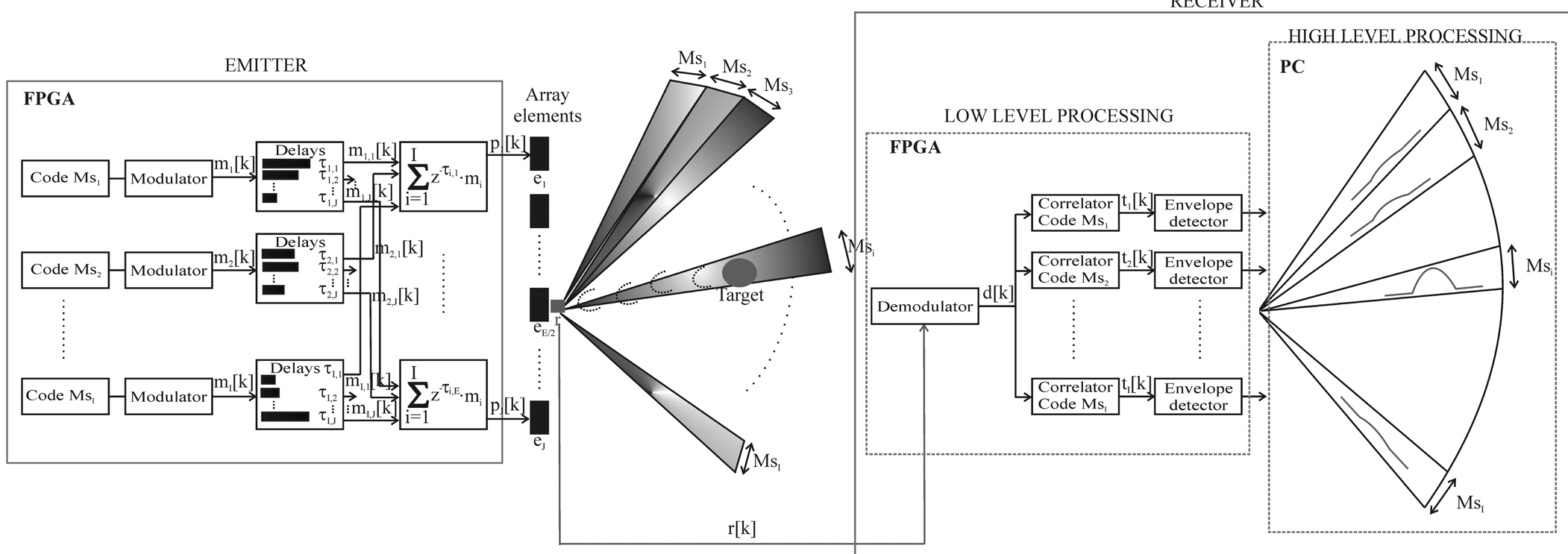 Fig 1: General view of the proposed architecture showing the FPGA-based emitter and receiver modules.
Efficient Hardware Implementation
To handle the 32-channel overlap, the authors designed a bespoke FPGA architecture. Instead of 32 separate, intensive correlators, they used a modular, pipelined correlator that reuses intermediate results.
- Emitter: Managed delay generation and BPSK modulation for 8 elements.
- Receiver: Integrated a BPSK demodulator and an efficient CSS correlator, utilizing external DDR2 memory for high-volume data storage via a Direct Memory Access (DMA) protocol.
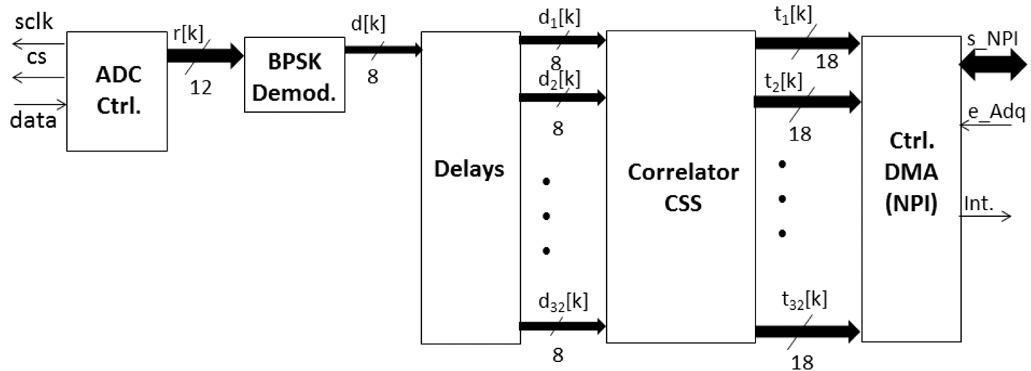 Fig 2: Detailed architecture of the Emitter module in the Xilinx Virtex-5 FPGA.
Experimental Validation
Using an EMFi-based (ElectroMechanical Film) array, the team tested the system in real-world environments.
- Range: Consistent detection of objects up to 1.5 meters.
- Axial Resolution: Achieved 1 cm precision, meaning it can distinguish two objects placed just a centimeter apart in depth.
- Lateral Resolution: Successfully resolved angular sectors with a 16° resolution across a 64° field of view.
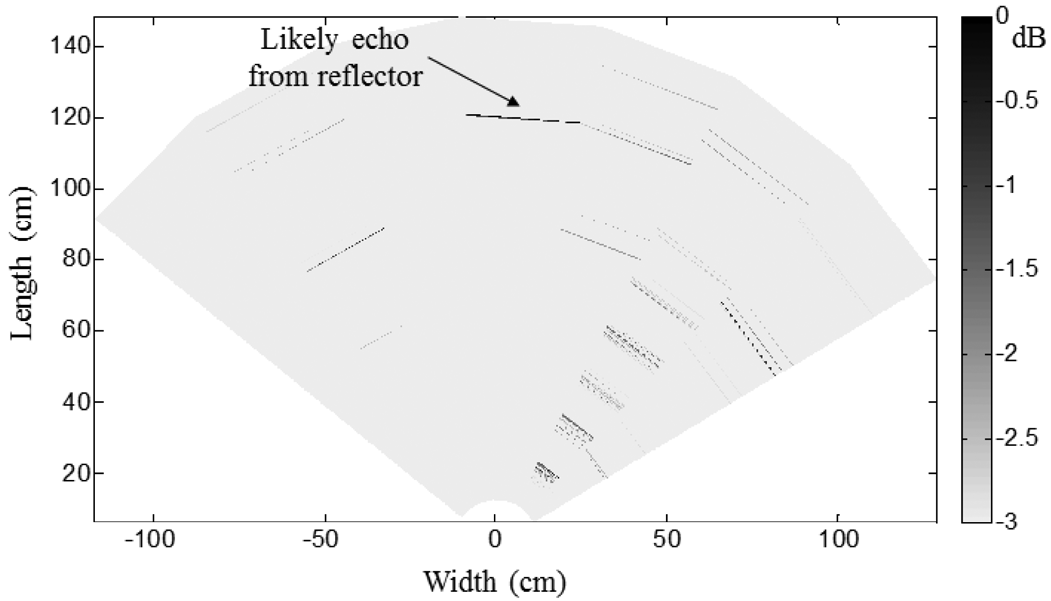 Fig 3: B-scan images demonstrating the detection of reflectors at 1m and 1.5m.
Critical Insight & Conclusion
The genius of this work isn't just in the math of the sequences, but in the co-design of the code and the hardware. Most researchers focus on the "Process Gain" of the code (how well it stands out from noise). This team realized that by accepting a slightly lower energy efficiency (due to zero-padding), they could massively simplify the FPGA logic.
Takeaway: For real-time robotics, an "efficient but imperfect" code that fits on a low-cost FPGA is often superior to a "perfect" code that requires a supercomputer to decode. This architecture paves the way for affordable, high-speed 2D ultrasonic "cameras" for autonomous indoor navigation.