
SocAware: Bridging the Gap in Social Application Interoperability through Tie-Strength Quantification
SocAware: A Middleware for Social Applications in Online Social Networks
SocAware is a specialized middleware designed for Online Social Networks (OSNs) that facilitates information sharing and interoperability between heterogeneous social applications. It employs a unique social relation extraction engine and a quantitative tie-strength calculation mechanism to build a unified knowledge base (KB) for third-party development.
TL;DR
SocAware is a middleware platform that solves the "data silo" problem in Online Social Networks (OSNs). By extracting heterogeneous interaction data and converting it into a unified knowledge base of quantified social tie-strengths, it allows third-party applications to leverage complex social relationships without building their own crawlers or analysis engines.
Background & Motivation: The Silo Problem
In the current OSN landscape, data is the new gold, but it is locked behind the walls of platforms like Facebook, Twitter (X), or Sina Weibo. For developers, building a "social-aware" application (e.g., a recommendation system or a fraud detection tool) requires:
- Direct interfacing with fragmented APIs.
- Managing proprietary data formats.
- Re-calculating social metrics from scratch.
Most existing middlewares act as simple data pass-throughs. They fail to address the qualitative difference between a "follower" and a "close friend," leading to a lack of depth in social applications.
Methodology: Quantifying the Human Connection
SocAware's innovation lies in its ability to transform raw activity logs into a structured Social Knowledge Base. The architecture is divided into three functional layers:
1. Relation Extraction Layer
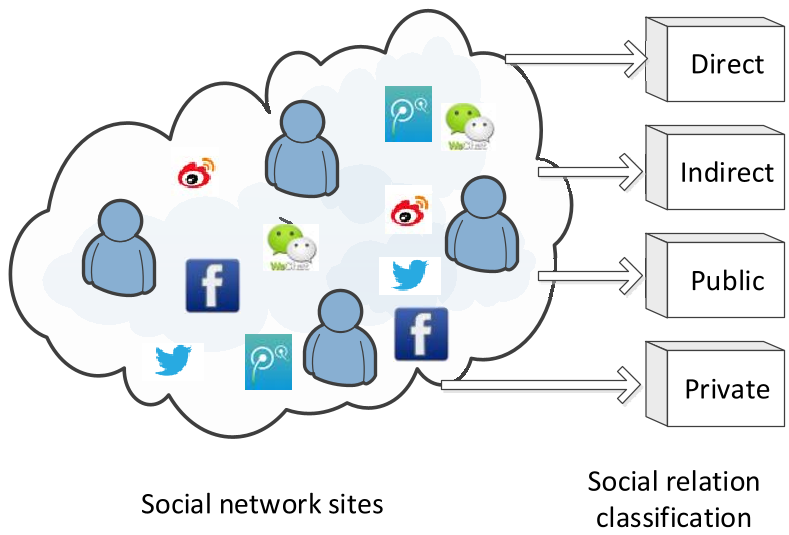
Using platform-specific APIs (demonstrated with Sina Weibo), the system monitors activities such as Mentions (@), Private Messages, and Forwarding. These are mapped into a 2x2 matrix:
- Direct vs. Indirect: Does it involve explicit communication or just common interests?
- Public vs. Private: Was the interaction visible to the world or a one-on-one exchange?
2. Management Layer & The Strength Formula
This is the "brain" of SocAware. It uses a weighted addition formula to determine the Tie Strength (): Where represents the weight of the relation type. This allows the system to prioritize private messages over mere "likes" when determining how close two users are.
3. Application Layer
Developers interact with SocAware through a set of APIs that abstract away the complexity of RDF (Resource Description Framework) models, providing an object-oriented interface to the social graph.
Experimental Validation
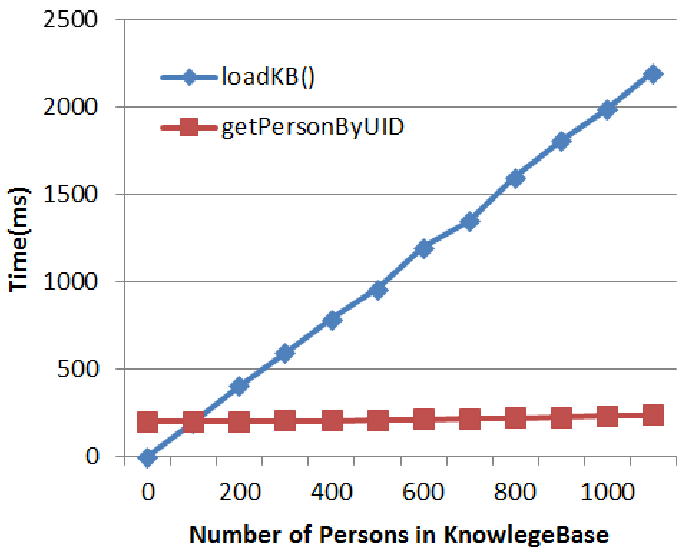
The authors evaluated the middleware's performance on standard hardware, focusing on the latency of knowledge base operations.
- Scalability: As shown in the performance graphs, the time taken for
getPersonandaddPersonremains efficient for interactive use-cases, even as the database grows. - Versatility: To prove the system isn't just for "friend-finding," the authors built a Spam Detection application (identifying bots by their weak, public-only ties) and a Real-name Authentication system.
Critical Insight & Conclusion
While SocAware provides a robust framework for its time, its primary contribution is the standardization of social tie-strength. By treating social "closeness" as a queryable metric rather than a raw list of interactions, it enables a new generation of context-aware software.
Takeaway for Today's AI Era: While this paper focuses on traditional middleware, the logic of "Relation Extraction" and "Strength Calculation" is a direct precursor to how modern Graph RAG (Retrieval-Augmented Generation) systems process social context for Large Language Models.
Limitations: The current implementation relies on public APIs which are increasingly restricted by platforms. Future iterations would likely need to incorporate decentralized protocols (like ActivityPub or AT Protocol) to bypass centralized API gatekeeping.