
SocACL: Reinventing Social Network Privacy through Logic Programming
Social access control language (SocACL)
SocACL (Social Access Control Language) is a formal Attribute-Based Access Control (ABAC) language designed for Online Social Networks (OSNs). It leverages Answer Set Programming (ASP) and model checking to provide fine-grained policy evaluation based on user attributes and complex social relationships, achieving a balance between feature richness and semantic rigor.
TL;DR
The Social Access Control Language (SocACL) is a framework that treats social media privacy as a formal logic problem. By translating user relationships and attributes into Answer Set Programming (ASP), it allows for highly granular "who-can-see-what" rules that are mathematically verifiable, moving beyond the simple "friends-only" toggles of today's social networks.
Background: Published at the SIN '13 conference, this work sits at the intersection of Access Control Models and Declarative Programming, seeking to solve the inherent ambiguity in social media privacy settings.
Problem & Motivation
Why are Facebook or LinkedIn privacy settings so frustrating? The authors point to two main flaws:
- Coarseness: Settings are usually "all or nothing" or limited to basic circles.
- Ambiguity: Users lack tools to verify if their settings actually work as intended.
Existing research often relies on bi-directional relationships (where both parties must agree). However, in modern OSNs, relationships are often one-sided (following/unfollowing). SocACL addresses this by treating relationships as unidirectional attributes—essentially "what I believe my relationship to you is"—and provides a formal language to evaluate these beliefs.
Methodology: The Power of ASP
The core innovation of SocACL is its translation layer. Every policy statement is converted into an ASP rule.
1. Structure of a Policy
A typical SocACL rule follows the format:
Principal says Head if Body;
This is translated into:
Head'_{Prin} <- Body'.
2. Direct vs. Indirect Relationships
SocACL handles the social graph with three distinct types of connectivity:
- Direct: Standard 1st-degree links.
- Strict-Indirect (sind): Requires a specific sequence of relationship types (e.g., "Friend of a Colleague").
- Relaxed-Indirect (rind): Based on distance/depth (e.g., "anyone within 3 degrees of me").
3. Architecture & Evaluation
The system utilizes the DLV Engine, a powerful tool for deductive databases, to perform model checking. When a user "asks" for access, the system checks if the query is "cautiously true" (true in all possible valid states of the policy base).
 Note: The EBNF grammar defines the rigorous structure required for ASP translation.
Experiments & Results: Alice’s Policy Base
The authors demonstrate SocACL through a use case involving "Alice," who wants to share "animalPhotos" only with those within a 2-degree relationship.
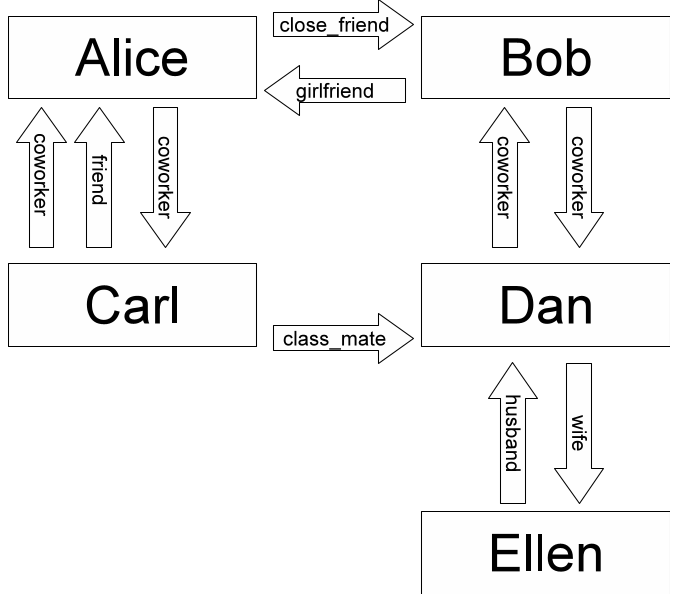 Figure: The social graph used to test policy reachability.
Key Findings:
- Precision: The system correctly identified that Carl (2nd degree) could view a photo, while Ellen (outside the threshold) was blocked.
- Complexity: For most OSN tasks, the inference is co-NP, which is computationally feasible for medium-scale policy bases.
- Deny-Override: The logic naturally supports "deny" rules that take precedence over "allow" rules, a critical feature for security.
Critical Analysis & Conclusion
Takeaway
SocACL introduces a "Socially Aware" ABAC. Unlike standard ABAC which might just look at "Age > 18," SocACL looks at "Is this person a friend of a person I trust?" This captures the transitive nature of trust inherent in social interactions.
Limitations
As a short paper, SocACL has a few gaps:
- Obligation Enforcement: While it can define that a user should do something (like "clean a room" or "pay a fee") after access, it does not yet have a mechanism to ensure that action happens.
- Scalability: While ASP is powerful, calculating shortest paths (rindRelationship) in a graph with millions of nodes (like the real Facebook) would require significant optimization beyond the standard DLV implementation.
Future Outlook
The move toward "Zero Trust" and complex data sharing ecosystems makes the formal verification offered by SocACL more relevant than ever. Future iterations could integrate Machine Learning to help users "write" these logic rules simply by describing their desired privacy outcomes in natural language.