
Empowering the Care Circle: A Social Model Strategy for Accessible Networking
A Social Approach to Accessible Social Networking Using the CAT Model
This paper presents an application of the Comprehensive Assistive Technology (CAT) model to design accessible social networking solutions for children with motor impairments. By analyzing the "care circle"—including family, medical practitioners, and educators—it proposes a virtual social environment to streamline the selection and support of assistive technologies (AT).
TL;DR
This research moves beyond the "medical fix" for disability, applying the Comprehensive Assistive Technology (CAT) model to create social networks for children with motor impairments. Instead of just tweaking hardware, the authors advocate for a virtual environment that connects the "care circle"—parents, therapists, and teachers—to optimize how assistive technology is chosen and used.
Background: Moving Beyond the Medical Gaze
In the realm of disability studies, a critical shift has occurred: moving from the Medical Model (disability as a physical "defect") to the Social Model (disability as a result of environmental and social barriers). Despite this shift, many accessibility frameworks like HAAT or MPT remain stubbornly focused on the individual's physical limitations.
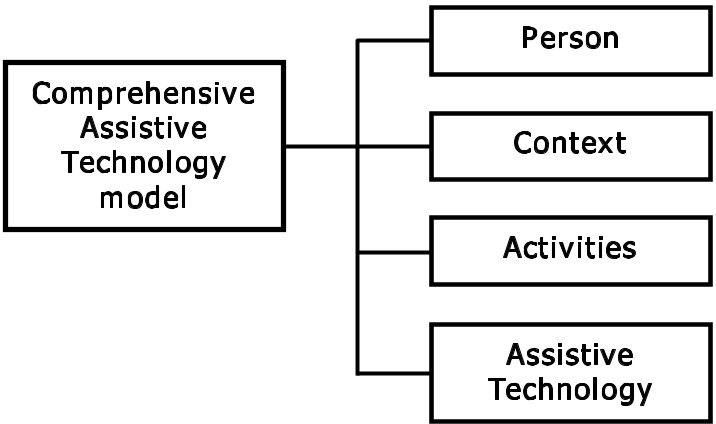
This paper utilizes the CAT Model, which rebalances the scale by emphasizing the Context and Activity as much as the Person.
The Problem: The "Cupboard" Syndrome
A significant pain point in assistive technology (AT) is that many expensive devices end up "in the cupboard" unused. Why?
- Communication Gaps: Key members of a child's care circle (e.g., grandparents or teachers) are often excluded from the selection process.
- Platform Exclusion: Typical social networks are too complex, text-heavy, or change their interfaces too abruptly for users with motor or cognitive impairments.
- Fragmentation: Essential information for a child's development is often stored locally, making it hard for a distributed care circle to coordinate.
Methodology: Applying the CAT Model
The authors break down the solution using the CAT model’s hierarchy: Person (P), Context (C), and Activities (A).
1. The CAT Framework
The model uses tree diagrams and tabular representations to map requirements. By labeling attributes, researchers can identify specific gaps—such as the need for "fun" and "entertaining" interfaces for children, or the need for multi-language support (e.g., for non-English speaking grandparents).
2. Identifying Barriers via Comparison
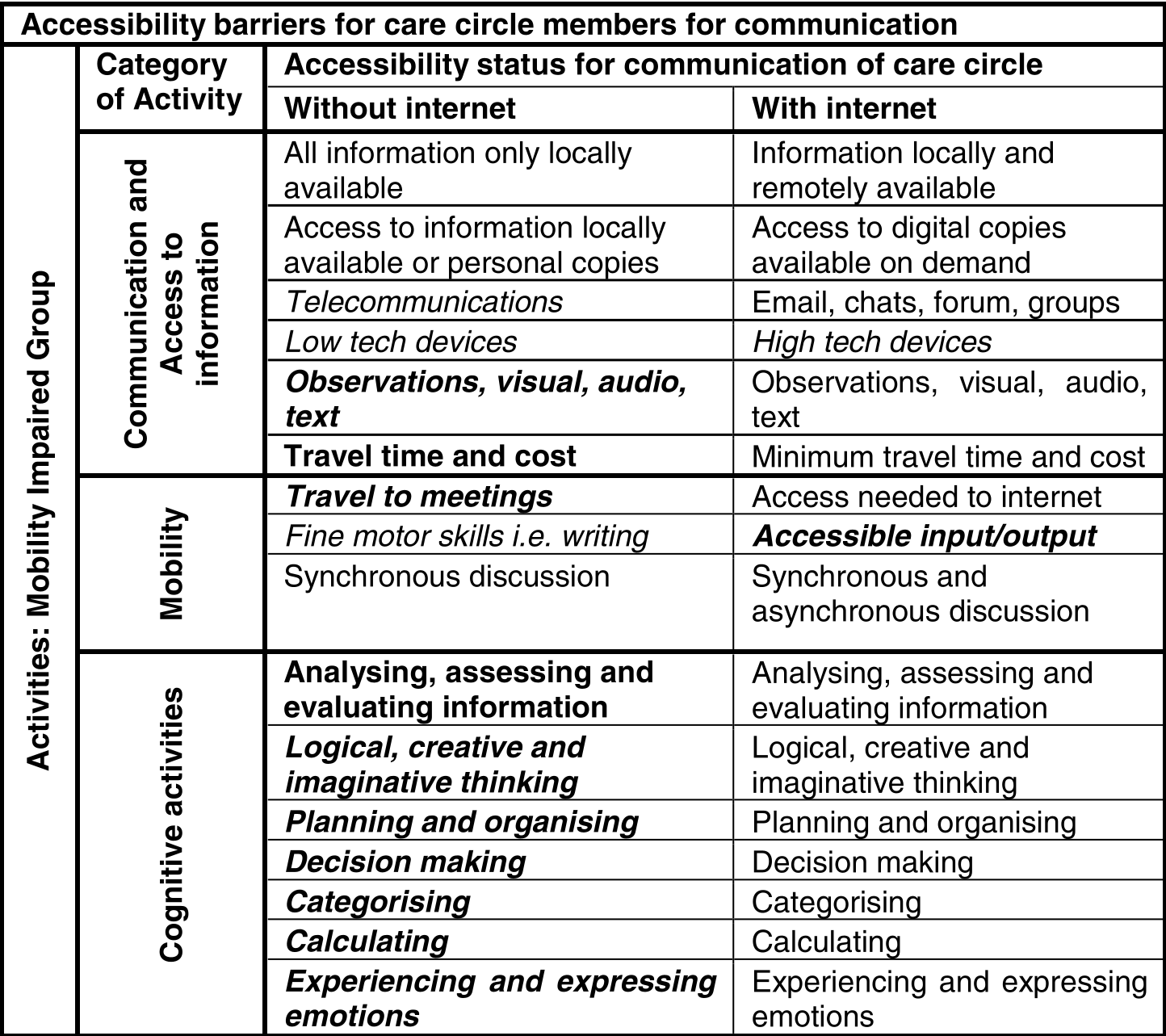
The paper compares traditional communication environments with internet-based ones. A key insight is that digital environments allow for asynchronous discussion, which is vital for busy professionals and parents who cannot always meet in person.
Design Solution: A Social Network for Inclusion
The proposed architecture is a secure, web-based social network where:
- Gatekeeping: Parents or guardians control access to the child's profile.
- Multimodality: Support for images, audio, and video to reduce the burden of text-heavy interfaces.
- Cross-Platform: Accessible via PC and mobile, ensuring it fits into the daily routines of all care circle members.
Critical Analysis: Impact and Limitations
Why this works: The genius of this approach lies in the "Social Model." By making the care circle more efficient, the child's environment becomes less disabling. The network acts as a "Social AT" that supplements physical AT.
Limitations: The paper reflects the technology of its era (late 2000s/early 2010s). Today, we would need to consider Data Privacy (GDPR) more rigorously and the potential for AI-driven automation to help summarize the massive amounts of data generated by such a network.
Conclusion
The CAT model provides a robust scaffold for designing systems that don't just "fix" a user, but "enable" a community. To reduce disability, we must look at the digital world not as a series of technical hurdles, but as a platform for social inclusion.
Takeaway: Future accessibility design should prioritize the "Care Circle" as a primary user group, recognizing that the social infrastructure is the most powerful assistive technology we have.