
Social Accountability: Bridging the Gap Between IP Packets and Real Identities
A Social Accountability Framework for Computer Networks
The paper introduces a "Social Accountability Framework" that binds Internet actions to real-world identities using Online Social Networks (OSNs). By leveraging existing protocols (IKE/IPsec), it classifies network traffic as either "accountable" or "unknown," enabling services like anti-spam and secure blogs to verify users without a complete Internet architecture overhaul.
TL;DR
The Internet is plagued by anonymity-driven attacks because IP addresses don't inherently represent people. This paper proposes a Social Accountability Framework that connects network traffic to Online Social Network (OSN) profiles. It allows websites to demand identity verification through a lightweight, incrementally deployable system using pGates, sGates, and standard IPsec, requiring no changes to the Internet's core infrastructure.
Problem & Motivation: The Anonymity Pandemic
The "architectural simplicity" of the Internet—once its greatest strength—is now its Achilles' heel. Because IP addresses are easily spoofed and rarely tied to a person, malicious actors can launch DoS attacks or spread defamation with impunity.
While "clean-slate" solutions like AIP exist, they are virtually impossible to deploy because they require replacing global routing hardware. The authors' insight is simple: We already have a global identity infrastructure—Social Networks (Facebook, LinkedIn). Why not use them to vouch for network traffic?
Methodology: High-Level Architecture
The framework operates through two main components that overlay existing OSI layers:
- pGate (Personal Gate): Software on a user's device that marks outgoing packets with cryptographic tags using IPsec AH/ESP.
- sGate (Social Gate): A middlebox representing organizations. It acts as a witness, provides membership proof ("vouching"), and manages NAT traversal.
The Handshake and Addressing
To handle the modern reality of Private IPs and NATs, the framework employs Social DNS. When user A wants to talk to user B, they resolve a domain that points to B’s sGate. The system dynamically maps these connections into a virtual 10.0.0.0/8 space, allowing end-to-end IPsec tunnels even through multiple layers of NAT.
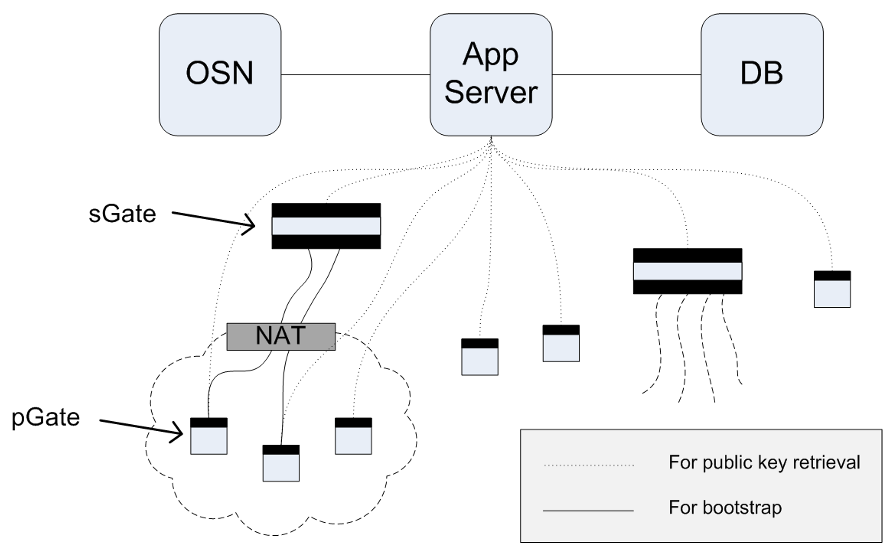 Fig 1: The dual-gate architecture connecting users and organizations via OSN identities.
Why Social Nets?
Unlike a rigid Hierarchical PKI (like SSL certificates), this "Web of Trust" model leverages existing social links. Trust isn't binary; it's contextual. A blog owner might allow comments only from "friends of friends" or members of a specific LinkedIn group.
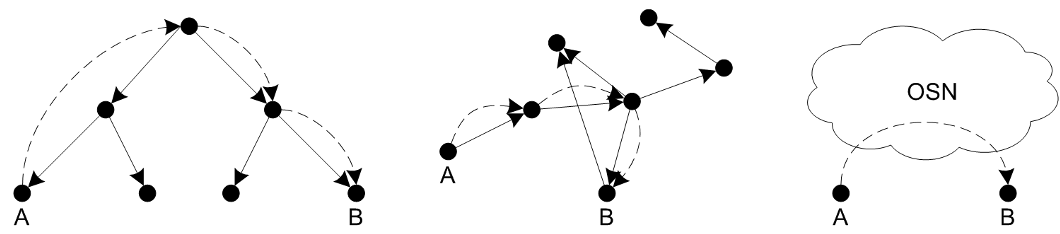 Fig 2: Differing trust models. The Social Accountability Framework (right) relies on active social platform links for key management.
Experiments & Performance
The authors implemented a prototype in C using libipq.
- Latency: The overhead for session establishment (Probe + IKE) is roughly 108ms. Considering the cross-continental nature of the test (McGill to Manitoba), a 33ms additional delay over standard IPsec is remarkably low.
- Throughput: There is a drop from 50 Mbps to 40 Mbps. However, the authors argue that 15% of this loss is due to
libipq’s kernel-to-user space copying, not the framework's logic itself. Moving the implementation into the kernel (using Click) would likely close this gap.
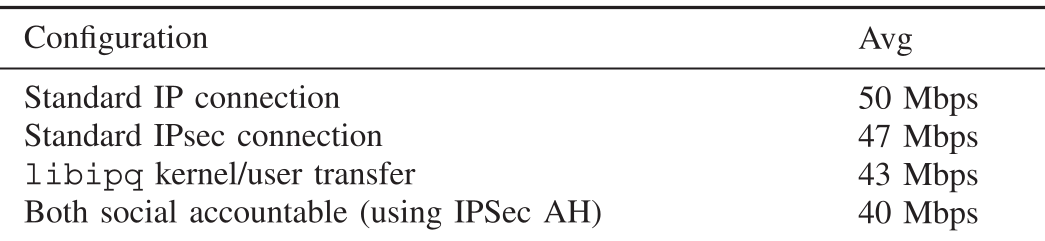 Fig 3: Throughput comparison showing that social accountability adds minimal overhead beyond standard IPsec.
Critical Analysis & Conclusion
Takeaway
The Social Accountability Framework provides a "gray zone" for the Internet. It doesn't force identity on everyone, but it empowers service providers to say, "You can be anonymous elsewhere, but here, you must be accountable."
Limitations
- OSN Centralization: The framework relies on the availability and APIs of major OSNs. If an OSN changes its API or goes offline, the accountability layer breaks.
- Privacy Concerns: While it solves accountability, it potentially trades it for privacy by linking network traffic to social profiles. The authors note the framework is optional, but if every major site adopts it, anonymity is effectively killed.
- Kernel Performance: The current user-space implementation is a bottleneck for high-speed organization gates (sGates).
Future Outlook
This research anticipates the shift toward "Zero Trust" architectures. By integrating identity at the network layer rather than just the application layer, we can create more resilient systems against spam, botnets, and online harassment.