
CBMF: Bridging Social Reputation and Dynamic Interests for Superior Recommendations
Exploring social activeness and dynamic interest in community-based recommender system
The paper introduces CBMF (Community-Based Matrix Factorization), a novel recommendation framework that integrates "social activeness" and "temporal interest dynamics" into community detection. By partitioning users and items into overlapping communities using a modified PLSA model before applying Matrix Factorization, it achieves SOTA performance on Top-N recommendation tasks.
TL;DR
Recommender systems often struggle because they treat user behavior as a static snapshot. CBMF (Community-Based Matrix Factorization) changes this by injecting two critical real-world variables into the recommendation engine: how "active" a user is in their social circle and how their interests "decay" over time. By grouping users into communities based on these weights, the system reduces data sparsity and boosts recommendation accuracy (MAP) by up to 109% compared to traditional methods.
The Core Challenge: The Static Sparsity Trap
Most Collaborative Filtering (CF) algorithms assume that if you liked a sci-fi movie in 2010, you are equally likely to want another one in 2024. This ignores Temporal Drift. Furthermore, they treat every user's rating as equally valuable, ignoring Social Activeness—the idea that a "power user" or a "tastemaker" with high reputation usually provides more reliable signals than a casual lurker.
The authors argue that by detecting communities—groups of users and items with shared latent traits—we can focus on denser clusters of data, but only if we weight those communities by social influence and time.
Methodology: The Two-Phase Intelligence
CBMF operates in two distinct stages to transform raw rating data into high-precision Top-N lists.
Phase 1: Weighted Community Detection
Instead of a simple clustering, the authors use a modified Probabilistic Latent Semantic Analysis (PLSA). They introduce a synthesized weight that combines:
- Social Activeness (): Calculated via PageRank on the social trust network. Users with more "in-degree" trust relations carry more weight.
- Temporal Dynamic (): A time-decay function that prioritizes recent ratings.
The resulting POI (Point of Interest) score determines which community a user belongs to, allowing for overlapping memberships—reflecting the reality that a person can belong to both a "Tech" and a "Gaming" community simultaneously.
Phase 2: Localized Matrix Factorization
Once communities are formed, the global sparse matrix is broken into several denser sub-matrices. The authors then apply Probabilistic Matrix Factorization (PMF) within each community. This helps the model learn "local" nuances that would be lost in a massive, global calculation.
Empirical Results: Crushing the Baselines
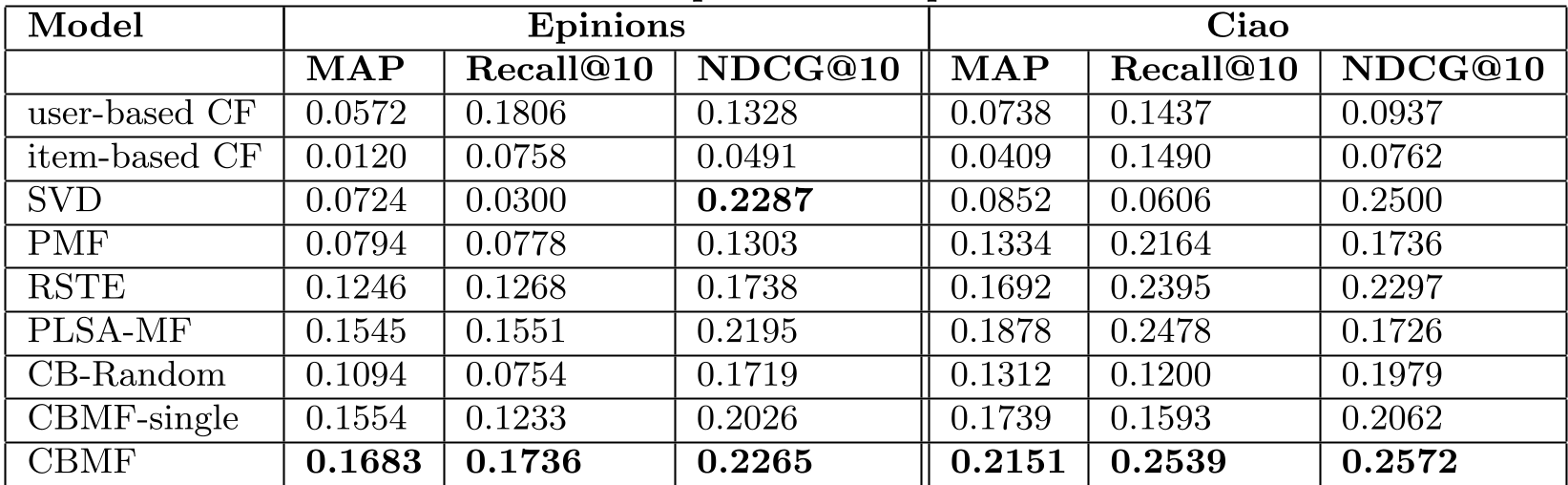
The performance gains of CBMF are substantial. Tested against classic SVD, PMF, and social-aware models like RSTE, CBMF consistently takes the lead.
| Dataset | Metric | PMF (Baseline) | CBMF (Proposed) | Improvement |
|---|---|---|---|---|
| Epinions | MAP | 0.0794 | 0.1683 | +111.9% |
| Ciao | MAP | 0.1334 | 0.2151 | +61.2% |
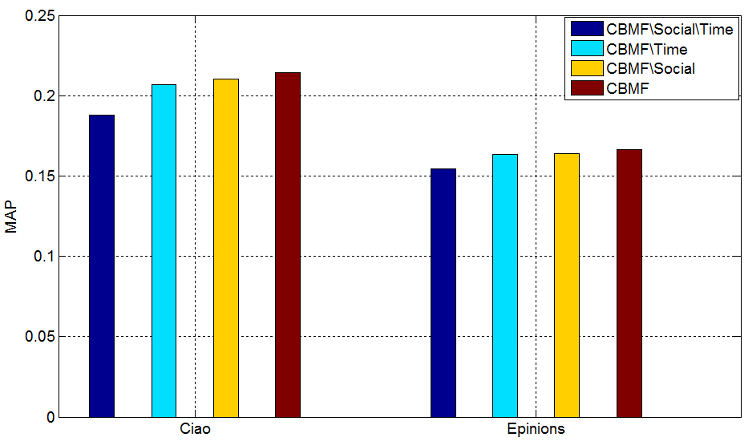
Key Insight from Ablation Studies: The authors found that removing the temporal component () hurt performance more than removing the social component (). This confirms that when you liked something is often more predictive of your next move than who you know.
Critical Analysis & Future Outlook
The beauty of CBMF lies in its Inductive Bias: it assumes that human interest is a local, time-sensitive, and socially-influenced phenomenon. By mathematically modeling these "common sense" intuitions, they solve the technical problem of matrix sparsity.
Limitations:
- Computational Overhead: Running PageRank and PLSA before MF adds complexity.
- Scalability: While the authors suggest MapReduce for future work, the current overlapping community approach might face bottlenecks as the number of "clusters" grows.
Conclusion: CBMF is a significant milestone in community-based recommendation. It proves that "Social" is not just a graph of links, but a weight of influence, and "Interest" is not a static state, but a decaying signal. This work paves the way for more "context-aware" AI systems that understand the fluid nature of human preference.