
CBMF: Bridging Social Activeness and Temporal Dynamics in Recommender Systems
Exploring social activeness and dynamic interest in community-based recommender system
The paper introduces CBMF (Community-Based Matrix Factorization), a two-phase recommendation framework that integrates social activeness and temporal dynamic interest into community detection. By partitioning users and items into denser sub-communities and applying matrix factorization within each, CBMF achieves state-of-the-art results on Epinions and Ciao datasets.
TL;DR
CBMF (Community-Based Matrix Factorization) is a novel dual-phase framework that tackles the "data sparsity" and "cold start" demons of recommendation engines. By leveraging Social Activeness (who is influential?) and Dynamic Interest (what is relevant now?), it clusters users into overlapping communities before performing Matrix Factorization. The result? A massive jump in precision and recall across real-world social datasets.
Background & Motivation
Despite the success of Collaborative Filtering, most models treat users as static points in a high-dimensional space. In reality, two things are always true:
- Not all users are equal: A "Big V" (high-reputation) user's rating is often more indicative of quality than a sporadic user's.
- Interests drift: Your obsession with rock music at age 20 might evolve into a preference for classical music at 30.
Previous community-based methods focused strictly on link analysis (who follows whom) but ignored these behavioral nuances. The authors of this paper argue that by quantifying Social Activeness and Temporal Decay, we can build a much more "trustworthy" and "relevant" latent space.
Methodology: The Two-Phase Approach
Phase 1: Socially-Aware Community Detection
Instead of using standard clustering, the authors modify Probabilistic Latent Semantic Analysis (PLSA). They introduce a synthesis weight that governs the importance of a user-item rating:
- (Social Activeness): Calculated using PageRank on the social trust network. High-reputation users get higher weights.
- (Temporal Dynamic): A time-decay function ensures that recent ratings have more influence on current community assignment than ratings from years ago.
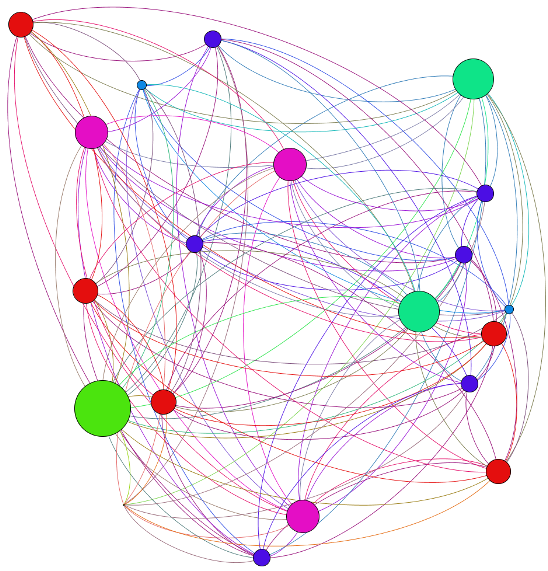 Figure 1: Illustration of users with different social activeness in a network.
Phase 2: Localized Matrix Factorization
Once users and items are allocated to communities (which can be overlapping), the global sparse matrix is broken down into several dense sub-matrices. Probabilistic Matrix Factorization (PMF) is then applied to each community. This "divide and conquer" strategy allows the model to capture niche preferences that would normally be drowned out in a global model.
Experimental Results
The framework was tested on Epinions and Ciao datasets. The results are clear: CBMF dominates.
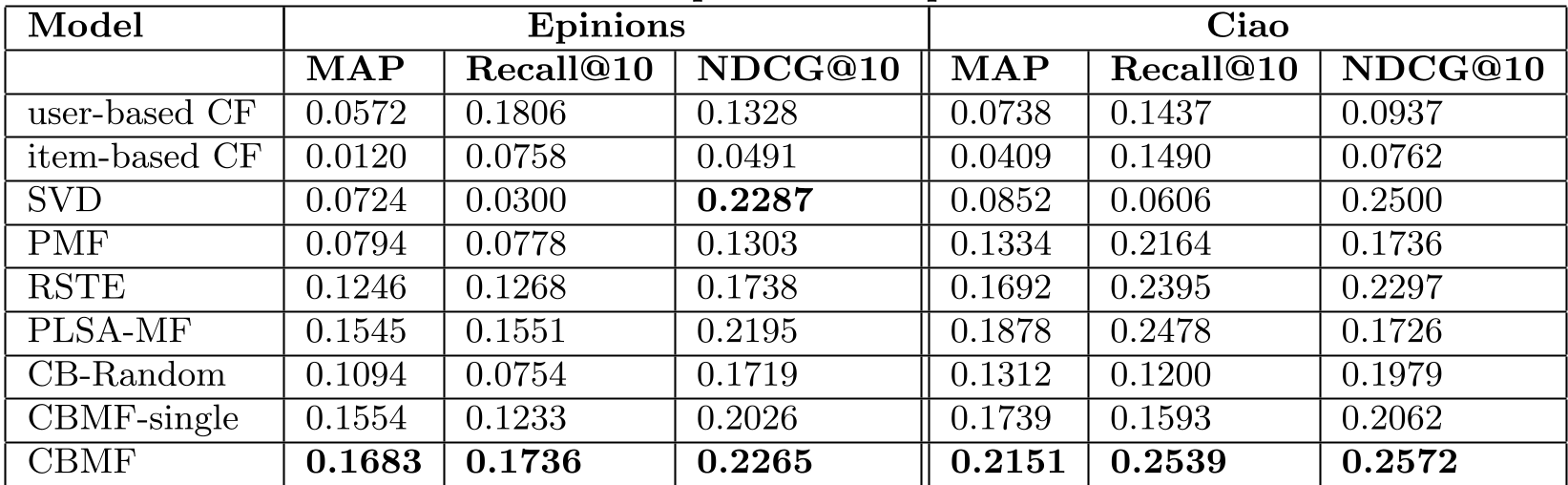
Key Insights from the Data:
- Sparsity Mitigation: The sub-matrices generated by the communities were significantly denser than the original matrix, which explains the jump in MAP (Mean Average Precision).
- Overlapping vs. Single: CBMF (overlapping) outperformed CBMF-single, confirming that users naturally belong to multiple interest groups.
- Time > Social: In the ablation study, removing the temporal feature caused a larger performance drop than removing social activeness, highlighting that recency is a critical signal for modern systems.
Critical Analysis & Conclusion
CBMF proves that "context is king." By pre-processing the user-item relationship through the lens of social influence and time, we can significantly boost the efficiency of Matrix Factorization.
Limitations:
- The current framework uses PageRank, which might be computationally expensive for real-time updates in massive networks.
- The merging phase (averaging results from multiple communities) is simple; a more sophisticated attention-based merging mechanism might yield even better results.
Future Outlook: The authors suggest moving toward MapReduce implementations for parallelization. In the era of Deep Learning, the logical next step for this research would be replacing the PMF phase with Graph Convolutional Networks (GCNs) to further exploit the multi-hop relationships within those detected communities.
Senior Editor's Note: This paper is a classic example of how "Physical Intuition"—understanding that human behavior is dynamic and social—can outperform raw algorithmic complexity.