
Elevating Activity Recognition: Why Spatial Proximity is the Key to Social Intelligence
Social activity recognition based on probabilistic merging of skeleton features with proximity priors from RGB-D data
This paper introduces a probabilistic framework for Social Activity Recognition (SAR) using RGB-D data, specifically through a redesigned Dynamic Bayesian Mixture Model (DBMM). It integrates spatio-temporal skeleton features with "proximity priors" derived from proxemics theory to classify eight distinct human-human interactions, achieving a SOTA accuracy of over 85% on a newly released public dataset.
TL;DR
In the realm of robotics and Active & Assisted Living (AAL), recognizing what one person is doing is no longer enough—we need to understand what two people are doing together. This paper introduces a sophisticated probabilistic framework that combines individual body language with "Social Features" and Proxemics Theory. By learning how physical distance encodes social intent, the authors achieve over 85% accuracy in recognizing complex interactions like hugging, fighting, and helping someone walk.
The Blind Spot of Modern HAR: The "Social" in Interaction
Most Human Activity Recognition (HAR) research treats the world as a stage for a solo performer. While we have mastered detecting "walking" or "drinking," social activities—like a "handshake" or "pushing"—are fundamentally different because the meaning lies in the relationship between two skeletons.
The authors identify a critical gap: existing models often concatenate all data into one flat vector, losing the semantic distinction between who is the "actor" and who is the "reactor." Furthermore, they cite Proxemics Theory (the study of how humans use space), arguing that the physical distance between two people is not just noise, but a powerful "prior" that can predict the activity before the motion even begins.
Methodology: The Multi-Mixture DBMM
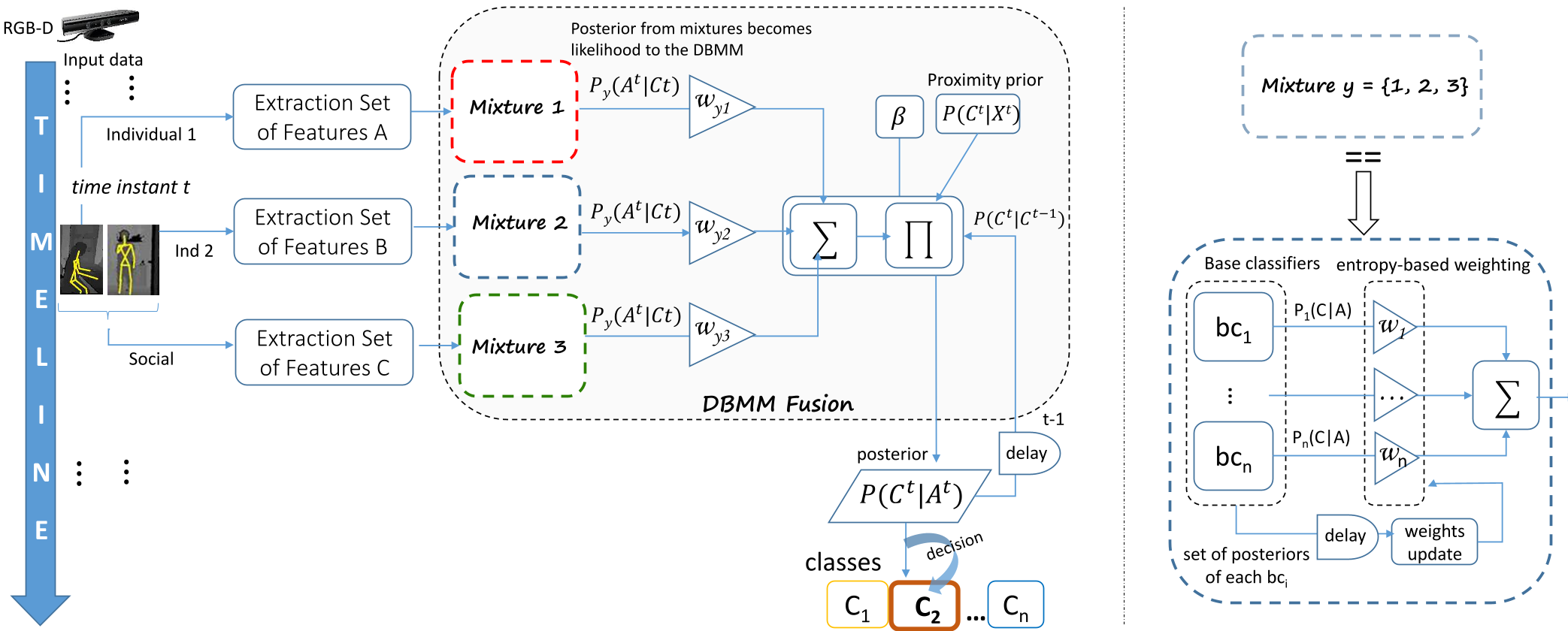
The core innovation is an extension of the Dynamic Bayesian Mixture Model (DBMM). Instead of a single classifier, the authors utilize a hierarchical fusion strategy:
- Triple Mixture Fusion: The system processes three distinct semantic streams:
- Individual 1 Features: 171 spatio-temporal features (angles, velocities, log-covariance of joints).
- Individual 2 Features: Same as above, accounting for the second participant.
- Social Features: 245 features specifically describing the 3D relationship between the two skeletons (e.g., torso-to-torso distance, energy of approach).
- The Proximity Prior: Using a Multivariate Gaussian Distribution, the model "learns" the typical personal space associated with each activity. For example, a "hug" has a distinct distance profile compared to a "conversation." This serves as a Bayesian prior (), narrowing down the possibilities for the motion classifiers.
Empirical Evidence: The ISR-UoL Dataset
To validate their approach, the team created the ISR-UoL 3D Social Activity Dataset. It includes challenging scenarios for assisted living, such as:
- Casual: Handshake, Greeting Hug, Conversation.
- Assisted Care: Helping to Walk, Helping to Stand up.
- Risk/Aggression: Fighting, Pushing, Calling Attention.
Key Results
The inclusion of proximity priors was the "secret sauce." While motion features provide the "how," distance provides the "context."
- Holistic Model (One Mixture): 82.98% Accuracy.
- Full Proposed Model (Multiple Mixtures + Priors): 86.20% Accuracy.
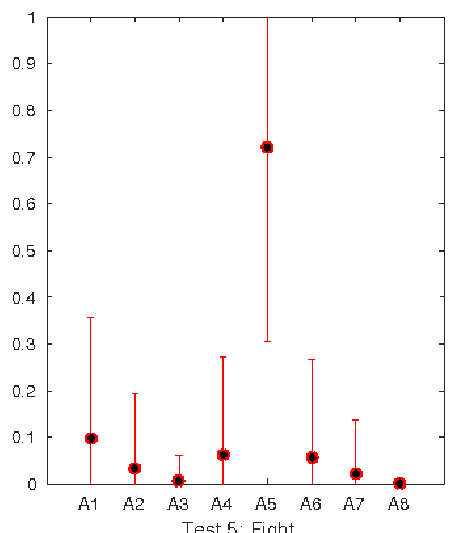 Above: The effectiveness of the proximity priors across different activities. Note how "Conversation" and "Handshake" occupy distinct spatial territories.
Critical Insights & Future Outlook
The beauty of this work lies in its semantic modularity. By separating features into "Individual" and "Social" mixtures, the model remains robust even if one person is partially occluded. It treats social interaction as a dialogue of skeletons.
Limitations: Currently, the model relies on top-down distance priors which might vary across cultures (as the authors admit with their diverse Italian, Brazilian, and Portuguese participants). Future iterations could benefit from adaptive proxemics that learn a specific user's comfort zone over time.
For developers in the AAL and service robotics space, this paper provides a blueprint for building robots that don't just "see" humans, but "understand" the social fabric of their interactions.
References
- Coppola, C., et al. "Social Activity Recognition based on Probabilistic Merging of Skeleton Features with Proximity Priors from RGB-D Data."
- ISR-UoL 3D Social Activity Dataset [Available Online].