
From Clicks to Centrality: Why Your Social Activity is the Ultimate Mirror of Your Network Power
Social activity and structural centrality in online social networks
This study investigates the relationship between user activity and structural centrality in Online Social Networks (OSNs). Using a Structural Equation Model (SEM) on data from 26,000 members, the authors demonstrate that "Personal Activity" is a highly reliable surrogate for traditional structural centrality measures like Degree, Closeness, and Betweenness.
TL;DR
In the world of social media marketing, finding the "Opinion Leader" is the holy grail. While academics have long used complex math (Structural Centrality) to find these people, this paper reveals a simpler truth: Personal Activity—the density of your 1:1 interactions—is a near-perfect proxy (98% correlation) for structural power. If you message many people and request many friends, you are the center of the web.
Positioning: This work bridges the gap between Graph Theory (the math of connections) and Behavioral Analytics (the study of what people actually do), providing a practical "shortcut" for businesses to identify influencers.
The Problem: The High Cost of Knowing "Who Matters"
For decades, identifying key network members relied on Structural Centrality. If you wanted to find an influencer, you had to calculate:
- Degree Centrality: How many people are you directly connected to?
- Betweenness Centrality: Do you act as a "bridge" between different groups?
- Closeness Centrality: How many "hops" does it take to reach everyone else?
The problem? These are computationally "heavy." For a network of millions, calculating betweenness is a nightmare. Moreover, structural data is often "hidden" from third-party marketers, while activity data (likes, messages, posts) is much easier to observe.
The Insight: Personal vs. Impersonal
The researchers hypothesized that not all activities are created equal. They divided user behavior into two buckets:
- Personal Activity (1:1): Sending direct messages, friendship requests, and invitations. This is "bonding" behavior.
- Impersonal Activity (1:n): Status updates, forum posts, and picture uploads. This is "broadcasting" behavior.
The authors suspected that only Personal Activity truly builds the "structural importance" of a member.
Methodology: Testing the Link
Using data from a German event-planning social network (~26,000 members), the authors applied SmartPLS 2.0 to model the causal relationships.
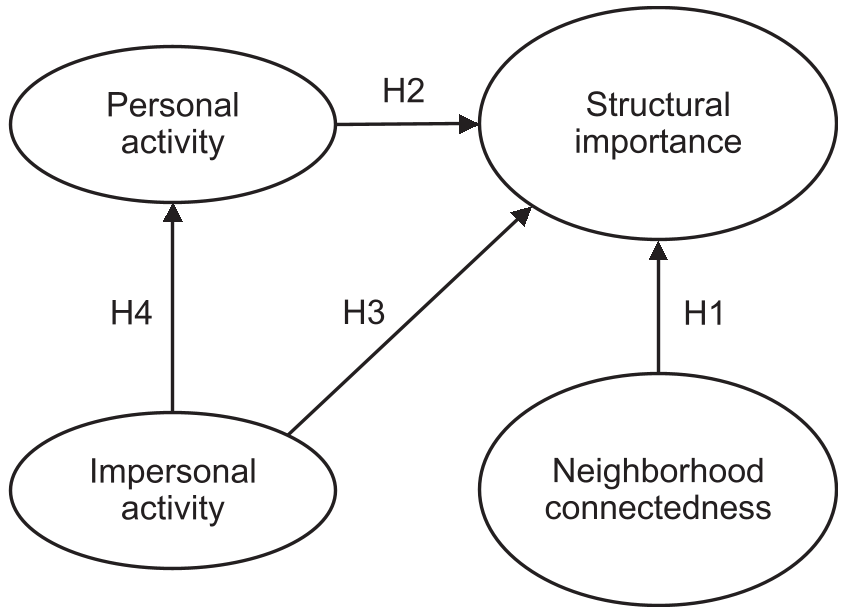 Figure 1: The Research Model illustrating the hypothesized paths between Personal/Impersonal activity and Structural Importance.
They measured seven specific types of activity (A1-A7) and mapped them against the classic Freeman indices (S1-S3).
Results: The 98% Correlation
The findings were striking. The path coefficient between Personal Activity and Structural Importance was 0.98.
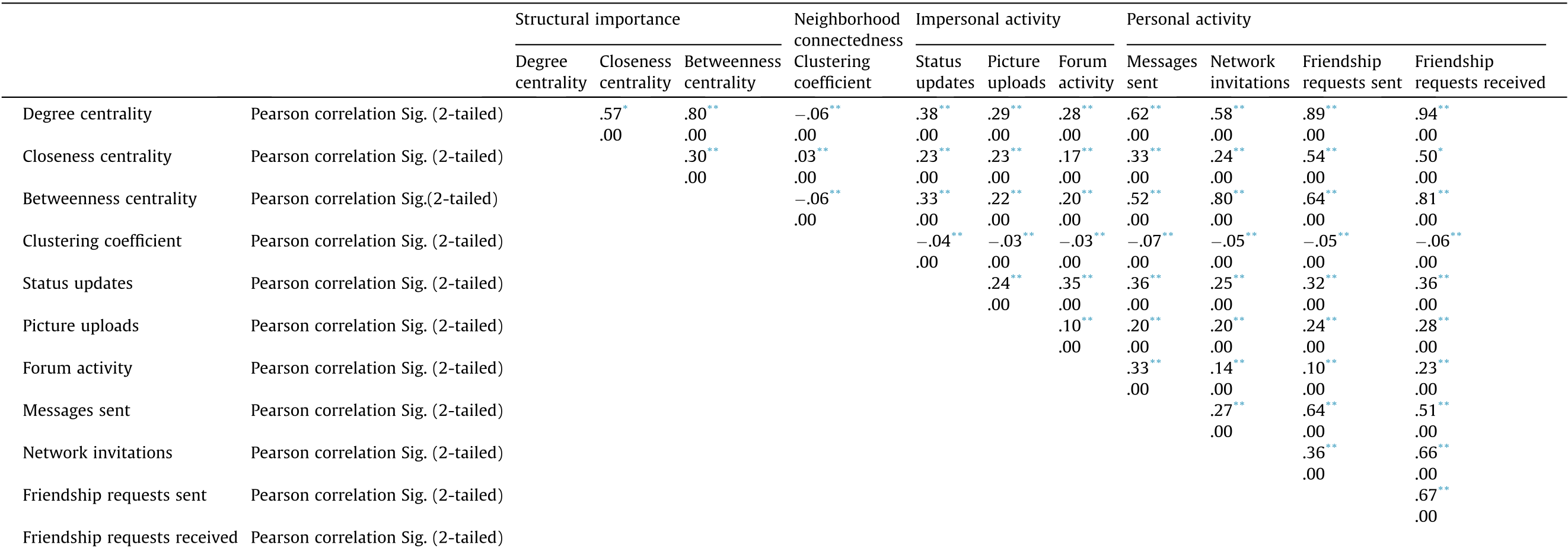 Table 1: Correlation matrix showing the strong link between Personal Activities (Messages/Requests) and Centrality measures.
Key Findings:
- Broadcasting isn't Centrality: Impersonal activity (forum posts) had 0.00 effect on structural importance. You can shout into the void all day, but it doesn't make you a structural "bridge" in the network unless you engage in 1:1 interactions.
- The Indirect Loop: Interestingly, Impersonal activity did have a 0.47 effect on Personal activity. This means posting in forums makes you "visible," leading to more 1:1 messages, which eventually builds your centrality.
- Neighborhood Doesn't Matter: The "Clustering Coefficient" (how connected your friends are to each other) had almost no impact on your own importance.
Critical Analysis & Conclusion
Takeaway
The study proves that for SEOs, marketers, and platform owners, you don't need a PhD in Graph Theory to find your "Evangelists." Simply looking at high-frequency 1:1 communicators (the "Talkatives") will give you the same list of targets as high-end structural analysis.
Limitations
- Content vs. Volume: The study looks at the quantity of messages, not the quality or sentiment. A user sending 1,000 spam messages might look "central" but lacks real influence.
- Single Network Bias: The data comes from an event-planning site. Behavior on "Interest-based" networks (like Reddit) might differ significantly from "Social-based" networks (like Facebook).
Future Outlook
As privacy laws (like GDPR) make it harder to map entire social graphs, Activity-based Targeting will become the dominant way to find influencers. Future researchers should look at how these dynamics evolve over time—does a "burst" of activity lead to a long-term central position, or is it a fleeting influence?