Social Analytics in an Enterprise Context: From Manufacturing to Software Development
Social Analytics in an Enterprise Context: From Manufacturing to Software Development
This paper introduces Anlzer, an open-source social data analytics engine designed to help enterprises bridge the gap between user-generated content and product design. By integrating Elasticsearch and Couchbase with lexicon-based sentiment analysis, it provides a scalable framework to monitor five distinct emotional categories across major social platforms.
Anlzer: Bridging the Gap Between Social Deluge and Product Engineering
TL;DR
Modern enterprises are drowning in social media data but starving for actionable product insights. Anlzer is an open-source analytics engine that transforms unstructured social posts into structured emotional and trend data. Moving beyond simple "Positive/Negative" labels, it uses a five-category sentiment model to help manufacturers and developers refine their product design in real-time.
The Context: Why Social Data is "Noise" to Most Companies
While most companies use social media monitoring for PR and marketing, they rarely use it for Product-Service Design. The challenges are technical and structural:
- The Informal Nature of Data: Social media text is rife with slang, misspellings, and a total lack of grammar.
- Computational Complexity: Real-time analysis of the "exponential growth" of user content is expensive and slow.
- Domain Rigidity: Most sentiment tools are trained on specific datasets (e.g., movie reviews) and fail when applied to niche domains like furniture manufacturing or enterprise software.
The Architecture: A Five-Layer Solution
The authors built Anlzer to be "domain-independent" by design. The architecture is a study in efficient data engineering:
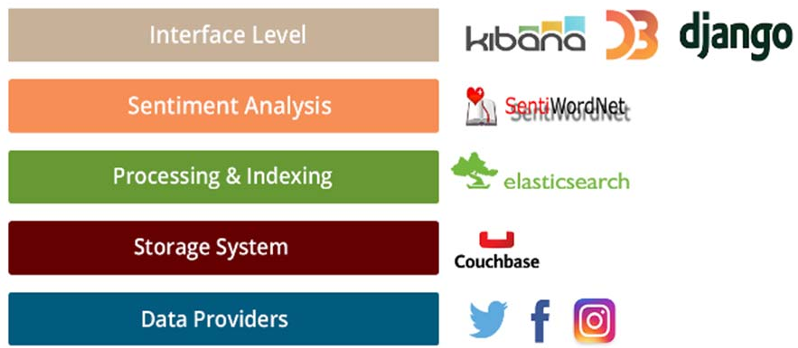
- Data Providers: Connectors for Twitter (Streaming API), Facebook, and Instagram (Polling).
- Storage: Utilizes Couchbase, a NoSQL document database, allowing for a flexible schema that handles the unpredictable nature of JSON social data.
- Processing & Indexing: Employs Elasticsearch for full-text search. This is the "speed layer," reducing query latency by 50%.
- Sentiment Analysis Engine: Powered by NLTK, it switches from supervised learning to a Lexicon-based approach (SentiWordnet). This is a critical strategic move—it allows the tool to work in new industries without the need for massive, pre-labeled training sets.
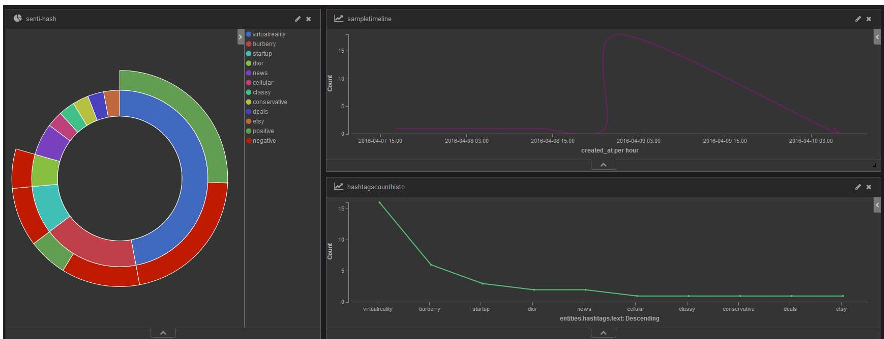
- Interface: A Django-based web app that integrates Kibana 3 and D3.js for interactive visualizations.
Methodology: From Keywords to "Five Emotions"
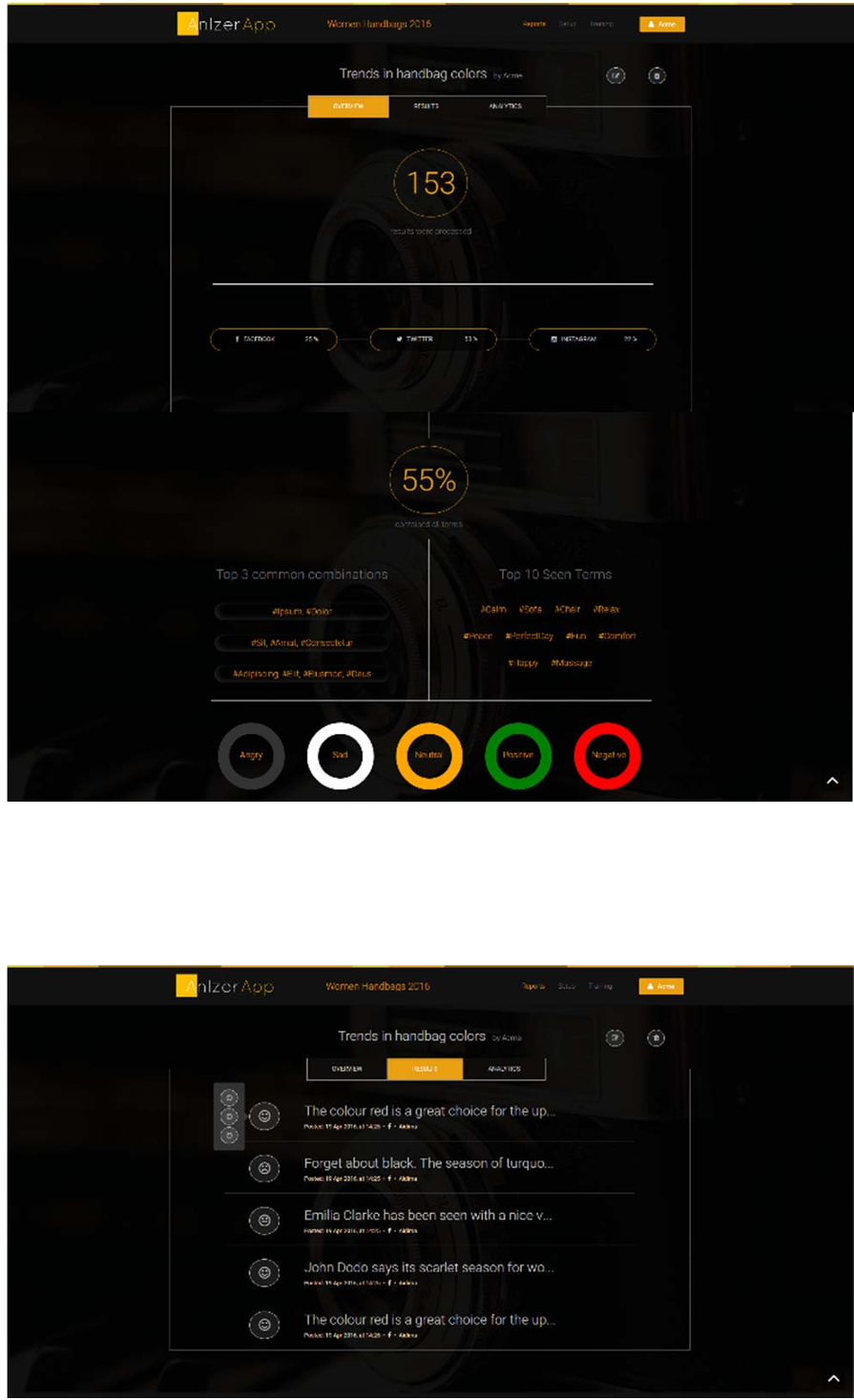
Unlike standard tools that give a "Polarity Score," Anlzer maps keywords to five emotional Synsets: Angry, Sad, Neutral, Happy, and Excited.
By querying SentiWordnet, the engine retrieves objectivity and polarity scores for the first three synsets of a word. These scores are normalized and compared against predefined thresholds. This "experimentation playground" allows non-programmers to fine-tune filters to see, for example, why customers are "Angry" about a specific furniture leg design or a software's new UI update.
Industry Impact: Manufacturing and Software
In the Furniture domain, Anlzer is used within the PSYMBIOSYS "Factories of the Future" project. It allows designers to see emerging trends—like a preference for certain materials—months before they would show up in sales reports.
In Software Development, Anlzer acts as a "continuous feedback loop." Product managers can:
- Validate proposed features before coding.
- Monitor reactions to and bugs in existing releases immediately.
- Mitigate "brand damage" by responding to viral complaints in real-time.
Critical Analysis & Conclusion
Anlzer’s strength lies in its open-source, decoupled architecture. By separating the data ingestion from the visualization, it remains highly scalable. The move to a lexicon-based sentiment model is a pragmatic choice for cross-domain utility, though it may lack the nuance of modern Transformers (like BERT or GPT-based models).
Limitations: Currently, it is heavily reliant on English and faces API limitations from platforms like Facebook and Instagram, which do not offer the same "real-time" streaming capabilities as Twitter.
Future Path: The authors envision incorporating enterprise-internal data (like satisfaction surveys) and moving towards a "semi-supervised" model where the lexicon results serve as training "seeds" for more advanced Machine Learning.