
The Geography of Peer Pressure: How Age and Location Shape Adolescent Substance Use
Social and geographic contexts of adolescent substance use: The moderating effects of age and gender
This study investigates the interplay between social networks, geographic location, and adolescent substance use among 254 urban youth. Using a unique place-based social network analysis, it demonstrates that substance use is significantly driven by interaction with drug-using peers at perceived "risky places" and by residing in neighborhoods with high concentrated disadvantage.
TL;DR
Is substance use a product of who you hang out with, or where you hang out? This study suggests it’s both—but with a twist. By analyzing 254 urban adolescents in Philadelphia, researchers found that the impact of "risky" neighborhoods and "bad" social circles doesn't hit home until a critical developmental window (ages 14-16). Surprisingly, while boys use substances more, both genders are equally susceptible to environmental influences.
Contextualizing Risk: Beyond the Home Address
Most studies look at an adolescent's home neighborhood to predict behavior. However, teens are mobile. They go to school, parks, and "risky places" that may be far from their front door. The authors argue that we must look at the Activity Space—the routine locations an adolescent actually visits—to understand the real impact of social and geographic context.
The core insight is that social interactions are place-based. You don't just have a "risky friend"; you have a "risky friend you see at a specific street corner."
Methodology: Mapping the Social-Spatial Interface
The researchers combined two powerful tools:
- Adolescent Social Network Assessment (ASNA): This quantified the "quality" of an ego's network based on whether peers used drugs or provided protective positive influences.
- Ecological Interview: This mapped the "risky places" where these social interactions actually occurred.
The Analytical Framework
The study used factor analysis to distill complex neighborhood data into five dimensions: Concentrated Disadvantage, Ethnic Diversity, Hispanic Concentration, Crime, and Residential Instability.
 Figure 1: Conceptualizing the link between Social Network Quality and Place-Based Risk.
Key Findings: The "Age Shift"
The most striking discovery was the moderating effect of Age.
- The 16-Year-Old Threshold: For younger teens (under 15), the neighborhood’s socioeconomic status had almost no correlation with their substance use. However, at age 16, a "switch" flips. The environment starts to exert a massive influence on behavior.
- The Power of Peers: While peer influence starts earlier (around age 14), its strength grows exponentially as the adolescent nears 20.
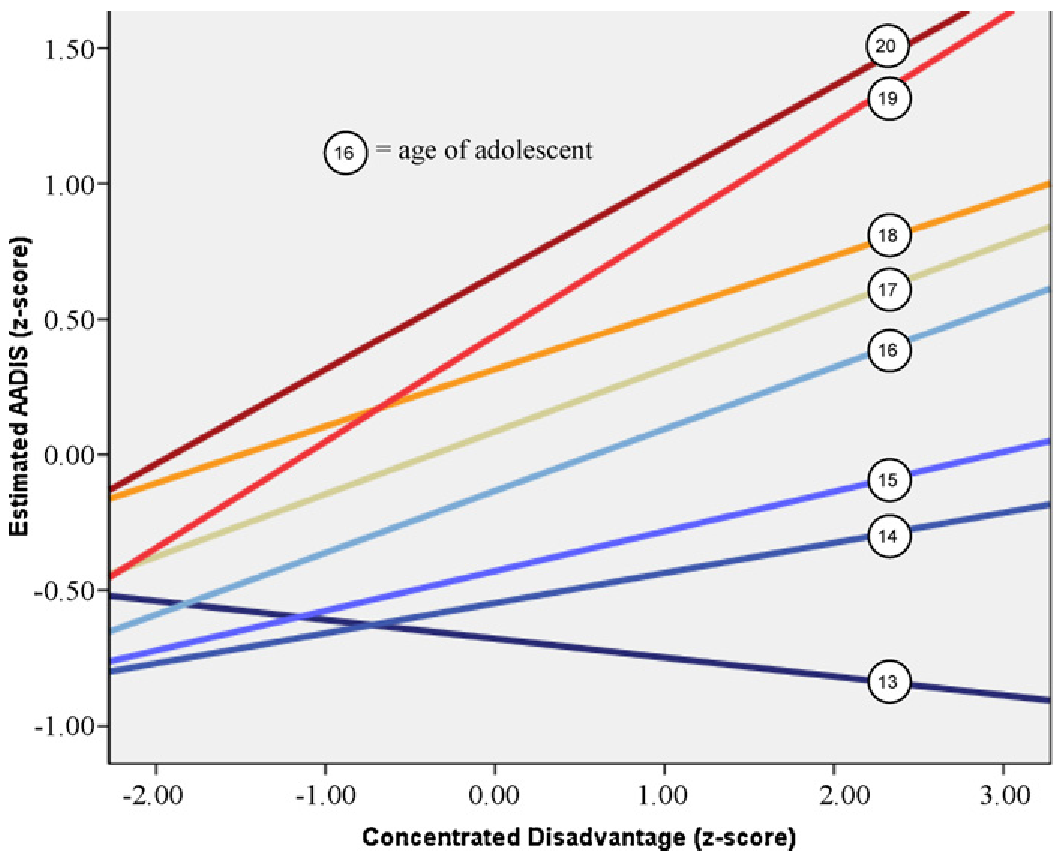 Figure 2: The increasing slope shows that as adolescents get older (red lines), the relationship between neighborhood disadvantage and substance use becomes significantly steeper.
The Gender Paradox
While the data confirmed that males use substances more frequently than females (Model 1, t = 3.104), gender did not moderate the effects. This means that a girl in a "risky" social network at a "risky" location is just as influenced by those factors as a boy is. The "protective" nature of female social circles often cited in older literature was not observed as a moderating factor here.
Critical Analysis & Policy Implications
The study’s reliance on cross-sectional data is a limitation—it’s a "snapshot" in time, meaning we can't definitively say if risky places cause use, or if users seek out risky places (the selection vs. influence debate).
Takeaways for Intervention:
- Hyper-Local Targeting: Prevention programs shouldn't just target "at-risk neighborhoods" generally; they should target the specific "nodes" (risky places) identified by youth.
- Timing is Everything: Since the environment’s influence surges at age 16, middle-adolescence serves as a critical window for environmental "protective" interventions before the context-behavior link hardens.
Conclusion
This work pushes social science toward a "Spatially Integrated" model of behavior. By proving that age moderates how we perceive and react to our surroundings, Mennis and Mason provide a roadmap for more nuanced, developmentally-aware public health strategies.